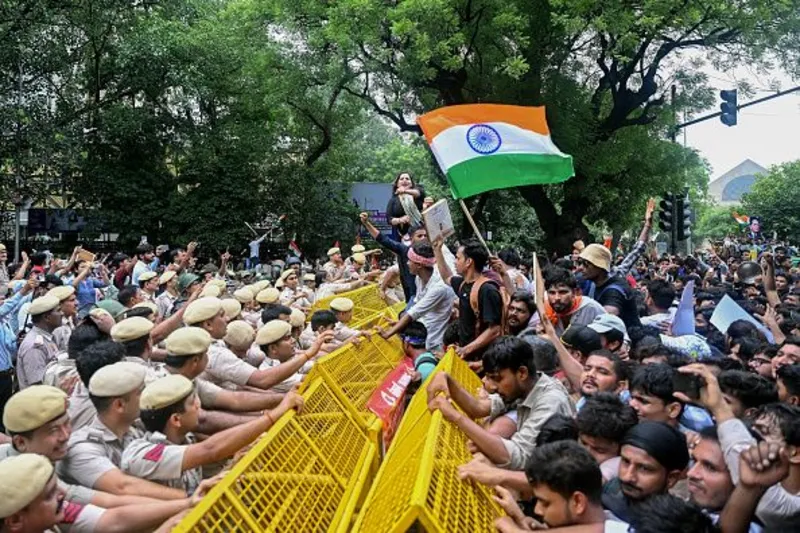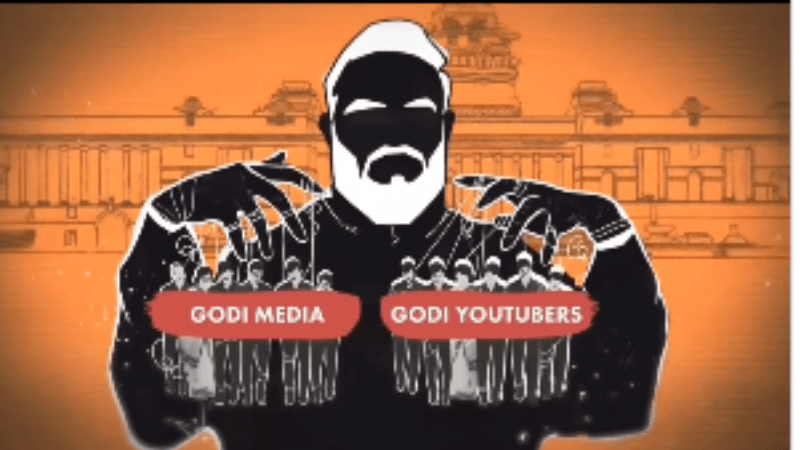
The chants echoing through India's student protests are not directed only at the government. Increasingly, they are aimed at television cameras and microphones. Protesters have repeatedly denounced sections of the mainstream press as "Godi Media"- a term suggesting that parts of the media have abandoned their watchdog role in favor of amplifying the government's narrative.
Whether one agrees with the slogan or not, its growing popularity reflects a deeper concern: the widening gap between India's news media and public trust. This is not merely a debate over political bias. It is increasingly a debate about the shrinking space for independent journalism in the world's largest democracy.
Over the past decade, India has witnessed growing concerns about media independence. International press freedom assessments have consistently placed the country well below many other democracies, citing issues such as political pressure, legal intimidation, concentration of media ownership, and increasing risks faced by journalists.
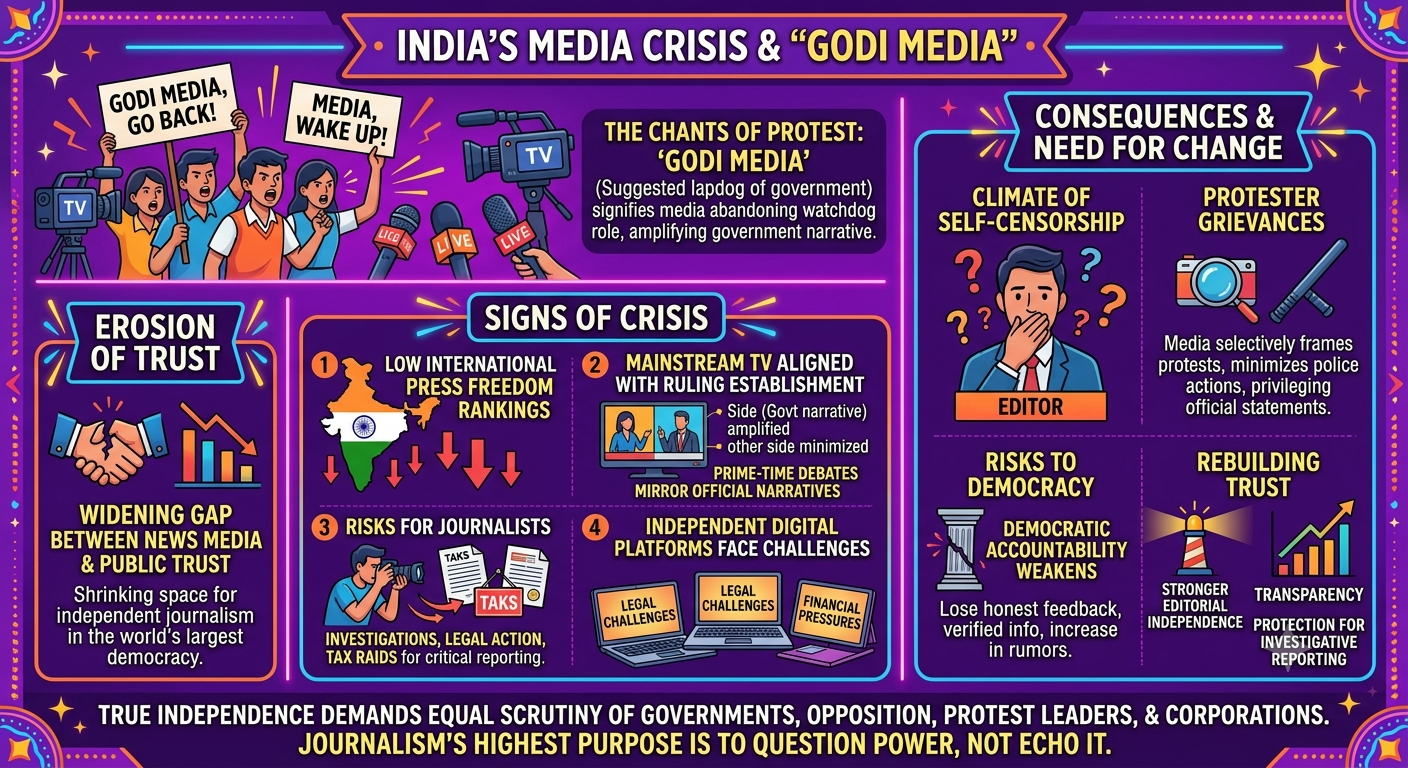
Critics argue that a significant segment of mainstream television news has become closely aligned with the ruling establishment. Prime-time debates frequently mirror official narratives, while critical reporting on issues involving those in power often receives comparatively less attention than political controversies surrounding opposition parties.
Several journalists and independent media organizations have also reported facing investigations, legal action, tax raids, or regulatory scrutiny following reporting critical of the government. Although authorities often maintain that such actions are conducted according to law and deny any political motivation, these developments have contributed to a widespread perception that investigative journalism carries increasing institutional risks.
At the same time, independent digital news platforms have emerged as alternative sources of reporting. Yet many of them also face legal challenges, financial pressures, or regulatory restrictions, raising broader questions about the operating environment for independent journalism.
The cumulative effect is not necessarily direct censorship in the traditional sense. Rather, many observers describe a climate in which self-censorship becomes increasingly common, as editors and media owners weigh the political and commercial costs of aggressive reporting.
It is against this backdrop that the anger seen during student demonstrations becomes easier to understand. Many protesters no longer believe that major television channels represent independent journalism. Instead, they view sections of the media as participants in political messaging rather than impartial observers of public events.
When demonstrators accuse journalists of selectively framing protests, minimizing police actions, emphasizing isolated incidents of violence over broader grievances, or privileging official statements without equivalent scrutiny, they are expressing a crisis of confidence in the media's role. Whether every criticism is justified is beside the point. The perception itself carries enormous consequences.
A democracy depends not only on elections but also on institutions that citizens trust to document reality fairly. Once that trust weakens, every report becomes vulnerable to accusations of political loyalty.
A media landscape that is widely perceived as being too close to the government carries risks extending beyond journalism itself. Governments lose honest feedback from society. Citizens lose confidence in verified information. Rumors travel faster than reporting. Independent journalists become targets of suspicion from every political camp. Most importantly, democratic accountability weakens.
History shows that when news organizations become reluctant to ask difficult questions, corruption, administrative failures, and abuses of power become harder to expose. The media's constitutional function is not to endorse governments or opposition movements. It is to scrutinize both.
A press that consistently avoids uncomfortable questions directed at those in authority gradually ceases to function as a watchdog and risks becoming a public relations mechanism.
The solution, however, is not for journalism to become an extension of protest movements. Media credibility cannot be restored by replacing one political loyalty with another. True independence demands equal scrutiny of governments, opposition parties, protest leaders, corporations, and powerful institutions alike.
The press must verify before amplifying, investigate before concluding, and challenge every center of power—regardless of ideology. Its legitimacy comes not from satisfying one political constituency but from maintaining professional integrity even when every political actor is dissatisfied.
The tensions visible during India's student protests should be viewed as more than a domestic dispute between protesters and television networks. They illustrate what happens when citizens begin to believe that journalism no longer serves the public interest but the interests of power.
Rebuilding trust will require more than improved public relations. It demands stronger editorial independence, greater transparency, protection for investigative reporting, media pluralism, and an environment in which journalists can question authority without fear of retaliation.
Ultimately, the future of India's democracy will depend not only on the strength of its electoral institutions but also on the independence of its press. Journalism fulfills its democratic purpose only when it remains free to question those who govern, expose wrongdoing wherever it exists, and inform citizens without fear or favor.
Editor ,Bay of Bengal Post