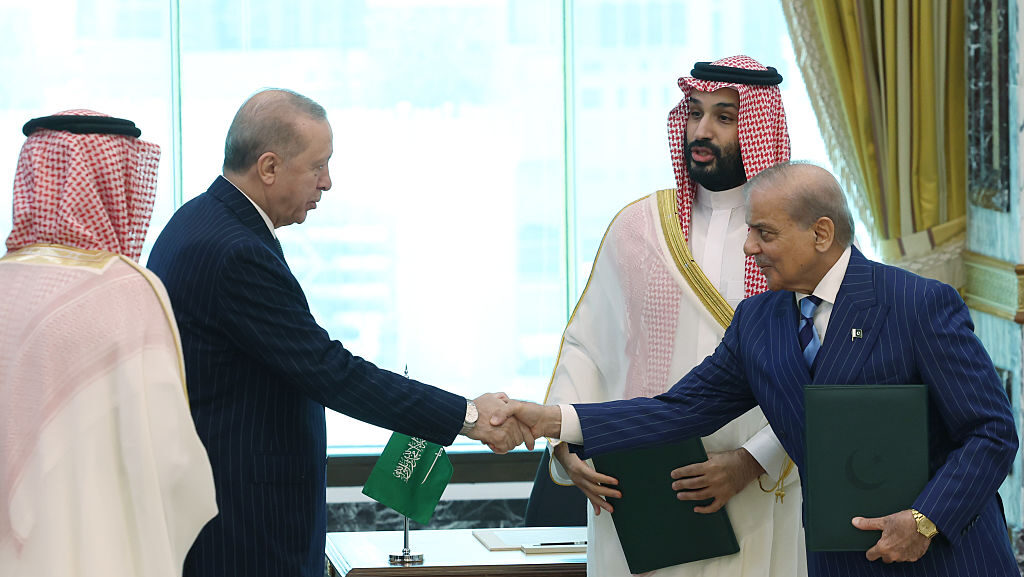
India is discovering an uncomfortable reality- Pakistan is no longer content to be defined solely by its rivalry with New Delhi. The defense agreement signed by Pakistan, Saudi Arabia and Turkey in Mecca on August 7 has triggered intense debate across India over what the emerging trilateral alignment means for the country’s security. Although the pact does not explicitly target India, New Delhi has ample reason to take it seriously.
The agreement brings together three strategically important Muslim-majority states with increasingly overlapping security interests. More importantly for India, it potentially gives Pakistan something it has long sought but struggled to secure- greater strategic depth beyond South Asia.
India’s Ministry of External Affairs has already acknowledged that it is assessing the implications of the agreement “from the perspective of our national security as well as considerations of regional peace and stability.” New Delhi has also reiterated that it will take all necessary measures to safeguard its national interests. The diplomatic language is measured. The underlying concern is not.
For decades, India has attempted to frame Pakistan primarily through the prism of terrorism, Kashmir and bilateral conflict. New Delhi’s strategy has often been to isolate Islamabad diplomatically while expanding India’s own influence across the Gulf and beyond.
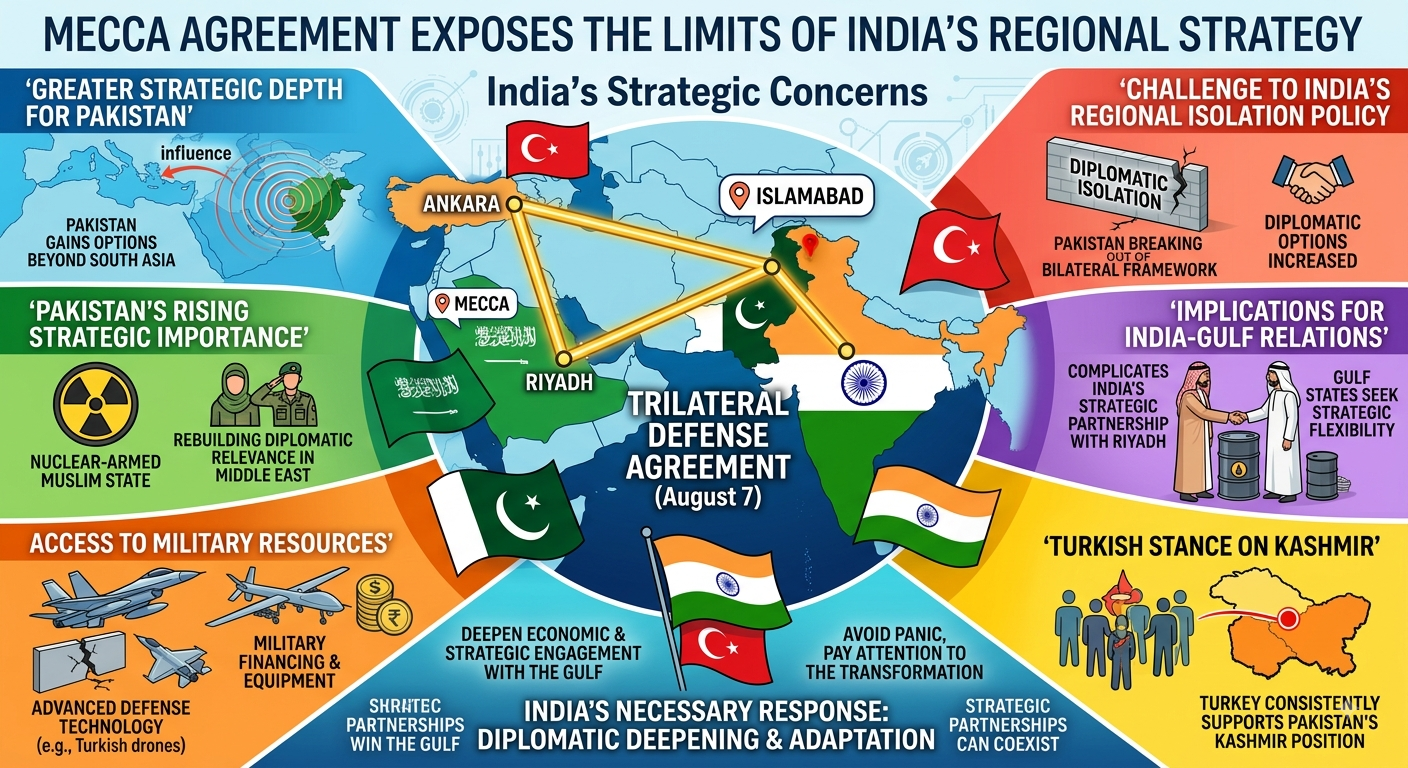
That strategy is now facing an unexpected challenge. Pakistan has been rebuilding its diplomatic relevance in the Middle East. Its role in facilitating dialogue during the Iran-US confrontation has already demonstrated that Islamabad can offer something that India cannot easily replicate- military credibility combined with deep relationships across the Muslim world.
Pakistan is also the only nuclear-armed state among Muslim-majority countries. That distinction matters. The new defense pact could give Islamabad greater access to military financing, equipment, maintenance capabilities and advanced defense technology. Even if the agreement initially remains limited in scope, institutionalized defense cooperation with Saudi Arabia and Turkey could gradually expand Pakistan’s strategic options.
India should therefore avoid viewing the pact simply as another Pakistan-centered security development. It is potentially the beginning of a broader redistribution of strategic influence.
Saudi Arabia brings money, energy and enormous geopolitical weight. Turkey brings something different- a sophisticated and increasingly independent defense-industrial base.
Over the past decade, Turkey has transformed itself from a major defense importer into an important exporter of military technology. Its drones, armored systems, missiles and other defense products have gained international attention. Pakistan and Turkey have already developed close military ties.
For India, this relationship is particularly uncomfortable because Ankara has consistently supported Pakistan’s position on Kashmir and has frequently criticized India's policies in the disputed region.
The trilateral pact could therefore institutionalize a relationship that India has previously been able to treat as primarily bilateral. That is a significant difference. India is not simply confronting closer Pakistan-Turkey relations. It is now watching those relations potentially become embedded within a wider security architecture involving Saudi Arabia. And that architecture is developing at a time when the Middle East itself is undergoing profound strategic realignment.
Perhaps the most consequential aspect of the agreement is not Pakistan or Turkey, but Saudi Arabia. India has spent years cultivating a close relationship with Riyadh. Economic ties, energy security, investment and counterterrorism cooperation have transformed the India-Saudi relationship.
New Delhi has also benefited from the broader strategic partnership between India and the Gulf states. The emergence of a defense arrangement involving Saudi Arabia and Pakistan therefore creates a complication that India cannot dismiss.Riyadh does not necessarily have to choose between India and Pakistan. Nor does the agreement automatically mean Saudi Arabia has abandoned its strategic relationship with New Delhi. But the assumption that India's growing economic importance in the Gulf would naturally translate into political and strategic primacy is now harder to sustain.
Saudi Arabia has its own interests. It needs security partnerships, military capabilities and strategic flexibility. Pakistan offers a nuclear umbrella, a large experienced military and longstanding ties with the Gulf. Turkey offers defense technology and an increasingly autonomous geopolitical posture.
For Riyadh, closer cooperation with both countries can therefore make strategic sense. For India, that same logic is precisely what makes the development uncomfortable.
Nor does a defense agreement automatically translate into a unified military command or guaranteed intervention in a future India-Pakistan conflict. But that does not make the development insignificant.
The real danger for New Delhi is the gradual creation of an environment in which Pakistan has more strategic partners, more diplomatic options and greater access to military resources. That is a very different Pakistan from the one India has spent years trying to isolate.
And it raises an uncomfortable question for Indian policymakers- What happens if Pakistan becomes too strategically important to isolate?
India's instinct may be to respond through military modernization. That is necessary, but insufficient. The deeper challenge is diplomatic. If Pakistan succeeds in presenting itself as a useful security partner to Saudi Arabia and Turkey, Islamabad can begin to rebuild influence in precisely the regions where New Delhi has invested enormous diplomatic capital.
India has sought to portray itself as the indispensable partner for the Gulf's economic future. Pakistan may now be positioning itself as a significant partner for the Gulf's security future. Those two roles are not mutually exclusive.
In fact, they can coexist. That should concern New Delhi more than the symbolism of the Mecca agreement itself.
The worst possible Indian response would be to dismiss the agreement as an alliance of convenience driven by shared religious identity. States rarely enter security partnerships for identity alone. They do so because interests converge.
Pakistan needs investment, technology and diplomatic space. Turkey seeks greater strategic autonomy and wider defense markets. Saudi Arabia wants stronger security capabilities and diversified strategic partnerships. Their interests overlap.
India's challenge is to ensure that its own interests remain competitive in this changing environment. That requires more than criticizing Pakistan or warning partners about Islamabad. New Delhi needs to deepen its economic and strategic engagement with the Gulf while maintaining independent channels with Turkey and avoiding the temptation to reduce every regional relationship to the India-Pakistan rivalry.
Most importantly, India must recognize that Pakistan's influence cannot be measured solely by its economic size. A country does not need to be an economic giant to become strategically indispensable.
Pakistan's nuclear capability, military capacity, geographic position and longstanding relationships across the Muslim world give it assets that India cannot simply neutralize through diplomatic pressure.
The Pakistan-Saudi-Turkey defense pact may not immediately alter the military balance in South Asia. Its more important consequence could be political. Pakistan is beginning to demonstrate that it can build partnerships beyond the traditional India-Pakistan framework. Saudi Arabia is demonstrating that it wants strategic options beyond dependence on any single major power. Turkey is demonstrating that its ambitions extend well beyond its immediate neighborhood.
India therefore faces a new strategic landscape in which its ability to shape regional outcomes can no longer be taken for granted. New Delhi should not panic. But it should pay attention. The question is no longer whether Pakistan can challenge India militarily. India remains vastly larger in economic and conventional military terms.
The more consequential question is whether India can prevent Pakistan from becoming strategically relevant in places where New Delhi had assumed its own influence would dominate.
The Mecca agreement is an early warning. If India responds only by trying to weaken Pakistan, it may miss the larger transformation taking place around it.
The real contest is not simply over who has more weapons. It is over who can build the wider network of partnerships that makes those weapons, those markets and those diplomatic relationships matter. And on that front, Pakistan may have just taken a step forward.
Golam Zakaria
Editor, Bay of Bengal Post