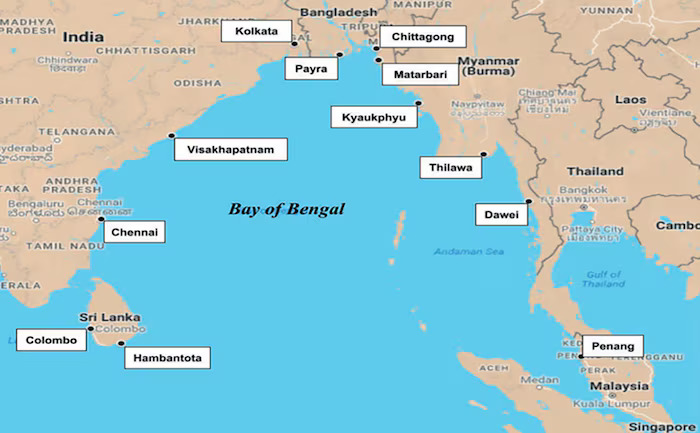
For decades, the Bay of Bengal was viewed as a relatively quiet, peripheral maritime space, largely overshadowed by the more volatile waters of the Pacific and the South China Sea. Today, however, this vast body of water- the largest bay in the world- has emerged as the beating heart of 21st century global geopolitics. Encompassing critical sea lines of communication and acting as a bridge between South and Southeast Asia, the bay has transformed into a high stakes arena where global trade, military power projection, and intense strategic rivalries collide. What happens in these waters over the coming years will not only shape the future of the Indo-Pacific region but will also reverberate across the global economy.
The strategic importance of the bay is deeply rooted in its role as a commercial superhighway. It sits adjacent to some of the world's most critical maritime chokepoints, most notably the Strait of Malacca, which channels nearly one-third of global trade and a quarter of seaborne oil. Together, the wider Indo-Pacific waters handle over 60 percent of global maritime trade and nearly 40 percent of energy shipments, making the security of transit routes through the Bay of Bengal a preconditioned absolute for global energy and commercial flows. This maritime dynamism is bolstered by a booming demographic landscape on its shores, where littoral nations like India and Bangladesh boast vibrant, young populations driving rapid urbanization, industrialization, and a thriving digital economy.
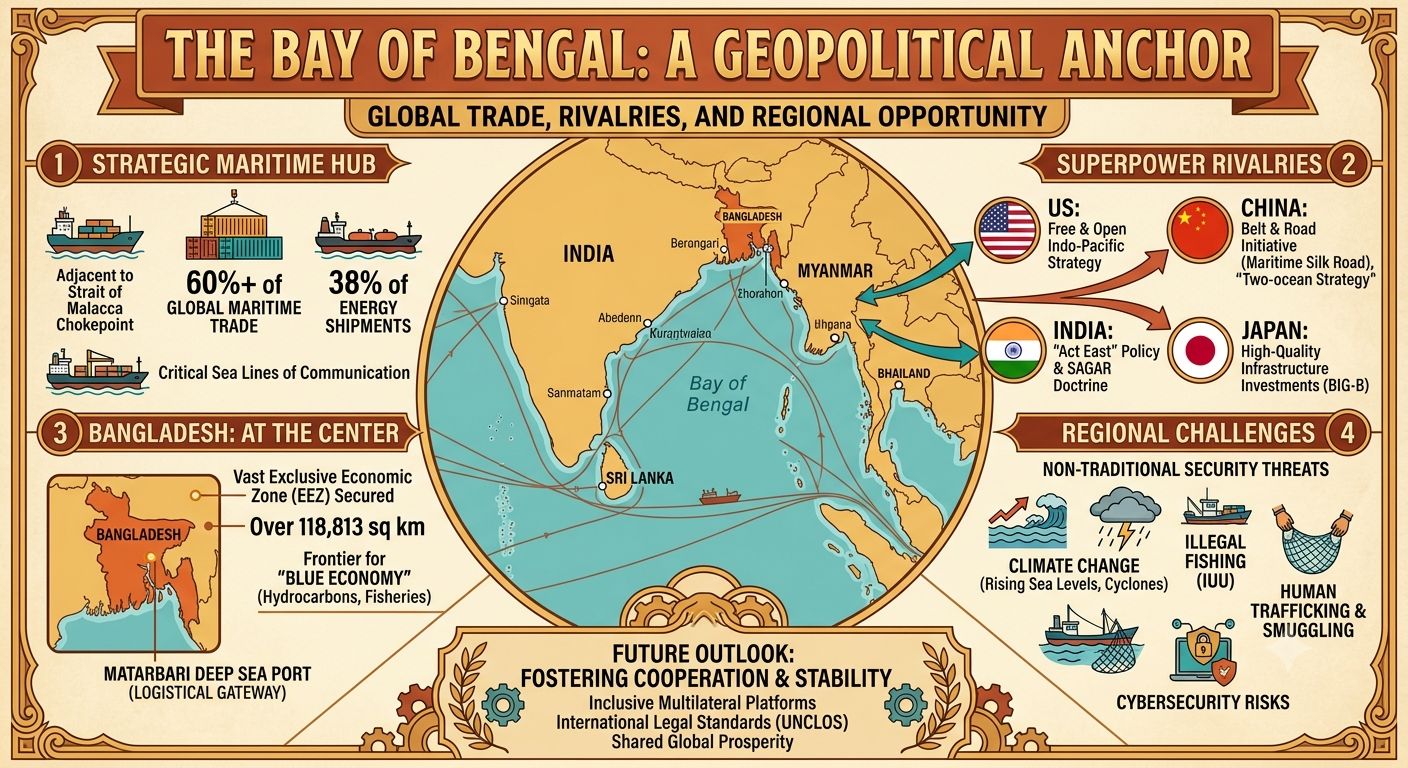
Because of this economic and strategic gravity, the Bay of Bengal has become the focal point of a geopolitical tug-of-war among global superpowers. The United States actively champions its "Free and Open Indo-Pacific" strategy to maintain maritime freedom and strengthen military ties with local partners. Conversely, China prioritizes the bay as a crucial node of its Belt and Road Initiative, specifically the 21st Century Maritime Silk Road, investing heavily in regional infrastructure to secure its "Two-ocean Strategy" and bypass vulnerable Pacific chokepoints. Meanwhile, India, acting as a regional heavyweight, views the bay as a vital maritime buffer and seeks to counter external footprints through its "Act East" policy and the Security and Growth for All in the Region, or SAGAR, doctrine. Japan has also entered the fray, promoting high-quality infrastructure investments such as the Bay of Bengal Industrial Growth Belt to boost regional connectivity.
At the absolute center of this unfolding drama sits Bangladesh. Following landmark maritime boundary arbitrations that peacefully resolved disputes with Myanmar and India, Dhaka now commands a vast Exclusive Economic Zone spanning over 118,813 square kilometers. This newly secured territory has unlocked a massive frontier for the "Blue Economy," with potential in marine fisheries, deep-sea hydrocarbon exploration, and maritime logistics that could contribute up to six percent of the nation's GDP by 2030. To capitalize on this, Bangladesh is developing major maritime assets, including the Japan-assisted Matarbari Deep Sea Port, which is poised to serve as a key logistical gateway linking landlocked South Asian regions with the broader global market.
However, holding such a pivotal geographic position comes with significant diplomatic pressure. Bangladesh has emerged as a classic "swing state" in the Indo-Pacific, forcing it to execute a delicate diplomatic balancing act. Adhering to its constitutional foreign policy of "friendship to all, malice to none," Dhaka has managed to welcome massive Chinese infrastructure investments under the Belt and Road Initiative while simultaneously deepening its strategic, economic, and security partnerships with India, Japan, the United States, and the European Union. By rejecting exclusive zones and opting for multilateral financing, the country has so far successfully navigated these overlapping spheres of influence without falling into the trap of zero-sum great-power rivalries.
Yet, the challenges facing the Bay of Bengal are not purely geopolitical. The region is increasingly threatened by silent, non-traditional security crises that transcend national borders. Ground zero for climate change, the bay experiences sea levels rising at an alarming rate of 4.4 mm per year—higher than the global average- which threatens coastal baselines, threatens vital fisheries, and fuels extreme weather events like destructive cyclones. Furthermore, the lack of robust maritime enforcement leaves these waters vulnerable to illegal, unreported, and unregulated fishing, human trafficking, maritime migration, and transnational smuggling networks. Underdeveloped cybersecurity at major regional ports also presents a modern digital vulnerability that could easily disrupt the flow of international trade.
As the geopolitical temperature continues to rise, the future stability of the Bay of Bengal will depend on the collective agency of its littoral states. To prevent these waters from becoming a theater of conflict, regional players must move beyond rigid power binaries and foster cooperative frameworks. By championing international legal standards like the United Nations Convention on the Law of the Sea and leveraging inclusive multilateral platforms, the nations of the Bay of Bengal can ensure that this vital commercial heartland remains an anchor of peace, stability, and shared global prosperity.
EDITOR ,Bay of Bengal Post