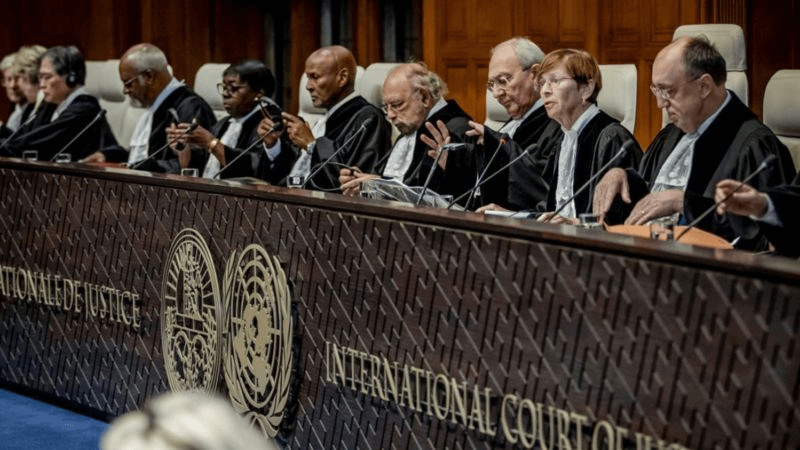
South Africa has initiated a significant legal challenge against Israel at the International Court of Justice (ICJ), presenting a five-point argument challenging Israel's ongoing occupation of Palestinian territories. The move is a bold escalation in the enduring Israeli-Palestinian conflict and raises crucial questions about international law, human rights, and the pursuit of Palestinian self-determination.
The Five-Point Argument:
1. Illegal Occupation: South Africa contends that Israel's occupation of the West Bank, East Jerusalem, and Gaza Strip violates international law, particularly the Fourth Geneva Convention. The argument asserts that Israel's settlements in these areas are unlawful and amount to a war crime.
2. Annexation: The challenge targets Israel's annexation of East Jerusalem in 1980 and recent moves towards annexing parts of the West Bank, deeming these actions violations of the right to self-determination and territorial integrity of the Palestinian people.
3. Apartheid: Drawing on its own history of racial discrimination, South Africa accuses Israel of implementing apartheid against Palestinians, depriving them of fundamental rights and freedoms based on their ethnicity.
4. Wall of Separation: South Africa argues that the Israeli separation wall built within the occupied territories is illegal under international law, as it discriminates against Palestinians and disrupts their daily lives and livelihoods.
5. Accountability: South Africa calls on the ICJ to hold Israel accountable for violating international law and requests the court to issue an advisory opinion on the legal consequences of the ongoing occupation.
South Africa's Motivation:
South Africa's legal challenge is rooted in its longstanding solidarity with the Palestinian cause and commitment to human rights and international law. This aligns with its historical fight against apartheid, positioning itself as a champion of global justice.
Israel’s Response:
Israel has rejected South Africa's claims, labeling the ICJ application as "politically motivated" and asserting that the court lacks jurisdiction in this case. Israel maintains that its settlements are legal and its actions in the occupied territories are driven by security concerns.
The ICJ case has garnered significant international attention and could have far-reaching consequences for the Israeli-Palestinian conflict. A ruling in favor of South Africa could strengthen the legal case against Israel's occupation and exert pressure on the international community to take concrete action.
However, it's essential to note that ICJ advisory opinions are non-binding, and the ruling may not directly enforce changes on the ground. Nevertheless, it could carry significant moral weight and influence future diplomatic efforts toward a just resolution of the conflict.
The ICJ is expected to take months, possibly years, to consider South Africa's arguments and issue a ruling. Meanwhile, the Israeli-Palestinian conflict continues to simmer, with recent tensions over Israeli settlements and security operations in the occupied territories. South Africa's legal challenge, while a bold step, represents one element of a complex puzzle. A lasting solution to the Israeli-Palestinian conflict necessitates sustained commitment from both sides, the international community, and a genuine pursuit of peaceful coexistence based on mutual respect and justice.
BOB Post