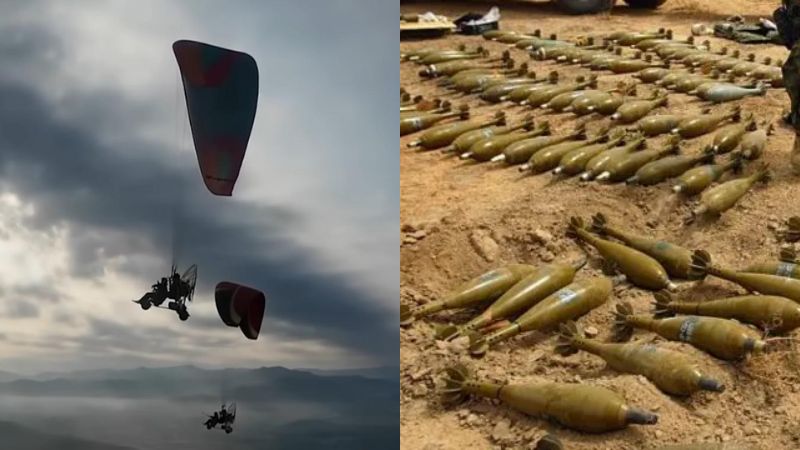
The Myanmar military junta has increasingly adopted paramotors—lightweight, motorised paragliders—as low-cost but deadly weapons in its escalating campaign of airstrikes against civilians and resistance forces, accoring to a recent from from BBC.
The issue drew international attention after a paramotor bombing on Monday night in Chaung-U Township, located in Myanmar’s central Sagaing Region. Nearly 100 people had gathered to celebrate Thadingyut, the festival of the full moon, which also served as a peaceful protest against the military regime that seized power in 2021.
Eyewitnesses told Reuters that the celebration turned into horror when a motorised paraglider flew overhead and dropped several bombs on the crowd. The assault lasted about seven minutes, killing at least 26 people and injuring dozens. “Initially, I thought the lower part of my body had been severed,” said one survivor. “This is mass murder—they are committing it openly.”
The BBC report describes paramotors as simple but effective tools of war that have become a key feature of the junta’s aerial campaign. Each aircraft can carry around 160 kilograms (350 pounds)—enough for a paratrooper and several 120mm bombs weighing up to 16 kilograms each. Flying at low altitudes, these paramotors use GPS guidance to target specific locations, with pilots manually dropping bombs by hand.
Experts note that paramotors are cheap to build and maintain, making them ideal for the junta as it faces financial strain and aircraft losses. Military sources told the BBC that paratroopers can be trained in just a few days, unlike conventional pilots who require years of instruction. Many of these aircraft are reportedly produced at Myanmar’s state-owned Heavy Industry Number 10, which manufactures aircraft parts for the military.
However, the machines have notable limitations. They move slowly—at around 65 km/h (40 mph)—and their loud engines make them easy to detect. Their low altitude also makes them vulnerable to gunfire, so the junta mostly deploys them at night or in areas with little resistance.

A rescue worker in Sagaing told Amnesty International that the sound of a paramotor “is like a chainsaw,” and residents often hide in ditches or makeshift bunkers during attacks.
According to the global monitoring group ACLED, eight paramotor airstrikes were recorded in January 2025 alone across Sagaing, Paletwa, and Taungtha, killing at least nine people. The first documented attack took place in December 2024 in the Myingyan District, a known resistance stronghold.
Dr. Min Zaw Oo, Executive Director of the Myanmar Institute for Peace and Security, told the BBC that the junta’s reliance on paramotors marks a shift toward low-cost aerial dominance. “They are cheap, quick to deploy, and require minimal pilot training,” he said, adding that the junta is also experimenting with gyrocopters, which can carry heavier bombs and reach longer distances.
The Irrawaddy news site reported that paramotors are typically used in areas with limited rebel air defenses, where residents lack the capacity to shoot them down.
Meanwhile, a report by the Stimson Centre noted that China’s military and technical support has allowed the junta to maintain its operations. Beijing has supplied arms, drones, and technicians, while pressuring border rebels to stop providing UAVs to opposition groups.
Since the 2021 military coup, Myanmar’s civil war has killed thousands and displaced millions. Analysts say the rise of paramotor warfare represents a new and disturbing phase—one where cheap, improvised aircraft are being used to terrorize unarmed civilians and extend the junta’s control over a country already torn by conflict.
BOB Post