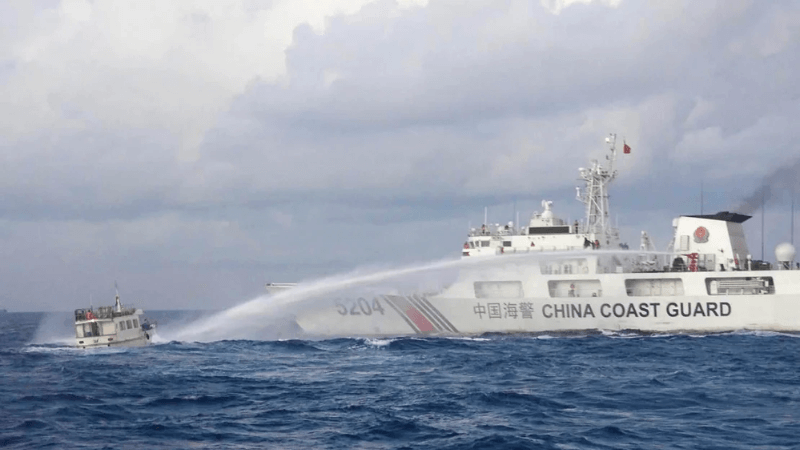
Tensions between China and the Philippines in the South China Sea have reached a critical juncture, sparking concerns that the ongoing maritime standoff could draw the United States into the conflict. The latest clash occurred when Chinese Coast Guard vessels used water cannons to disable a Philippine boat delivering supplies to a military outpost on Second Thomas Shoal, intensifying an already alarming situation. Analysts are expressing deep concern over the escalating frequency and intensity of incidents in the South China Sea. The recent clash, deemed the most serious of the year by Ray Powell, director of SeaLight, underscores the potential for miscalculation or a full-blown conflict. The Philippines, bound by a mutual defense treaty with the United States, raises the stakes, as an attack on Philippine forces could trigger U.S. involvement. The U.S.-Philippines Mutual Defense Treaty obligates both nations to support each other in case of an attack. The treaty's application in the South China Sea adds complexity to the situation, with the U.S. repeatedly affirming its commitment to the Philippines. Joint military exercises in the region serve as a deterrent, emphasizing Washington's readiness to stand by its treaty obligations.
China's territorial claims over the majority of the South China Sea have sparked tensions with neighboring nations, particularly the Philippines. The recent clash, involving the disabling of a Philippine boat, highlights China's assertive stance in enforcing its claims. This follows a pattern of militarization, island-building, and harassment of vessels in disputed waters, raising concerns about China's willingness to use force to achieve its goals.
Amid the escalating tensions, analysts emphasize the need for diplomatic solutions to de-escalate the situation. Clear communication channels, confidence-building measures, and multilateral agreements on maritime security are recommended. The international community, including the United States, is called upon to play a role in urging restraint and facilitating dialogue between the conflicting parties. The South China Sea remains a volatile region with the potential for further escalation. While the likelihood of a full-scale conflict is deemed low, the risk of accidental clashes and heightened tensions cannot be ignored. Dialogue and peaceful solutions are crucial to prevent the situation from spiraling out of control. Analysts argue that U.S. involvement in the South China Sea conflict may be imminent if tensions continue to escalate. The U.S. State Department's reiterated commitment to the mutual defense treaty signals Washington's intent to stand by the Philippines. However, analysts stress the need for more than verbal statements, calling for tangible actions, such as the direct resupply of the grounded Philippine ship, the Sierra Madre.
Resupply missions to the Sierra Madre, a grounded ship manned by Filipino marines at Second Thomas Shoal, play a critical role. The ship requires regular maintenance, and failure to deliver supplies could further embolden China. Joint escorts or direct U.S. involvement in resupply efforts are suggested as measures to dissuade China from further aggression. As the U.S. grapples with global challenges in Europe and the Middle East, maintaining a focus on Asia is imperative. Demonstrating a commitment to the region, even amidst other global crises, is crucial for deterring potential aggressors and reassuring allies like the Philippines. Analysts emphasize the need for Washington to balance its priorities effectively.
BOB Post