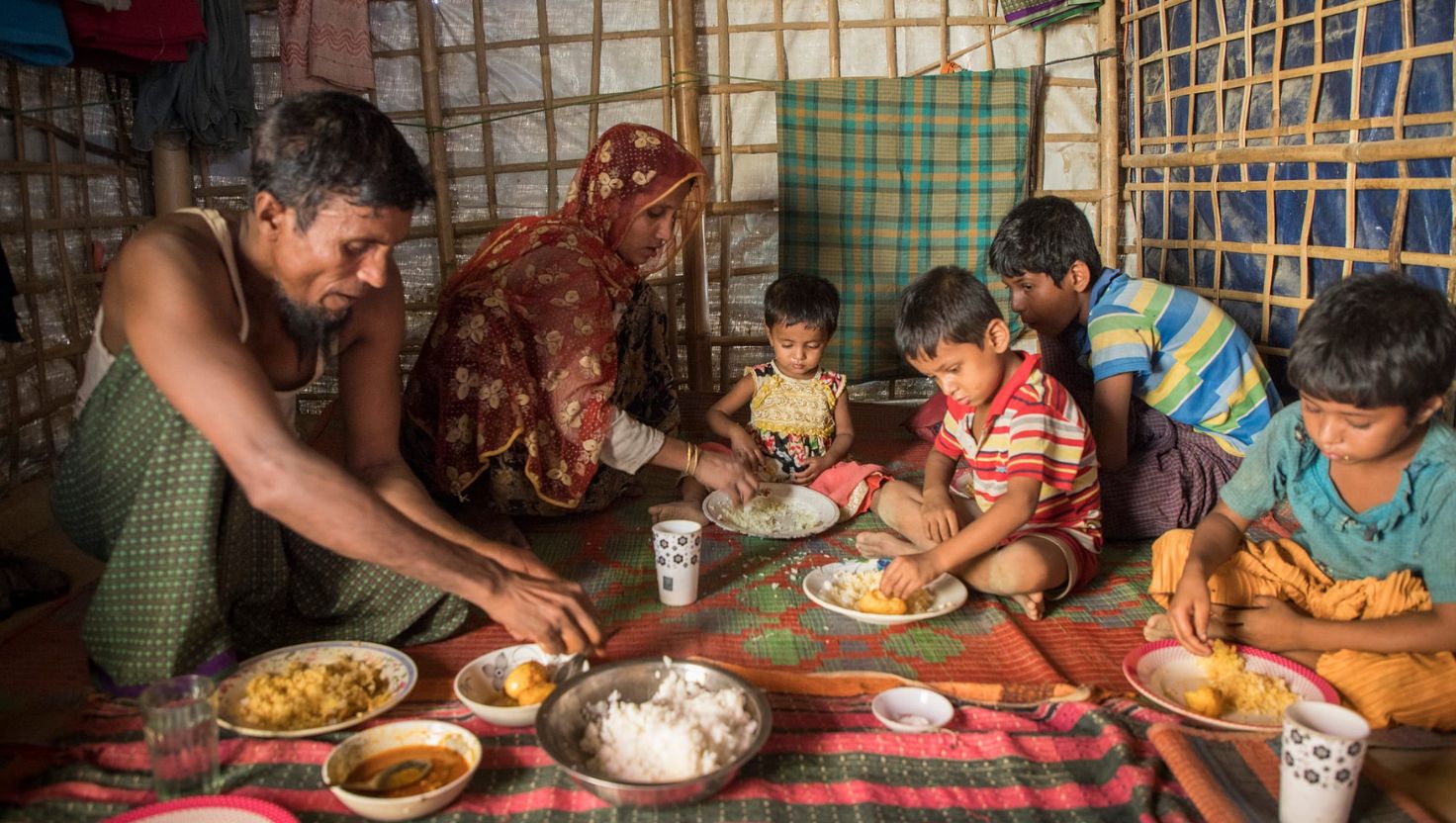
The World Food Programme (WFP) is set to reduce food assistance for Rohingya refugees in Bangladesh starting April 1, citing a major global funding shortfall driven by multiple international crises.
Currently, each refugee receives $12 per month in food aid. Under the revised structure, refugees will be divided into three categories based on vulnerability. The highly vulnerable group will continue to receive $12, while moderately vulnerable individuals will receive $10, and the least vulnerable will receive $7 per month.
Refugee Relief and Repatriation Commissioner Mohammed Mizanur Rahman said the classification is based primarily on socioeconomic conditions. Of the roughly 1.2 million Rohingya in the camps, about 33 percent have been identified as highly vulnerable, 50 percent as moderately vulnerable, and 17 percent as vulnerable.
Officials warn that the reduction in aid could significantly impact the health and overall wellbeing of refugees living in camps in Cox’s Bazar. A UN official noted that funding has been steadily declining in recent years and worsened further following cuts in international contributions, including those linked to policies under Donald Trump.
According to the United Nations Office for the Coordination of Humanitarian Affairs, only 53 percent of the $934 million required for Rohingya support in 2025 has been secured. This marks a continued decline from 64 percent in 2024, 71 percent in 2023, and 70 percent in 2022.
Although a previous plan to halve rations to $6 per person was avoided after a $73 million contribution from the United States, no new funding commitments have been confirmed this year.
Meanwhile, the UN and the Bangladesh government are preparing to launch a new Joint Response Plan (JRP) in Geneva in the coming months, though funding requirements have already been revised downward by 26 percent due to the challenging global financial climate.
The Rohingya population in Bangladesh continues to grow, with approximately 144,000 new arrivals recorded alongside an estimated 30,000 births annually. Authorities also report ongoing cross-border influx despite heightened security along the Bangladesh-Myanmar border.
Conditions in Myanmar’s Rakhine State remain unstable due to ongoing conflict between the military and the Arakan Army, making repatriation unlikely in the near future.
Earlier commitments by Chief Adviser Muhammad Yunus to facilitate the safe return of Rohingya refugees have yet to materialize, with officials acknowledging that current conditions are not conducive to immediate repatriation.
BOB Post