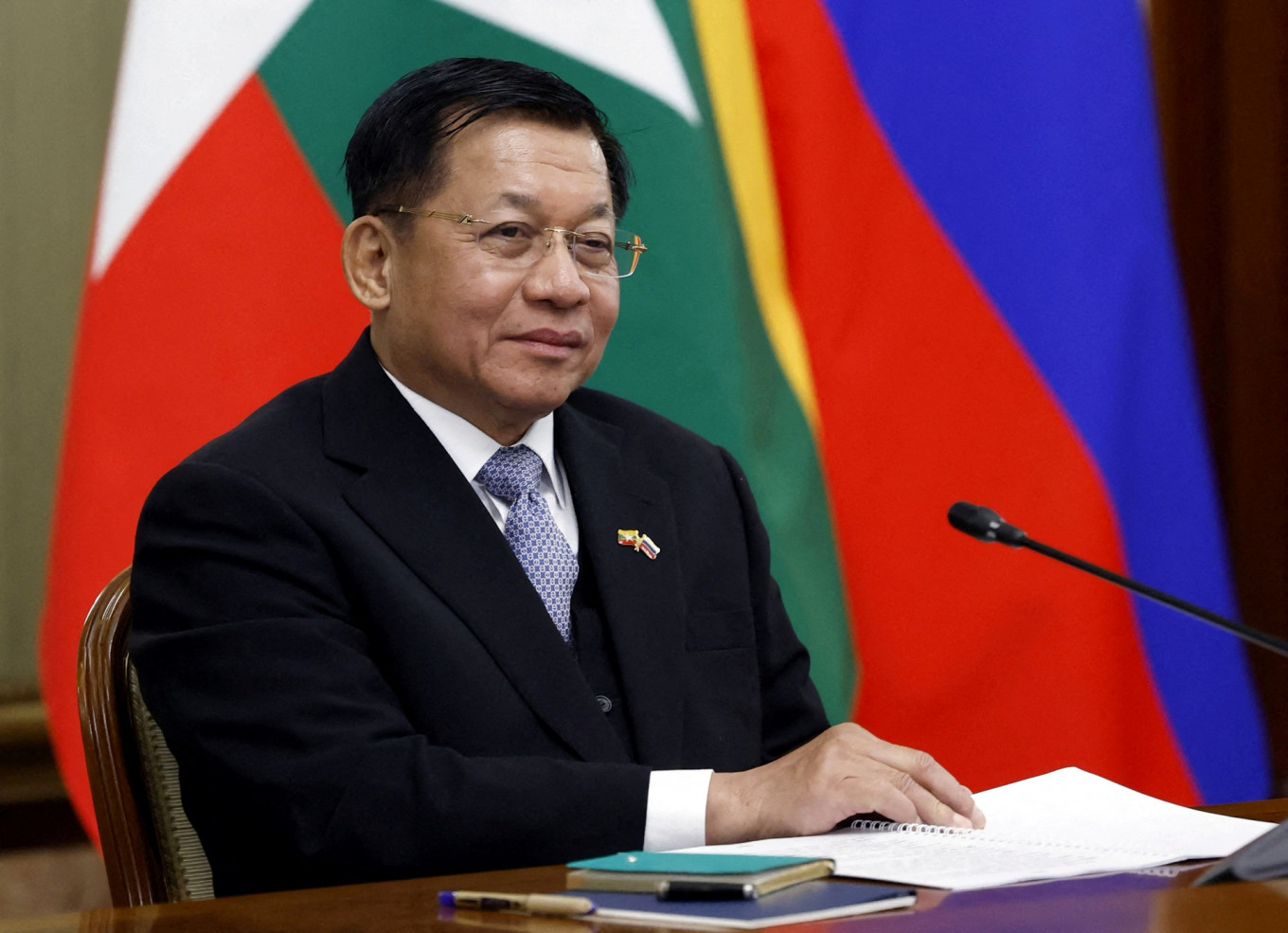
Myanmar’s junta chief Min Aung Hlaing was sworn in as president on Friday, extending his rule under a civilian government five years after seizing power in a military coup.
Min Aung Hlaing, who as armed forces chief led the 2021 overthrow of the elected government of Aung San Suu Kyi, detained the Nobel Peace Prize laureate and plunged the country into a prolonged civil war.
After nearly five years of direct military rule, he oversaw a tightly controlled election concluding in January. The vote excluded Suu Kyi’s party and resulted in an easy victory for military-backed allies, who then supported his rise to the presidency.
Speaking at a parliamentary ceremony in Naypyidaw, the 69-year-old leader said, “Myanmar has returned to the path of democracy and is heading toward a better future,” after taking the oath to begin his five-year term.
He stepped down as military chief to assume the presidency ahead of the country’s traditional New Year festival, Thingyan, which begins Monday.
However, democracy watchdogs and critics have dismissed the transition as a rebranding of military rule under a civilian facade. More than two-thirds of his 30-member cabinet are current or former military officials, many of whom also served in the post-coup junta and some facing international sanctions.
Security was tightened in the capital ahead of the ceremony, with reports of bomb squads deployed and multiple checkpoints surrounding parliament.
In recent days, authorities have released some political prisoners linked to Suu Kyi’s administration and invited civil servants who protested the coup to return to work. Critics described these steps as largely symbolic, while Min Aung Hlaing said his government would grant “appropriate amnesties” to promote reconciliation and peace.
Suu Kyi remains in detention, serving a 27-year sentence on charges widely condemned by rights groups as politically motivated. According to monitoring groups, more than 22,000 people have been imprisoned since the coup, while thousands have been killed in the ongoing conflict.
The military government has portrayed the election as a step toward restoring democracy and stability, though analysts argue it is aimed at legitimizing the regime internationally and reviving foreign investment.
Min Aung Hlaing also pledged to rebuild ties with the Association of Southeast Asian Nations, which has largely distanced itself from Myanmar since the coup.
Representatives from China, India and Thailand attended the ceremony, alongside delegates from more than 20 other nations.
Analysts say China remains a key backer of the new administration, with discussions underway to revive stalled infrastructure projects supported by Beijing.
Myanmar’s military has dominated the country’s politics for most of its post-independence history. A brief democratic opening beginning in 2011 ended with the 2021 coup, which analysts say was driven by fears of losing influence following Suu Kyi’s landslide election victory in 2020.
The recent election excluded major opposition parties and was not held in large parts of the country controlled by rebel groups, further raising concerns about its legitimacy.
Source: AFP