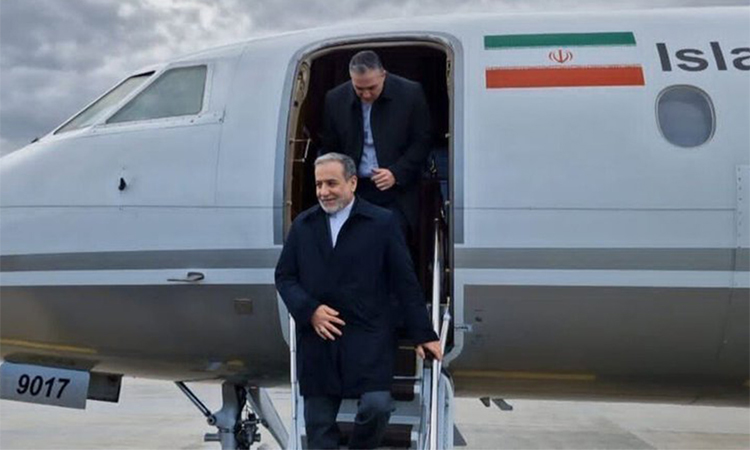
Iran’s Foreign Minister Abbas Araghchi arrived in St Petersburg on Monday for high-level talks with Russian President Vladimir Putin, as Tehran intensifies diplomatic efforts to ease escalating tensions in West Asia.
According to Iranian state media Islamic Republic News Agency (IRNA), the visit follows a series of shuttle diplomacy engagements in Oman and Pakistan aimed at building international backing for Iran’s latest de-escalation proposal. The report noted that Araghchi’s flight carried the symbolic callsign “Minab 168,” commemorating children who died in a reported US-Israeli strike on a school in southern Iran earlier this year.
Russian officials confirmed the visit, with the Foreign Ministry telling TASS that talks were scheduled, while Kremlin spokesman Dmitry Peskov said the meeting would focus on the rapidly evolving regional situation.
Iran’s ambassador to Moscow, Kazem Jalali, said the discussions would center on ceasefire prospects, ongoing diplomatic efforts, and broader conflict developments. He highlighted the close coordination between Tehran and Moscow, noting that both countries maintain regular high-level communication and share common positions on several regional and international issues.
This alignment has been evident at the United Nations, where Russia and China opposed a US-backed resolution concerning the Strait of Hormuz. Jalali described the proposal as “unbalanced,” underscoring Moscow’s continued diplomatic support for Tehran.
Prior to arriving in Russia, Araghchi held consultations in Islamabad, where discussions reportedly included a proposed legal framework for the Strait of Hormuz, the lifting of US-imposed restrictions on Iranian ports, and guarantees against further military action. Iranian officials maintained that the visit did not include direct talks with US representatives.
However, according to the Iranian outlet Fars News Agency, Tehran conveyed a document to be passed to Washington outlining its “red lines,” including sovereignty over the Strait of Hormuz and its nuclear programme.
Meanwhile, according to Reuters, behind-the-scenes diplomatic contacts appear to be continuing despite the cancellation of planned peace talks by US President Donald Trump last week, signaling cautious movement toward a potential resolution.
A separate report by Axios indicated that Iran has submitted a new proposal to the United States aimed at reopening the Strait of Hormuz and ending hostilities. The proposal also suggests postponing nuclear negotiations to a later stage in the peace process, reflecting Tehran’s phased approach to de-escalation.
The visit to Russia marks a key step in Iran’s broader diplomatic push, as regional tensions remain high and major powers continue to position themselves in shaping the outcome of the crisis.
BOB post