China has proposed reviving a regional economic corridor linking Bangladesh, Myanmar and its southwestern provinces, signaling a shift in Beijing's connectivity strategy that could reshape the geopolitical landscape of the Bay of Bengal and South Asia.
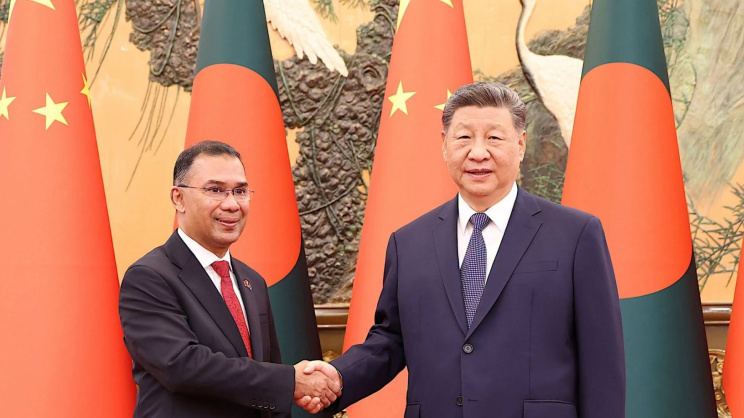
The proposal, unveiled during Bangladeshi Prime Minister Tarique Rahman's visit to Beijing in June, revives elements of the long-stalled Bangladesh-China-India-Myanmar (BCIM) Economic Corridor but adopts a more gradual approach by initially focusing on Bangladesh and Myanmar while leaving the door open for India's future participation.
Rather than waiting for consensus among all four BCIM members, Beijing appears to be advancing a smaller and more flexible framework that reflects changing regional realities, particularly deteriorating China-India relations and Myanmar's ongoing civil conflict.
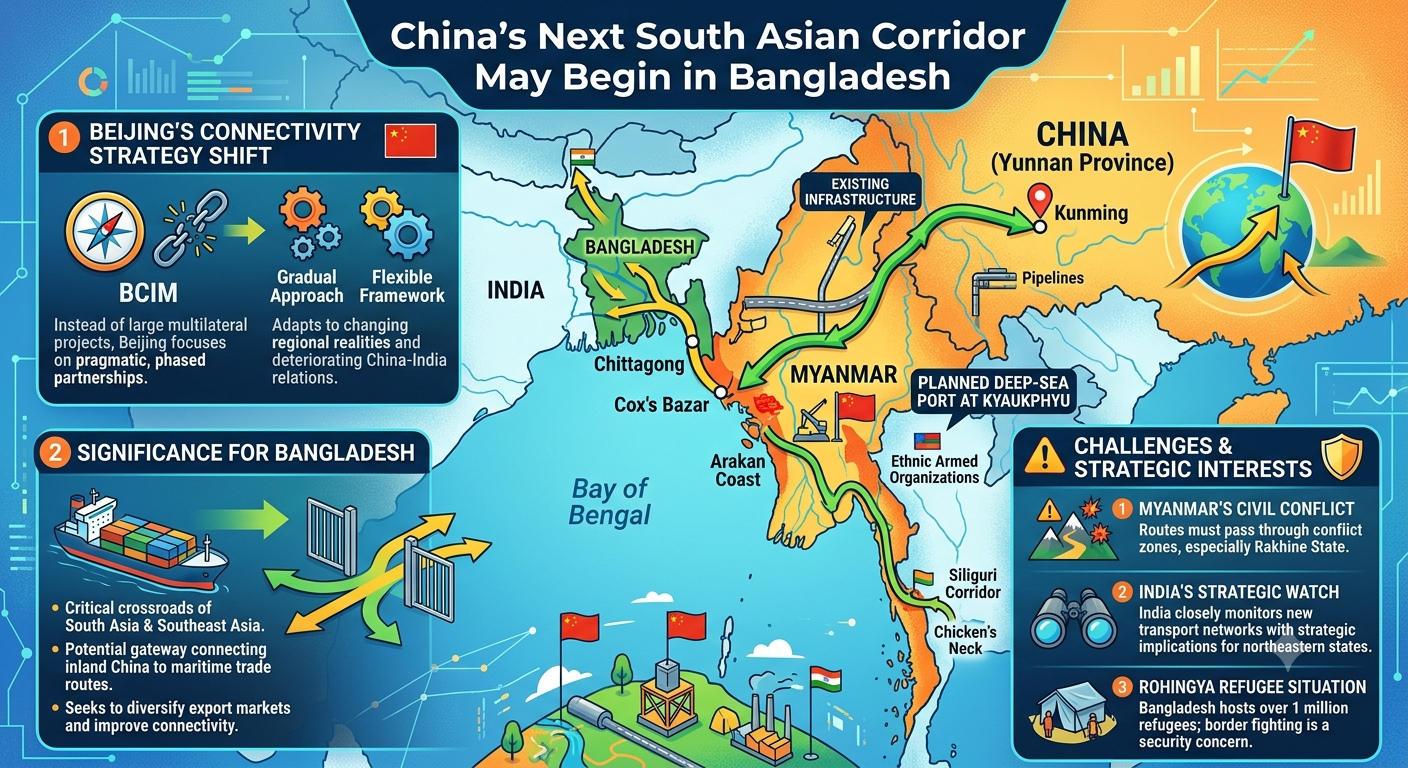
For Bangladesh, situated at the crossroads of South Asia and Southeast Asia and overlooking the Bay of Bengal, the proposal carries both economic promise and strategic significance. The country occupies a critical geographical position between India's northeastern region, China's landlocked Yunnan Province and Myanmar, making it a potential gateway connecting inland China to maritime trade routes.
If implemented, the corridor would provide another overland connection from China's Yunnan Province to the Bay of Bengal, complementing the existing China-Pakistan Economic Corridor and the China-Myanmar Economic Corridor under Beijing's Belt and Road Initiative.
The proposal comes as Bangladesh seeks to diversify its export markets and improve regional connectivity. China remains Bangladesh's largest import source, supplying around $18 billion worth of goods in the 2024-25 fiscal year, while Bangladesh's exports to China remain below $1 billion, underscoring a significant trade imbalance.
During the Beijing visit, Prime Minister Rahman urged China to increase imports of Bangladeshi pharmaceuticals, leather products, aquatic goods and agricultural produce. Improved transport links could also reduce logistics costs and encourage greater manufacturing investment.
However, analysts say the corridor faces formidable geopolitical and security challenges.
Any land route connecting Bangladesh with southwestern China must pass through Myanmar, where conflict has intensified since the military seized power in February 2021. Several ethnic armed organizations now control large stretches of territory, particularly in border regions that would be crucial for any future transport corridor.
The situation is especially sensitive in Myanmar's Rakhine State, bordering Bangladesh, where the Arakan Army has established control over much of the region. Rakhine is strategically important because it provides access to the Bay of Bengal and lies along potential transport routes connecting Bangladesh with China's existing infrastructure in Myanmar.
China has already invested heavily in pipelines, roads and the planned deep-sea port at Kyaukphyu, making stability in western Myanmar central to Beijing's long-term economic interests.
For Bangladesh, the corridor also intersects with broader regional dynamics. The country continues to host more than one million Rohingya refugees who fled violence in Myanmar, while periodic fighting near the border has heightened security concerns.
India is also expected to closely monitor the proposal. Although New Delhi has consistently opposed incorporating the original BCIM initiative into the Belt and Road framework, any new transport network linking Bangladesh and Myanmar would carry strategic implications for India's northeastern states and the wider Bay of Bengal region.
The proposal also comes as China reiterates support for Bangladesh's Teesta River Comprehensive Management and Restoration Project in the country's north. The project's proximity to India's strategically sensitive Siliguri Corridor commonly known as the "Chicken's Neck" that connects mainland India with its northeastern states adds another geopolitical dimension to Beijing's growing engagement in Bangladesh.
While no formal timeline has been announced and Dhaka says it is still studying the proposal, the initiative reflects China's evolving regional approach.
Instead of pursuing large multilateral projects that have struggled to gain consensus, Beijing now appears to be emphasizing pragmatic, phased partnerships that align with shifting geopolitical realities.
For Bangladesh, located at the meeting point of South Asia, Southeast Asia and the Bay of Bengal, the proposed corridor presents both an opportunity to strengthen regional trade and a challenge to balance competing strategic interests as China and India continue to shape the region's geopolitical landscape.
BOB Post