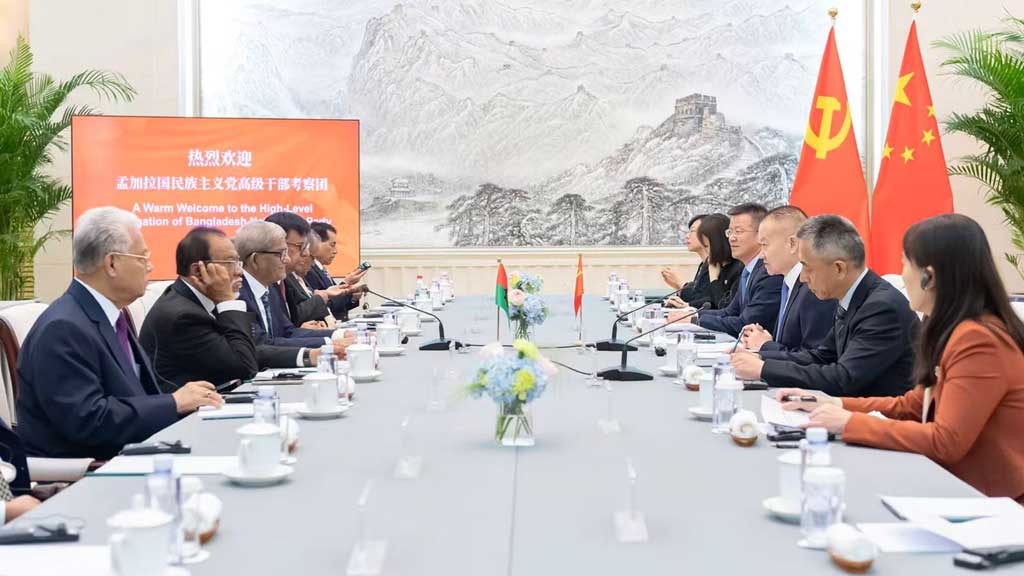
Senior BNP leader Mirza Fakhrul Islam Alamgir has highlighted China’s pivotal role in addressing the Rohingya crisis and resolving the long-standing Teesta water-sharing issue during high-level meetings in Beijing.
Fakhrul, leading a Bangladesh Nationalist Party delegation, met Chinese Vice-President Han Zheng at the Great Hall of the People on Tuesday. The delegation also held separate talks with Liu Haixing, head of the International Department of the Communist Party of China (IDCPC).
The discussions placed strong emphasis on the Rohingya humanitarian crisis, with Fakhrul describing it as one of the most pressing regional challenges. He stressed that China’s continued diplomatic and political engagement is crucial to ensuring the safe, dignified, and voluntary repatriation of Rohingya refugees currently sheltered in Bangladesh.
According to bdnews24, Fakhrul underscored that a sustainable resolution to the crisis requires coordinated international efforts, with Beijing playing a constructive role in facilitating dialogue between Bangladesh and Myanmar.
Both sides reaffirmed their commitment to strengthening Bangladesh–China relations under the framework of the “Comprehensive Strategic Cooperative Partnership,” focusing on mutual respect, equality, and expanded cooperation across multiple sectors.
Fakhrul reiterated Bangladesh’s adherence to a “Bangladesh First” foreign policy, prioritizing national interest, sovereignty, and public welfare, while also reaffirming Dhaka’s firm support for the “One China” policy.
In addition to the Rohingya issue, Fakhrul called for enhanced Chinese cooperation in the proposed Teesta River Integrated Management Project, highlighting its importance for agriculture and livelihoods in northern Bangladesh.
The BNP delegation also sought greater collaboration in the health sector, including support for advanced medical technologies, robotic surgery, immunization programmes, and the proposed Bangladesh–China Friendship Hospital.
Both parties expressed optimism that continued high-level engagement would deepen bilateral ties and open new avenues for structured cooperation, including plans to formalize exchanges through a memorandum of understanding.
BOB Post