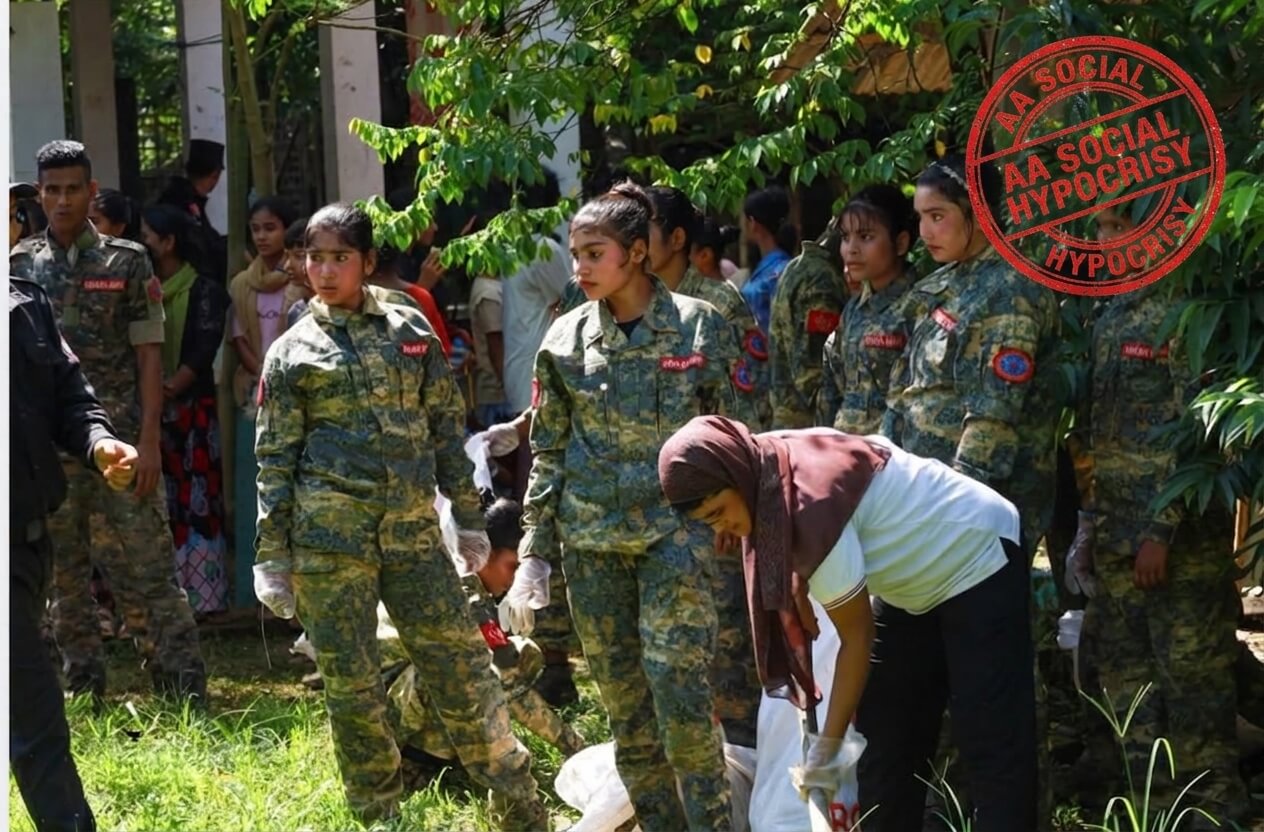
The Arakan Army (AA) is increasingly portraying itself as a force of religious harmony in Rakhine State. Its latest “Social Harmony Campaign”—bringing Buddhist, Muslim and Hindu youths together to clean mosques and monasteries in Buthidaung and Maungdaw- offers a carefully crafted image of coexistence.
According to Narinjara, 126 people took part in the August 9 and 11 activities, including Muslim women associated with the AA. ULA officials presented the campaign as evidence that different religious communities are now united under AA leadership.
But behind the carefully produced images lies a bigger question: is this genuine reconciliation- or an attempt to repair the AA’s image amid allegations of religious intolerance and abuses?
The AA now controls much of northern Rakhine and is seeking to present itself as a governing authority rather than simply an armed movement. That makes international legitimacy increasingly important.
A Buddhist, Muslim and Hindu group cleaning religious sites together provides exactly the kind of image that can support that narrative. But religious harmony cannot be measured by a single public event.
A Muslim shopkeeper in Maungdaw, speaking on condition of anonymity- “It is good that people are cleaning the mosque together. But what matters to us is whether we can live and work without fear. One day of cleaning cannot tell the whole story.”
A local Muslim resident says, “We want peace. We want to reopen our businesses, send our children to school and live normally. We do not want to be used to prove someone else's political message.”
"Such voices are more important than carefully selected photographs"- says Moyenul Hasan, a researcher and lecturer from Dhaka.
He added that the participation of some Muslims in an AA-organised campaign also does not necessarily mean that the broader Rohingya population enjoys equal protection.
Mr. Hasan says, “Can displaced Rohingya safely return? Will their homes and property be protected? Can Muslims freely practise their religion? Do minorities have equal access to education, healthcare and livelihoods? These questions- cannot be answered by a clean-up campaign."
BOB Post