Bangladesh Home Minister Salahuddin Ahmed has sought to put an end to the country’s long-running debate over the use of the term “indigenous,” saying that all citizens living within Bangladesh’s territory share a single national identity as Bangladeshis.
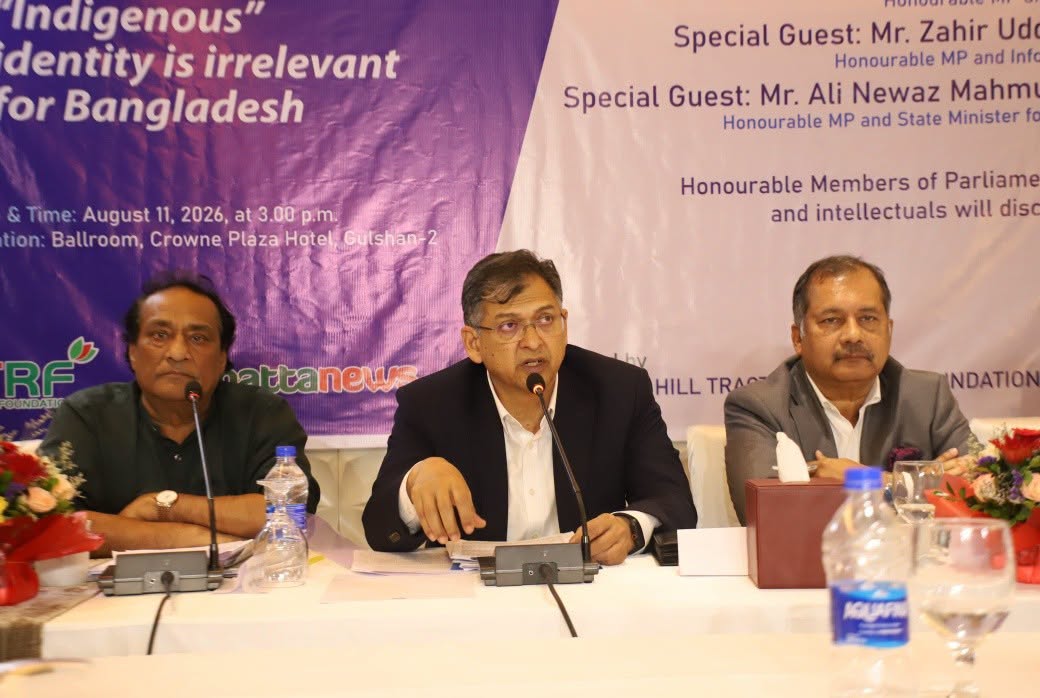
Speaking at a roundtable titled The ‘Indigenous’ Identity Is Irrelevant for Bangladesh” in Dhaka on Tuesday (11 August) evening, the minister said there was no separate “indigenous” group in the country in the geographical and constitutional context of Bangladesh.
“Everyone living within the geographical boundaries of Bangladesh has equal rights. We are all Bangladeshis and residents of Bangladesh,” he said, according to a statement issued by the Home Ministry Tuesday night.
The discussion was organized by the Chittagong Hill Tracts Research Foundation (CHTRF) and chaired by its chairman Mehedi Hasan Palash. Information and Broadcasting Minister Zahir Uddin Swapan and Culture State Minister Ali Newaz Mahmud Khaiyam attended the event as special guests.
Ahmed said the identity of all people across Bangladesh had been collectively agreed upon as “Bangladeshi” in the July National Charter, which he described as a document endorsed by political parties and stakeholders.
According to the minister, this national consensus and political commitment constitute an important foundation for protecting Bangladesh’s sovereignty and territorial integrity.
At the same time, he stressed that rejecting the use of the term “indigenous” as a separate national identity did not mean ignoring the cultural and social rights of the country’s ethnic communities.
He said the state remained fully committed to protecting, developing and preserving the religious, social and cultural heritage of its small ethnic groups, tribal communities and other communities.
The government, he added, maintains special measures and quota provisions for disadvantaged groups, women and children to help ensure equality with the national mainstream, with such measures also recognized by the Constitution.
The minister also referred to neighboring multilingual and multinational countries, arguing that the existence of hundreds of languages in those states had not necessarily resulted in separate state recognition of “indigenous” identities. Instead, he said, disadvantaged communities had been provided with opportunities and facilities to integrate into the mainstream.
Bangladesh’s Position on UN Indigenous Declaration
Ahmed also addressed Bangladesh’s position on international instruments concerning indigenous peoples.
Referring to the United Nations Declaration on the Rights of Indigenous Peoples (UNDRIP), adopted on September 13, 2007, he said Bangladesh had maintained a clear position from the outset.
He said Bangladesh had abstained during the vote on the declaration and noted that several influential countries had also opposed it.
The minister further said that the UN declaration and ILO Convention 169 were not applicable to Bangladesh, stressing that the country was not a party to the convention.
The remarks come amid a recent debate in Bangladesh over the appropriate constitutional, political and social terminology for the country’s ethnic communities, particularly in the Chittagong Hill Tracts.
While successive governments have used terms such as “tribal,” “small ethnic groups” and other descriptions in official contexts, a significant part of human-rights advocates have sought recognition of the term “indigenous peoples” in line with international frameworks.
Ahmed’s comments represent a clear reaffirmation of the government’s position that “Bangladeshi” should remain the overarching national identity for all citizens, while ethnic, religious and cultural distinctions can continue to be protected without creating a separate “indigenous” national identity.
BOB Post