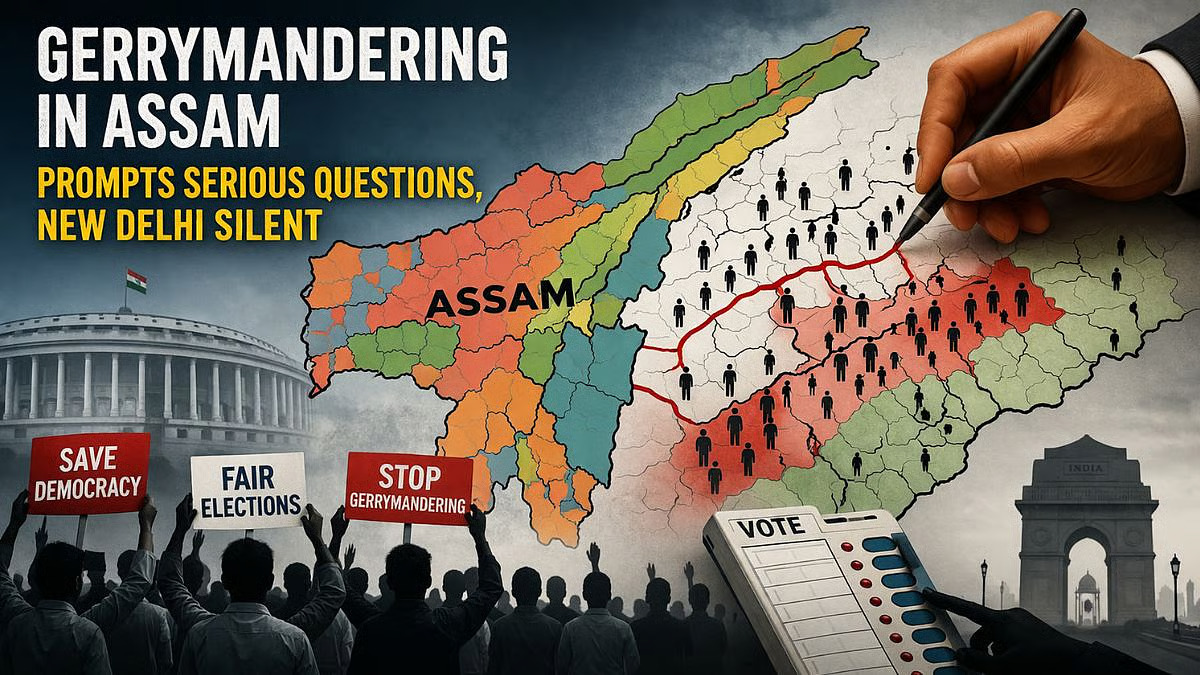
As the northeastern Indian state of Assam heads into assembly elections, concerns are mounting over whether a recent redrawing of electoral boundaries has weakened the political voice of its Muslim population.
In Katigorah, a constituency near the Bangladesh border, retired schoolteacher Islam Uddin has long encouraged voter participation within his community. But this election cycle, his optimism is tempered by uncertainty. “It’s about sending our representative to speak for us,” he said, questioning whether that remains possible under the new electoral configuration.
The controversy stems from a 2023 delimitation exercise carried out by the Election Commission of India, which redrew constituency boundaries across the state. The move has significantly altered the demographic balance in several areas, including Katigorah, where an influx of Hindu voters from neighboring constituencies has shifted it from a near-equal population split to a Hindu-majority seat.
According to Al Jazeera, critics argue that the redistricting has disproportionately affected Muslim voters by diluting their electoral influence through methods often described as “cracking,” “packing,” and “stacking.” These strategies involve redistributing voter groups in ways that reduce their ability to elect preferred candidates.
Political analysts say the number of Muslim-majority constituencies in Assam has dropped notably following the delimitation. While Muslims make up over 34 percent of the state’s population, their effective representation in the 126-member assembly may now be significantly lower. Opposition figures and researchers claim that areas with concentrated Muslim populations have been split or merged in ways that favour Hindu-majority outcomes.
The issue is particularly evident in the Barak Valley region, where constituencies have been restructured, reducing the total number of seats and altering their demographic composition. Seats that previously elected Muslim candidates have either been merged with Hindu-majority areas or reclassified, limiting electoral prospects for minority representatives.
The ruling Bharatiya Janata Party, led nationally by Prime Minister Narendra Modi and in Assam by Chief Minister Himanta Biswa Sarma, has rejected allegations of bias. Party representatives maintain that the delimitation process was conducted independently by the election commission and followed established guidelines.
However, opposition leaders and civil society groups argue that the changes risk marginalizing a significant section of the population at a time of heightened political and communal tensions. Some analysts have gone as far as describing the exercise as a model of “communal gerrymandering,” warning that its implications could extend beyond Assam to other parts of India.
With voting underway, the debate over electoral fairness and representation continues to shape the political landscape in one of India’s most diverse states.
BOB Post