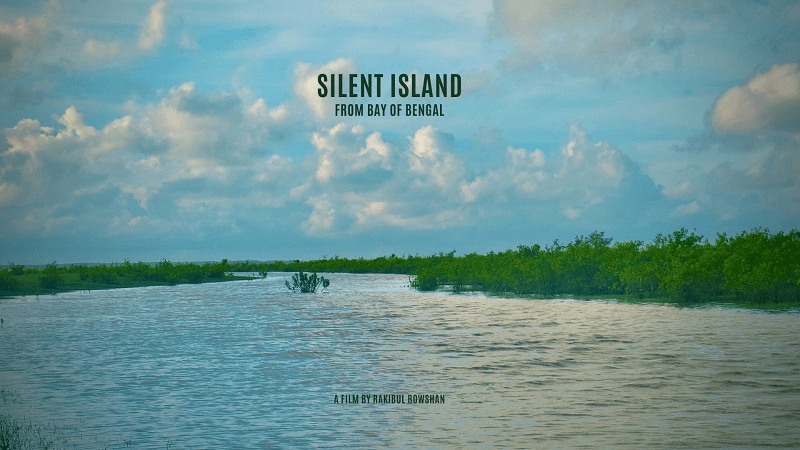
A hauntingly poetic short documentary titled Silent Island from Bay of Bengal, directed by independent Bangladeshi filmmaker Rakibul Rowshan, will be officially screened at the 4th Bangladesh Short Film and Documentary Festival 2025. Organized by the Bangladesh Shilpakala Academy, the festival will run from May 27 to 31 at the National Theatre Hall in Segunbagicha, Dhaka, with parallel screenings in all eight divisional cities across the country.
Clocking in at 19 minutes and 53 seconds, the film dives deep into the heart of a remote island in the Bay of Bengal, where words give way to wind, and silence speaks volumes. Through an absence of spoken dialogue, Silent Island from Bay of Bengal invites audiences into a contemplative experience where nature’s rhythms—the cries of seabirds, the rustle of mangroves, the crash of waves—become the only language. It captures the raw interactions between the environment and its non-human inhabitants, painting a solemn portrait of a world often overlooked.

“In Silent Island from Bay of Bengal, I tried to capture not just a location, but a state of being,” said Rowshan. “It’s a reflection on how animal lives, climate change, and human absence interact—sometimes tragically, often poetically. The film aims to break the illusion of human centrality and remind us of our shared vulnerability with all lifeforms.”
The documentary continues Rowshan’s signature cinematic style—merging metaphorical storytelling, poetic realism, and urgent ecological themes. His earlier acclaimed works, Locked Up and Mirror, were showcased at the Dhaka International Film Festival 2022, while The Face of Wind was exhibited at the World Youth Festival in Sochi, Russia. His most recent film before this, An Elephant Goes to the Himalayas from the Bay of Bengal, premiered at the Bangladesh International Short and Independent Film Festival 2024, where it garnered critical praise for its profound engagement with themes of cultural genocide.
Speaking to the significance of his work, Rowshan’s father noted, “This reflects how the lives of animals, climate change, and human absence sometimes interact tragically and often poetically. The film aims to challenge the illusion of human centrality and remind us of our shared vulnerability with all life forms.”
The narrative of Silent Island from Bay of Bengal is deeply tied to the ecological pulse of the Bay itself—a body of water that has long been the cradle of life, culture, and now, loss. The film mirrors the disappearing voices of coastlines reshaped by rising tides and biodiversity altered by human-induced climate shifts. It portrays the island not just as a place, but as a symbol of the fragile balance between presence and absence, memory and forgetting.
The Bangladesh Short Film and Documentary Festival, now in its fourth edition, serves as a vital platform for emerging and independent filmmakers from across the country. With a lineup of 89 films this year, the festival underscores the growing momentum of socially conscious and visually compelling storytelling in Bangladesh. The Bangladesh Shilpakala Academy continues to play a key role in democratizing access to cultural expression and encouraging narratives that resonate beyond the screen.
BOB Post