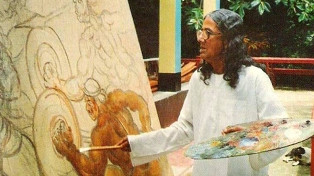
In the quiet landscape of Narail, where rivers, fields and village life once became the living canvas of an unconventional painter, the legacy of S M Sultan is set to come alive again on Monday as the district observes the 103rd birth anniversary of one of Bangladesh’s most distinctive artists.
Far from the galleries and cultural capitals of the world, Sultan built his artistic universe around farmers, labourers, nature and the raw strength of rural life. More than a painter, he emerged as a cultural figure whose work connected the soil of Bengal with a universal language of human dignity, making him a unique art personality in Asia.
The S M Sultan Foundation and Narail district administration have taken up a daylong programme at the S M Sultan Smriti Sangrahasala to mark the anniversary, according to BSS.
The programme will begin with Qurankhwani at Sultan’s grave at 6am. Tributes and a prayer mahfil will be held at his shrine at 9am, followed by the inauguration of a painting competition and exhibition for children and teenagers at 9:30am. An art camp will begin at 10am, while a discussion, award ceremony, prize distribution and cultural performances will be held later in the day.
Cultural Affairs Minister Advocate Nitai Roy Chowdhury is scheduled to attend the programme as the chief guest. S M Sultan Smriti Sangrahasala President and Narail Deputy Commissioner Dr Mohammad Abdul Salam will preside over the event.
Narail-1 MP Biswas Jahangir Alam, Narail-2 MP Ataur Rahman Bachchu and Cultural Affairs Ministry Secretary Kaniz Maula are expected to attend as special guests, while Bangladesh Shilpakala Academy Director General Rezauddin Stalin will join as the guest of honour.
Professor Reza Asad Al Huda Anupam of the Department of Fine Arts at Dhaka University will deliver the keynote discussion on “S M Sultan: An Artist Close to Life and Social Reality.” Abdul Halim Chanchal, director of the Department of Fine Arts at Bangladesh Shilpakala Academy, will deliver the welcome address.
This year, Dr Md Abdus Sattar will receive the Sultan Award-2026 for his contribution to the field of art and culture.
Sultan’s artistic journey had already crossed national boundaries long before his name became widely recognised in his homeland. His works were exhibited in Simla in 1946 and in Lahore and Karachi in 1948-49. In 1959, his paintings were displayed in New York, Boston and London, as well as at a university, decades before his major exhibition at Bangladesh Shilpakala Academy in 1976.
He also represented the then-Pakistan government at an International Conference of Painters in the United States in 1950, reflecting the international recognition he had received at an early stage of his career.
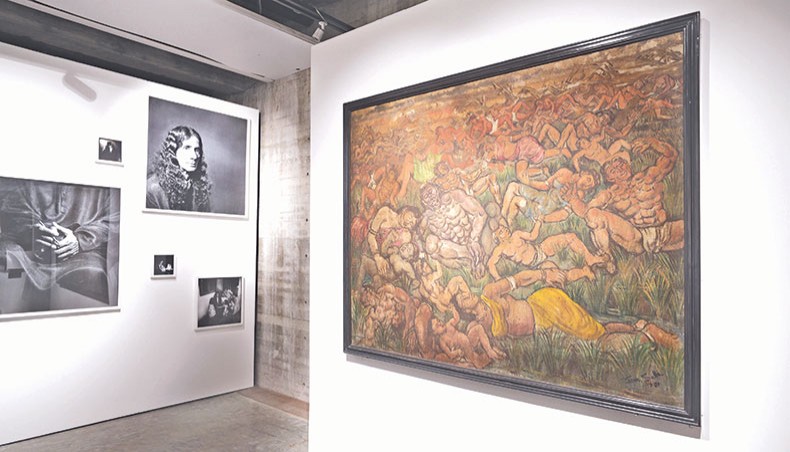
Yet Sultan remained deeply attached to the people and landscape of his homeland. His paintings often portrayed powerful rural figures, particularly farmers and labourers, transforming ordinary village lives into monumental images of strength, resilience and humanity.
His artistic philosophy was equally unconventional. He deliberately stayed away from the metropolitan art establishment and lived a remarkably simple life in Narail. His paintings drew their force from nature, rural society and the struggles of ordinary people, creating an artistic vocabulary that was both distinctly Bengali and broadly universal.
Sultan received the Ekushey Padak in 1982, the Bangladesh Charu Shilpi Sangsad Award in 1986 and the Swadhinata Padak in 1993. Cambridge University reportedly honoured him with the title “Man of Asia” in 1982, while the Bangladesh government recognised him as a “resident artist” in 1984.
Born on August 10, 1924, in the Masumdia area of Narail town, Sultan died on October 10, 1994, at Jashore Combined Military Hospital. He was buried in the yard of his home in the Masumdia-Kurigram area of Narail Municipality.
Three decades after his death, Sultan’s art continues to resist easy categorisation. His canvases do not merely preserve a vanished rural Bengal; they turn its farmers, workers, landscapes and struggles into enduring symbols of human strength. And every year, when Narail gathers around his grave and paintings, the quiet town briefly becomes a meeting point between Bengal’s soil and the wider world of art.
BOB Post