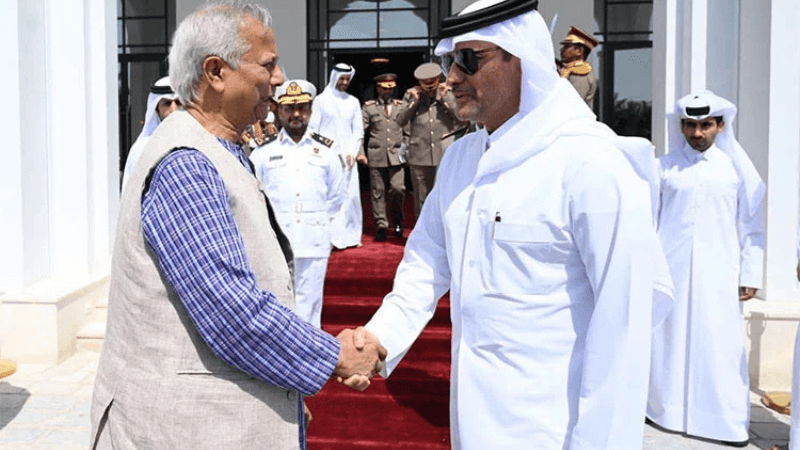
Nobel Laureate and Chief Adviser Professor Muhammad Yunus has called on Qatar to intensify diplomatic pressure on Myanmar and mobilize the Organisation of Islamic Cooperation (OIC) to accelerate the long-stalled Rohingya repatriation process. Addressing a high-level roundtable in Doha today, Prof Yunus emphasized the critical need for swift and collective global action to ensure the dignified and voluntary return of Rohingya refugees to their homeland in Myanmar.
Speaking at the event titled "Social and Environmental Challenges Around Forcibly Displaced Populations – The Case of the Rohingya" at the Mandarin Oriental Hotel, Prof Yunus appealed to Qatar to use its influential diplomatic ties and leadership within the Islamic world to catalyze change. He described the repatriation as "long overdue" and emphasized that the situation of over one million Rohingya refugees in Bangladesh remains dire and unsustainable.

"Qatar can use its good offices to put pressure on Myanmar for starting repatriation of Rohingya people without any further delay," said Prof Yunus. "Given the renewed international geopolitical and geostrategic scenario, Qatar can strongly express its solidarity and lead the charge among OIC countries to raise both funds and international pressure."
Prof Yunus praised Qatar’s consistent support for the Rohingya, recalling the bold statement made by Emir Sheikh Tamim bin Hamad Al-Thani during the 72nd United Nations General Assembly in 2017. At the time, the Emir had urged the Myanmar government and the international community to uphold their legal and moral responsibilities to protect the Rohingya population from violence and discrimination and to facilitate their repatriation with full rights.
Reinforcing his appeal, Prof Yunus highlighted ongoing humanitarian assistance by Qatar Charity to over 234,000 Rohingya refugees in Cox’s Bazar and Bhasan Char. This includes emergency medical support, educational materials, shelters, and sustainable energy solutions like LPG gas cylinders for 23,000 families—initiatives that also aim to mitigate environmental damage caused by deforestation in the camps.

“Such interventions are not only humanitarian necessities but environmental imperatives,” Prof Yunus added. “We urge Qatar to further expand these services, particularly the LPG program, as a model for sustainable refugee support.”
He also referenced a pivotal meeting on December 9, 2024, between Bangladesh’s National Security Adviser Dr Khalilur Rahman and Qatar’s Minister of State for Foreign Affairs Dr Mohammed bin Abdulaziz bin Saleh Al Khulaifi. During this meeting, the Bangladeshi representative called for Qatar's enhanced diplomatic involvement. Dr Khulaifi, in turn, reaffirmed Qatar’s strong commitment to the Rohingya cause, highlighting shared humanitarian values and religious ties.
The roundtable was attended by senior Bangladeshi officials, including Foreign Adviser Md Touhid Hossain, Energy Adviser Mohammad Fouzul Kabir Khan, SDG Affairs Coordinator Lamiya Morshed, and Press Secretary Shafiqul Alam. Also present was Sheikha Hind bint Hamad Al Thani, CEO of Qatar Foundation and host of the Earthna Summit.
As international attention fluctuates and funding dwindles, Prof Yunus urged the global community—particularly Islamic nations—to recognize the urgent moral, humanitarian, and environmental need for repatriation.
“The plight of the Rohingya must not be forgotten. The world must act now, not later, to bring justice and dignity to this persecuted population,” Prof Yunus concluded.
Bob post