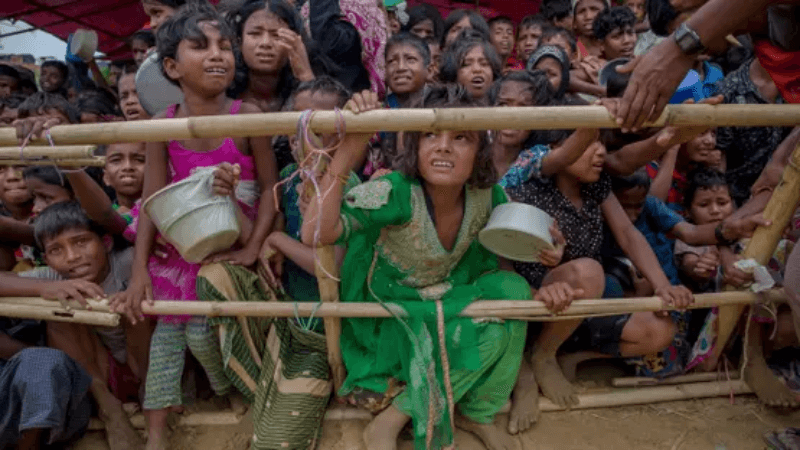
The United Nations warned on Tuesday(October 14) that its capacity to help children in Bangladesh's vast Rohingya refugee camps is shrinking rapidly and faces an imminent "funding cliff" that threatens years of progress.
The UN children’s agency, UNICEF, said that dire conditions for the nearly one million Rohingya who fled a military crackdown in Myanmar in 2017 are set to deteriorate further as financial support dries up. Most of the refugees live in overcrowded settlements in the coastal town of Cox's Bazar.
“A funding crisis is unfolding and it’s threatening to erase years of progress for the Rohingya children,” said Carla Haddad Mardini, UNICEF’s chief of private fundraising and partnerships, after returning from a visit to the camps. “It was disheartening to watch classrooms close, services shrink, and the futures of hundreds of thousands of children that are hanging by a thread.”
Haddad Mardini noted that services for education, water, sanitation, and hygiene have been among the hardest hit.
The funding shortfall comes as Bangladesh has recorded a new surge of 150,000 Rohingya refugees since the beginning of 2024. Simultaneously, major international donors, including the United States, have been cutting foreign aid, creating a ripple effect across the global humanitarian sector.
“Indications are that the situation will be even more dire next year,” Haddad Mardini stated. “The overall Rohingya response faces a funding cliff in early 2026... with worst-case projections suggesting that already-insufficient contributions could fall by half.”
The consequences are already severe. Severe acute malnutrition among children in the camps is now at its highest level since the 2017 influx.
The crisis has also created a dangerous security vacuum. According to Haddad Mardini, armed groups are increasingly active in the region, with 685 cases of child recruitment recorded so far this year more than five times the total for all of 2024.
“We’re doing everything possible to really stretch every dollar, but we’re running out of options,” she said. “No amount of cost-cutting can offset such a deep decline.”
(This news all information collected from AFP)
BOB Post