Civil society groups and activists in Sri Lanka are rallying to prevent the deportation of over 100 Rohingya refugees rescued off the island nation’s coast last month. The government’s announcement of potential deportation talks with Myanmar has sparked protests and calls for compassion from various corners of society.
The refugees, including more than two dozen children, were rescued on (December 19) near Mullaitivu district in northeastern Sri Lanka after their perilous journey across the Indian Ocean. Since then, they have been housed at the Keppapulavu Air Force base, a move criticized by activists as inappropriate and inconsistent with international humanitarian norms.
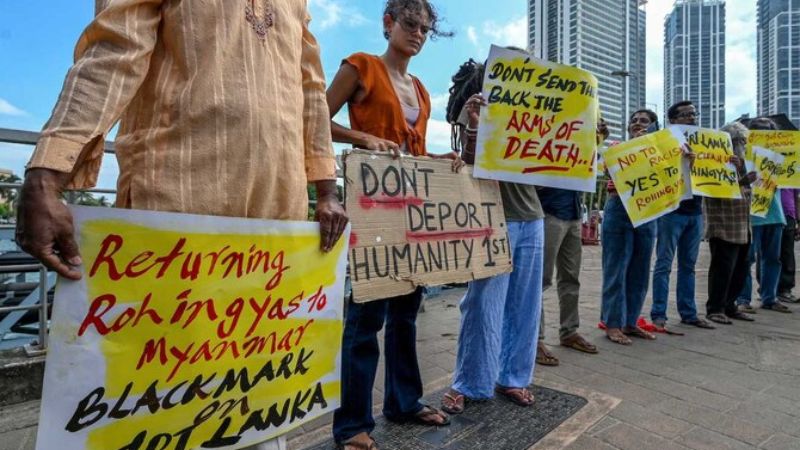
Public outcry intensified following Sri Lanka’s Minister of Public Security and Parliamentary Affairs Ananda Wijepala’s January 3 statement about discussions with Myanmar authorities to repatriate the refugees. Protests were held in Mullaitivu and Colombo, with activists emphasizing the dangers of returning the Rohingya to Myanmar, where they face systemic persecution.
“These are stateless people; they don’t have a home to go to,” said Thasneema Dahlan, a Colombo-based social activist. Speaking to Arab News during a protest on Friday, she underscored the gravity of the situation: “The Rohingya are massacred, chased, and terrorized in their own home. We are urging the government not to send them back because that is just sending them back to death.”
The Rohingya, often referred to as the “world’s most persecuted minority” by the United Nations, have endured decades of violence and displacement in Myanmar. In 2017, a brutal military crackdown forced over 730,000 Rohingya to flee to Bangladesh, with UN experts labeling the campaign a “genocidal” act involving ethnic cleansing, mass rape, and killings. The ongoing civil war in Myanmar’s Rakhine State has only exacerbated the crisis, prompting more Rohingya to undertake treacherous sea crossings. According to the UN refugee agency, over 7,800 Rohingya attempted such journeys in 2024—an 80% increase from the previous year.
Sri Lanka’s refusal to sign the 1951 UN Refugee Convention and its 1967 protocol complicates the situation. The country has historically acted as a transit point for refugees, relying on the UN High Commissioner for Refugees (UNHCR) to facilitate resettlement in third countries. In 2022, the Sri Lankan Navy rescued another group of 100 Rohingya, who remain under the care of local NGOs while awaiting resettlement.
Protesters and human rights organizations have criticized the current handling of the rescued group, particularly the decision to confine them to a military facility and limit access for aid agencies. The North-East Coordinating Committee, which organized a protest in Mullaitivu on Thursday, wrote in a letter: “Sheltering the refugees under a militarized environment is incompatible with international humanitarian norms and basic human values.”
Ruki Fernando, a Colombo-based human rights activist, called for the refugees to be placed under civil administration, emphasizing both legal and moral responsibilities. “Many Sri Lankans have been refugees. We need to help others,” Fernando told Arab News. “Under customary international law, non-refoulement is prohibited. It means no one fleeing a well-founded fear of persecution should be sent back.”
Fernando also highlighted the ethical obligations rooted in Sri Lanka’s religious and cultural traditions: “Our religious and spiritual values teach us to welcome, care for, and support those in distress.”
The situation remains tense as activists continue to file petitions and urge the government to reconsider its stance. With international scrutiny mounting, the fate of the rescued Rohingya refugees hangs in the balance, as Sri Lanka’s civil society fights to ensure their safety and dignity.
BOB Post