Before dawn breaks over the Rohingya refugee camps, life is already in motion. Narrow lanes fill with footsteps and quiet conversations as families prepare for another day shaped by hardship, routine and quiet determination.
In Camp-4, a 47-year-old Rohingya woman starts her morning by cooking breakfast for her three children inside a small shelter. Her husband lives separately with another wife, leaving her as the sole caregiver and decision-maker for the family. Each day requires careful navigation of camp services from ration collection points to water schedules and humanitarian offices a daunting task for someone who cannot read or write.
For years, illiteracy limited her independence. She depended on neighbors to explain notices, read signboards, and even sign documents on her behalf.
“I felt helpless,” she recalls. “I had to ask people about everything when to collect rations, when water would come. I couldn’t even sign my own name.”
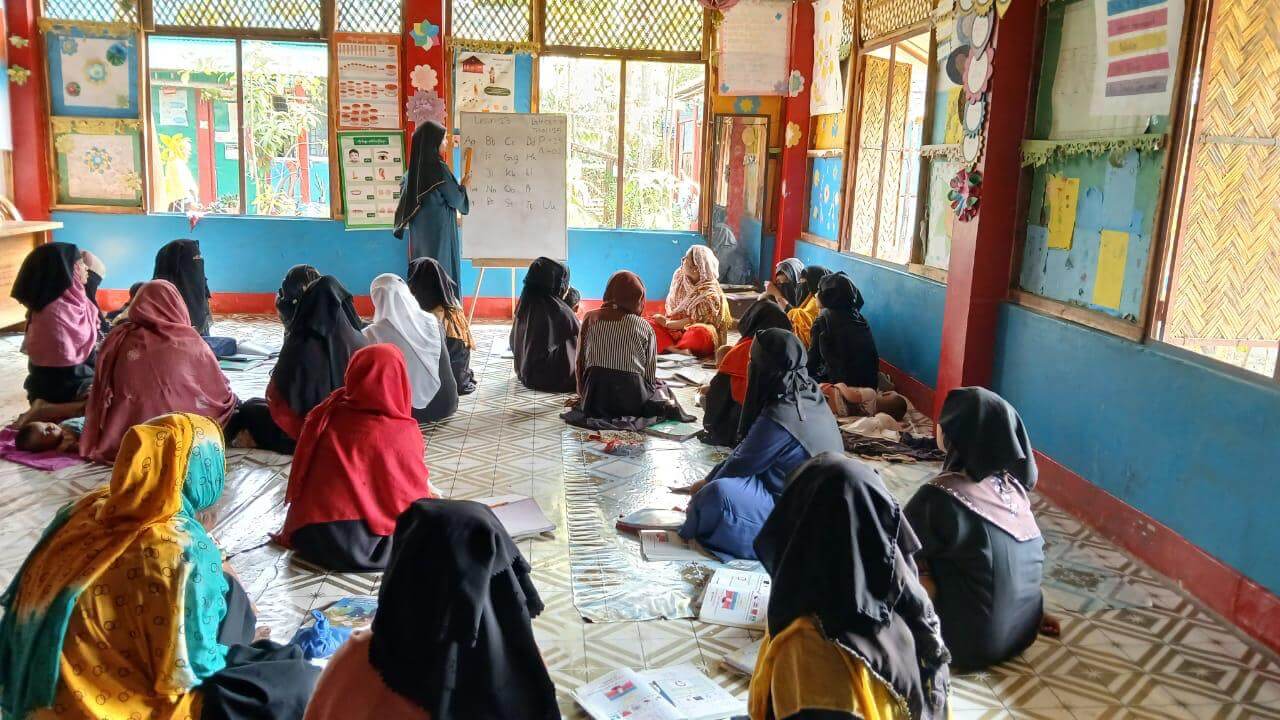
That sense of exclusion began to change when she learned about a Multi-Purpose Women’s Centre (MPWC) in Camp-4, locally known as Shanti Khana. The centre offers a safe space for women to learn basic literacy and life skills through UN Women-supported programmes.

Initially hesitant, she doubted whether learning was possible at her age. “I was scared,” she says. “I had never been to school and thought I would fail.”
She enrolled in the Accelerated Adult Learning (AAL) program, designed specifically for adults with no prior education. The classes combine basic reading, writing and numeracy with practical daily-life skills, using visual materials and patient instruction.
“I am a slow learner,” she admits. “But my teacher never gave up. She explained again and again until I understood.”
Gradually, she learned to recognize numbers, read simple words, and understand dates and time. A defining moment came when she signed her own name for the first time instead of using a thumbprint.
“That day, everything changed,” she says. “Now I can sign for myself. I don’t have to depend on others to read ration schedules or tell me when to collect water.”
The impact has been transformative. She can identify camp offices by name, approach service providers with confidence, and move through daily tasks with greater independence.
Her own progress has also strengthened her resolve to support her children’s education. Determined that they should not face the same barriers, she now encourages other women in her block to join literacy classes, sharing her experience as proof that change is possible.
“I know the consequences of being illiterate,” she says. “I want my children and other women to be literate and independent too.”
The training has opened doors to new aspirations. With basic literacy skills, she is now exploring vocational opportunities such as embroidery and tailoring, hoping to turn learning into a pathway for income generation.
“I want to keep learning,” she says. “Because learning changes everything.”
According to UN Women, investments in women’s empowerment through the Accelerated Adult Learning program supported by the Embassies of Japan, Sweden and Switzerland in Bangladesh are strengthening the capacity of Multi-Purpose Women’s Centres and Women’s Markets across the Rohingya camps.
So far, 349 women and girls, including 227 Rohingya women and 183 Rohingya girls, have improved their basic literacy and numeracy skills through the programme. UN Women says these foundational skills are critical steps toward leadership, income generation and informed decision-making, helping participants build confidence and agency.
The initiative has also introduced digital learning, with 72 tablets distributed under the AAL program. The devices allow women and girls to access reading materials directly, further supporting empowerment, resilience, and pathways toward more sustainable futures in the camps.
BOB Post