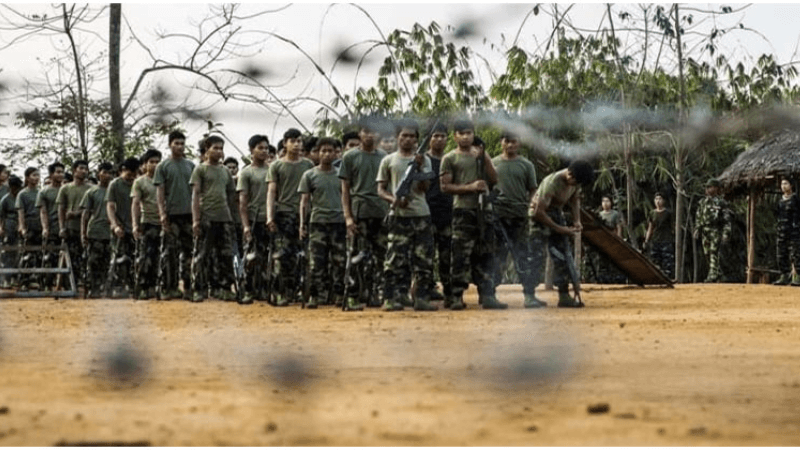
After years of being pushed to the margins of Myanmar’s political landscape and confined to refugee camps in Bangladesh, Rohingya armed groups have begun mobilizing against the Arakan Army (AA) in a desperate bid to reclaim their ancestral lands and secure basic rights in Rakhine State.
This development, detailed in a newly released International Crisis Group (ICG) report titled “Bangladesh-Myanmar: The Risks of a Rohingya Rebellion”, reflects the mounting frustration of a persecuted community still living in limbo nearly eight years after a brutal campaign of ethnic cleansing drove over 700,000 Rohingya from Myanmar into Bangladesh.
The Fight for Return and Representation

Long sidelined by both the Myanmar military and ethnic Rakhine forces, Rohingya factions are uniting under a common cause: resisting the Arakan Army’s consolidation of power in northern Rakhine, a region once home to the bulk of the Rohingya population. Their aim, according to the report, is to ensure they are not permanently excluded from any future governance structure in Rakhine State.
Since late 2024, several Rohingya armed groups—historically fragmented and often at odds—have set aside rivalries and reached a tactical alliance to oppose the AA’s dominance. This unity is described as an expression of collective desperation among Rohingya youths, many of whom see no future either in the camps or in Myanmar under the current power balance.
“Their mobilization reflects not extremism but the enduring will to return to their homeland with dignity and security,” said a Rohingya civil society representative in Kutupalong camp, speaking anonymously for safety.

Arakan Army: From Resistance to Exclusion?
While the AA has gained international recognition for resisting Myanmar’s military junta, the ICG report highlights its troubling history of exclusion and discrimination toward the Rohingya minority. The AA’s narrative of ethnic Rakhine self-determination has often sidelined Muslim communities, and reports of abuses against Rohingya civilians by AA fighters have mounted.
For many Rohingya, the AA represents a new form of domination—one that continues to deny them political rights and freedom of movement. As one Rohingya elder put it, “We fled from the Burmese military, and now we face rejection from those who say they fight for justice.”
The recent mobilization is thus not just military—it is symbolic. Rohingya factions argue that without their participation, no peace or autonomy in Rakhine can be legitimate.
Bangladesh’s Tightrope Walk
Bangladeshi authorities face a sensitive dilemma. On one hand, they are concerned about rising militancy within the refugee camps. On the other, some security officials quietly acknowledge that empowering Rohingya resistance groups may be one way to pressure the AA to engage in inclusive dialogue and accept repatriation of displaced communities.
The ICG warns that such covert strategies are risky. “Bangladesh must tread carefully to avoid provoking further instability while ensuring that Rohingya voices are not erased in the process of border diplomacy,” the report states.
Rohingya Militants: Mischaracterized or Misunderstood?
The report also cautions against simplistic portrayals of Rohingya armed factions as extremists. While some groups have invoked religious language to inspire recruits, many within the camps reject violence and remain committed to peaceful repatriation. Still, without international support and viable political pathways, frustration and radicalization are rising.
According to the report, the unity gathering held by Rohingya groups in late 2024 was “not a call for war, but a desperate plea for inclusion.”
The Way Forward: Dialogue, Not Denial
The ICG urges all parties—including the Arakan Army—to recognize that sustainable peace in Rakhine cannot be achieved without Rohingya representation. It recommends that:
The Arakan Army engage in direct talks with Rohingya representatives, affirming their right to live and participate equally in Rakhine’s governance.
Bangladesh increase humanitarian access and informal trade with Rakhine, reducing tensions and building interdependence.
International donors restore funding for Rohingya camps, to prevent further militarization born from despair.
Importantly, the report highlights that Arakan Army now controls areas from which Rohingya were violently expelled in 2017, placing it in a moral and political position to lead by example in reconciliation.
The Rohingya are not fighting to conquer—they are fighting not to be forgotten. Their armed mobilization, while fraught with risks, is rooted in years of broken promises, systemic exclusion, and shattered hopes of safe return. Without sincere engagement from the Arakan Army, and meaningful support from Bangladesh and the global community, the Rohingya’s call for justice may once again go unanswered—at the cost of another generation.
BOB Post