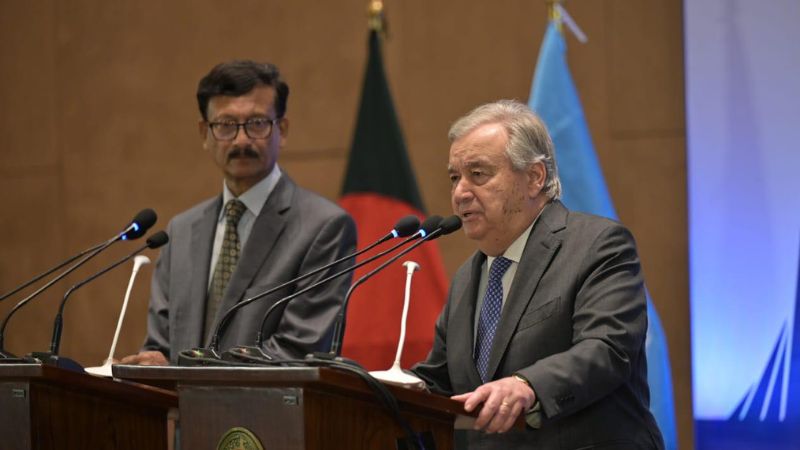
UN Secretary-General Antonio Guterres has stressed the need for dialogue with the Arakan Army (AA) to ensure the protection of Rohingya rights in Myanmar’s Rakhine State. Addressing a joint media briefing with Bangladesh’s Foreign Affairs Adviser Md Touhid Hossain, Guterres highlighted the difficulty of an immediate, dignified return of Rohingya refugees amid ongoing conflict between the Myanmar Army and the Arakan Army.
Guterres emphasized that it is crucial to engage with the Arakan Army to uphold the rights of the Rohingya population. He called for increased international pressure and the cooperation of Myanmar’s neighbors to end the violence and restore democracy, which he identified as a key step in facilitating the refugees’ return.
Humanitarian Aid and Cross-Border Assistance
The Secretary-General underlined the necessity of intensifying humanitarian aid within Myanmar to create conditions for a successful return of the refugees. He also mentioned the potential for a humanitarian aid channel from Bangladesh, should circumstances allow and authorization be granted.
Meanwhile, human rights organization Fortify Rights has called on both the Bangladesh government and the Arakan Army to facilitate humanitarian aid and cross-border trade to assist war-affected civilians in Myanmar’s Rakhine State. Ejaz Min Khant, Human Rights Associate at Fortify Rights, urged international stakeholders to explore all possible avenues to ensure life-saving aid reaches affected communities. “A humanitarian corridor between Bangladesh and Myanmar would enable vital aid and trade for all communities. Failure to act will cost lives,” he warned.
Bangladesh’s Foreign Adviser Hossain stated that while the issue of a humanitarian corridor was not directly discussed with the UN Secretary-General, such operational matters are being handled through UN agencies.
The Need for a Unified Approach and International Support
The Bangladesh government remains firm in its stance that the Rohingya must return to Myanmar with dignity and safety. Hossain reiterated the need for unified efforts to pressure all relevant parties in Myanmar to ensure this happens.
Guterres acknowledged the potential role of sanctions in influencing Myanmar’s authorities, but noted that securing UN Security Council approval for sanctions remains a challenge.
During his visit to Rohingya refugee camps in Cox’s Bazar, Guterres expressed deep concern over drastic aid cuts by major donors, including the United States and European nations. He described the camp as “ground zero” for the impact of these cuts, warning of an impending humanitarian disaster if immediate action is not taken.
“We are at risk of cutting the food rations in this camp,” he stated. “That would be an unmitigated disaster that we cannot accept because people will suffer and even die.”
The Urgent Need for a Peaceful Solution
Bangladesh currently hosts over one million Rohingya refugees who fled Myanmar following violent crackdowns in 2017. These events, described as a “textbook example of ethnic cleansing” by former UN High Commissioner for Human Rights Zeid Ra’ad al-Hussein, have led to one of the worst humanitarian crises in recent history.
Guterres emphasized that the world must not forget the plight of the Rohingya. He pledged to advocate for increased global support and reiterated the need for a comprehensive peace plan, starting with ceasing violence and establishing democratic governance in Myanmar.
“The more than one million Rohingya refugees here are proud. They are resilient. And they need the world’s support,” he said, commending Bangladesh’s generosity in hosting the refugees despite its own resource constraints.
A sustainable solution to the Rohingya crisis is essential for regional stability. The ongoing conflict in Myanmar threatens not only the displaced Rohingya but also regional peace and security. Ensuring a peaceful resolution through dialogue, humanitarian aid, and international pressure is crucial to fostering long-term stability and preventing further human suffering.
BOB Post