Myanmar’s military government has moved to recalibrate its foreign policy outreach with a rare high-level visit to Pakistan, as Foreign Minister Than Swe concluded a four-day official trip to Islamabad in January, the first such ministerial engagement between the two countries in more than a decade.
The visit came at a sensitive moment, coinciding with Myanmar’s appearance before the International Court of Justice (ICJ) in The Hague to contest allegations of genocide against the Rohingya. Analysts view the timing as deliberate, with Naypyidaw seeking to soften diplomatic pressure from the Organization of Islamic Cooperation (OIC), where Pakistan plays a key and influential role.
According to the Irrawaddy report, Myanmar’s leadership sees engagement with Pakistan as a strategic move to temper criticism within the OIC, particularly as the bloc continues to back Gambia’s genocide case at the ICJ. Pakistan had previously taken a strong stance against Myanmar following the 2017 military crackdown on Rohingya Muslims, formally summoning Myanmar’s ambassador and denouncing the violence as ethnic cleansing and crimes against humanity.

Despite those tensions, quiet military cooperation between the two countries has persisted. Myanmar has relied on Pakistan alongside China for defense support, including the procurement, maintenance and training linked to JF-17 Thunder fighter jets, which the Myanmar Air Force has used in air operations against resistance forces. Human rights groups say these air campaigns have repeatedly harmed civilians.
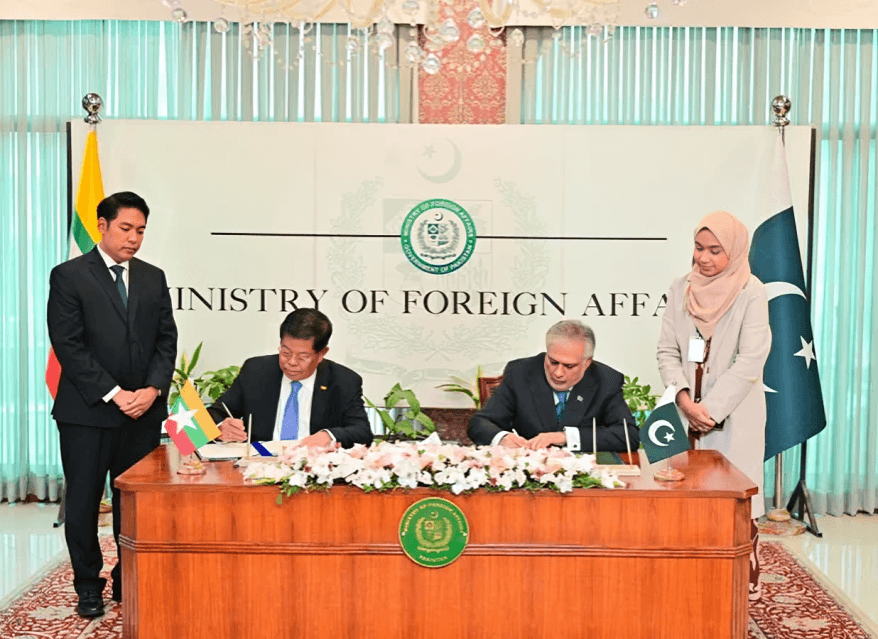
During the Islamabad visit, Then Swe and Pakistani Foreign Minister Ishaq Dar signed a memorandum establishing regular “Foreign Office Consultations,” signaling intent for sustained political engagement. Dar emphasized “regional reconciliation” and expressed support for a peaceful and stable Myanmar, language widely interpreted as diplomatic openness toward the junta’s effort to project a civilian-led political transition following military-backed elections held late last year.
Economic and sectoral cooperation also featured prominently in the talks, with discussions covering trade, agriculture, manufacturing, healthcare, technology and cultural exchanges. Pakistan also invited Myanmar officials to visit its Gandhara Buddhist heritage sites, highlighting religious tourism as a soft-power bridge despite enduring sensitivities over the Rohingya issue.
While the Rohingya crisis was not foregrounded in joint statements, it clearly shaped the visit’s context. With ICJ hearings ongoing, Myanmar appears eager to ease diplomatic isolation and explore pathways back into regional legitimacy raising renewed questions about whether such engagement risks weakening international efforts to secure accountability for alleged atrocities.
BOB Post