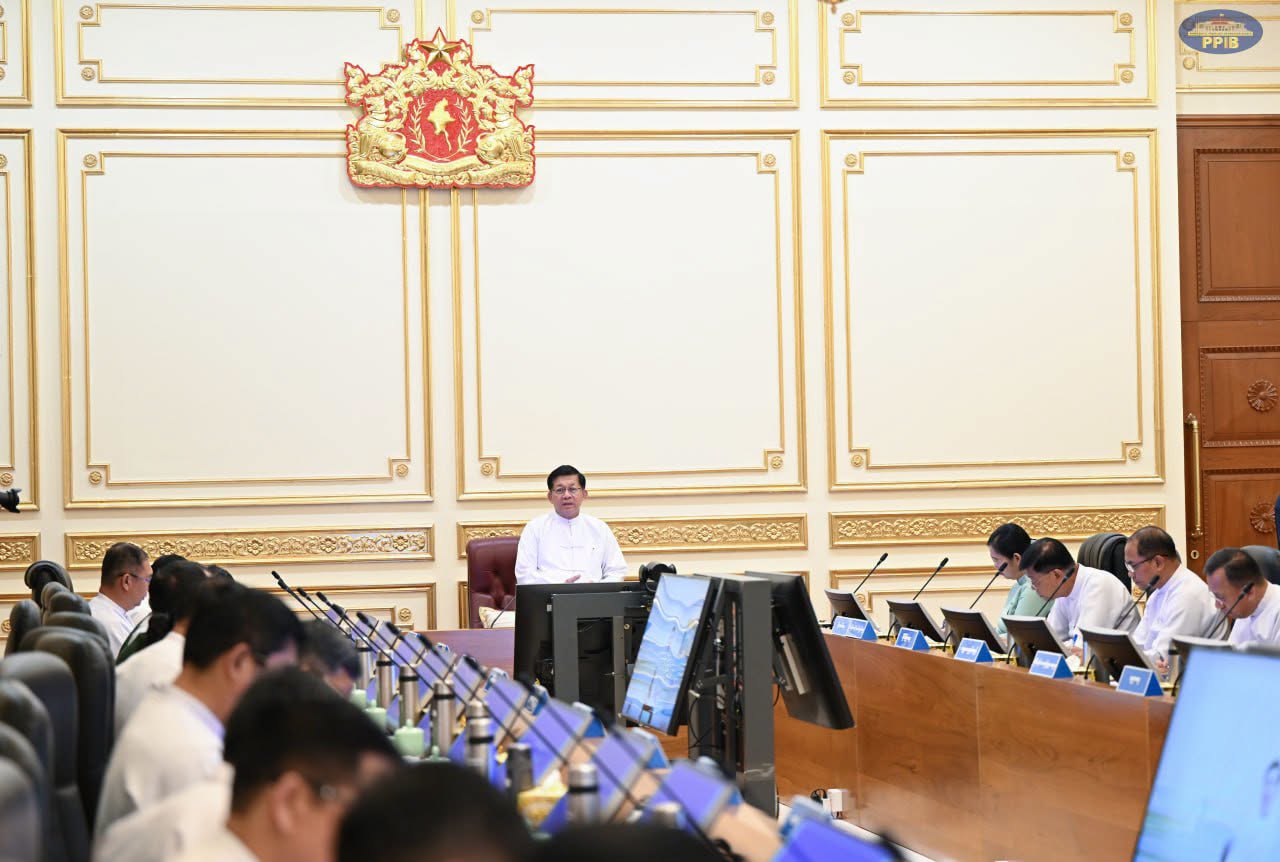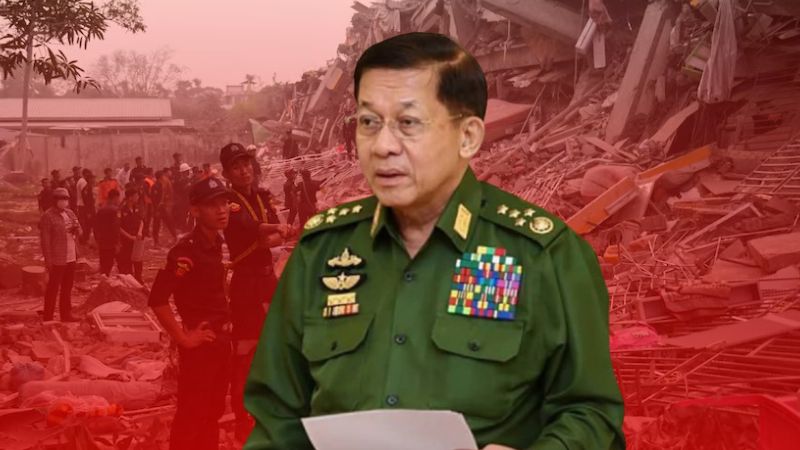
In the wake of Myanmar’s devastating 7.7 magnitude earthquake on March 28, which has left a trail of destruction across large swathes of the country, the military junta has turned a national disaster into a political opportunity, prioritizing regime survival and public relations over real humanitarian response.
Instead of mobilizing to aid the thousands buried under rubble, the military regime under Min Aung Hlaing has chosen to manipulate global sympathy and hijack international aid efforts, further exacerbating an already dire situation for millions of citizens in quake-hit regions.
The official death toll stands at nearly 3,000, though independent estimates suggest the true number could be several times higher. Satellite imagery analyzed by Microsoft shows entire neighborhoods in Mandalay reduced to rubble, with more than 500 buildings completely destroyed. The United States Geological Survey and humanitarian monitoring models predict fatalities could exceed 10,000, many likely still trapped under debris.
Yet, the junta’s immediate response was not to prioritize rescue efforts or coordinate aid distribution. Instead, it moved swiftly to take control of incoming relief supplies and used them as a means to consolidate power, punish dissent, and stage-manage optics for the international community.
Despite the epicenter of destruction being in regions like Mandalay, Sagaing, and Kachin—many of which are strongholds of anti-junta sentiment—the majority of aid is being redirected to Naypyidaw, the capital city that suffered relatively minor damage. This blatant misallocation of resources exposes the junta’s intent: securing loyalty among their own ranks and showcasing a false image of order and recovery.
Reports from local sources and international observers confirm that military checkpoints are preventing aid from reaching rebel-held and severely damaged areas. On April 1, the military fired upon a Chinese Red Cross convoy carrying emergency supplies under the escort of the Ta’ang National Liberation Army (TNLA). This unprovoked attack underscores the regime’s hostility toward neutral humanitarian intervention, especially when it bypasses junta oversight.
Numerous eyewitness accounts detail how citizens trying to carry out rescue operations have been obstructed or even attacked by the military. In one harrowing incident on March 30, a local mechanic named Ko Zaw Zaw attempted to help victims trapped under collapsed homes in Sagaing. Soldiers intervened, forcing him and his team to retreat, leaving survivors to perish under the wreckage.
This is not a government responding to a tragedy. This is a regime exploiting a crisis—turning rubble into a fortress and aid into ammunition.
Though the junta declared a temporary ceasefire on April 2, their actions tell a different story. Just a day prior, military aircraft bombed a Kachin Independence Army training facility, killing at least 30 young cadets. Airstrikes were also reported in Sagaing, where many survivors had fled in search of safety.
In reality, the so-called ceasefire is a tactical maneuver—an attempt to appear cooperative while continuing to pursue violent suppression of resistance movements under the cover of disaster recovery.
Human rights observers and regional analysts warn that unless the global community acts decisively, Myanmar’s junta will continue to use disaster relief as an instrument of control. “If aid is funneled through the military, it will only strengthen the regime’s grip and further marginalize those who need it most,” said one humanitarian analyst.
There are growing calls for international agencies, including the United Nations, International Red Cross, and key donor nations, to explore alternate delivery routes—particularly through borders shared with India, China, and Thailand. Rebel-controlled territories may offer safer and more ethical distribution channels for life saving resources.
Unless the world moves to bypass junta-controlled pipelines, humanitarian aid risks becoming a weapon of war.
The people of Myanmar now face two disasters: the physical devastation of a deadly earthquake, and the cruel opportunism of a regime that views human suffering as a stepping stone to power. With food, water, medical supplies, and shelter in dangerously short supply, time is running out—not just for the victims trapped under debris, but for a nation struggling to rise amid tyranny.
The question facing the global community is not whether Myanmar needs help—it does, desperately—but whether that help will serve the people or empower their oppressors.
BOB Post