Despite announcing a ceasefire following a devastating earthquake in March, Myanmar’s military junta has continued a deadly campaign of airstrikes and artillery attacks, according to the United Nations and data from the Armed Conflict Location & Event Data Project (ACLED).
The March 28 earthquake — the worst natural disaster in Myanmar in decades — killed thousands and triggered a multi-national humanitarian response aimed at aiding hundreds of thousands already suffering from years of conflict. In response to growing international pressure, the military declared a 20-day ceasefire on April 2, later extending it to April 30 following high-level peace talks led by Malaysia’s prime minister.
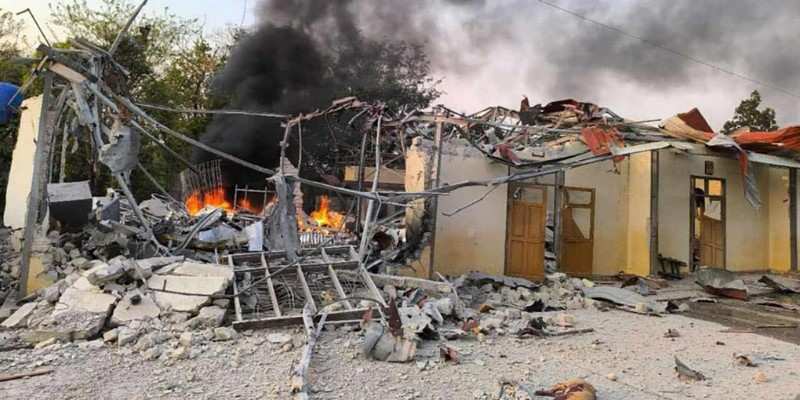
Between March 28 and April 24, the military launched at least 207 attacks — including 140 airstrikes and 24 artillery barrages — based on figures from the UN Human Rights Office. Of those, more than 172 attacks occurred after the ceasefire was announced, with 73 strikes in areas affected by the earthquake.
"It's business as usual," said James Rodehaver, Myanmar head for the United Nations Office on Human Rights. "The ceasefire ... should have involved stopping all military activity and repurposing your military to support the humanitarian response and that has not happened."
Myanmar has been in turmoil since the February 2021 coup that overthrew the democratically elected government of Aung San Suu Kyi. The military’s violent suppression of dissent sparked a full-blown civil war, including in areas previously untouched by conflict.
Two weeks into the declared ceasefire, junta aircraft bombed South Kan Ma Yaik village in southeastern Karen state on April 16, during Burmese New Year celebrations. A pregnant woman and her unborn child were killed, according to an eyewitness.
"The first bomb exploded near her house. Then she braced her children for a second bomb and shrapnel hit her body," the witness said. "All the children were bleeding all over."
While the account could not be independently verified, ACLED data confirms a military strike on the village that day, with at least one fatality.
Prior to April 2, the junta averaged 7.6 air or drone attacks per day, killing over five people daily, including civilians. Since the ceasefire began, that average has risen to 9.7 attacks daily, with over six deaths per day — 105 people in total killed by aerial strikes during that time.
In contrast, opposition forces — who lack conventional air power and rely mostly on drones — conducted only three aerial attacks between April 2 and April 18, the data shows.
The junta, however, has access to a substantial aerial arsenal, including Chinese and Russian-made fighter jets, Russian attack helicopters, and heavy unmanned aerial vehicles, according to a report by the International Institute for Strategic Studies.
ACLED Senior Analyst Su Mon said the military's post-quake strikes have targeted Sagaing and northern Shan state — regions with strategic significance — as well as Kachin and Rakhine states. "The military is still conducting aerial strikes that target civilian populations," she said.
In its ceasefire declarations, the junta warned it would still retaliate against "rebel actions," including recruitment and territorial gains. UN Human Rights Office’s Rodehaver acknowledged that in some cases, airstrikes followed attacks by armed groups but questioned the proportionality.
"Whenever you get attacked by ... small arms fire, your response is to launch airstrikes on an area and you end up killing a dozen people who were not involved in the fighting at all. Is that a ceasefire?" he asked.
The junta has not responded to repeated requests for comment.
BOB Post