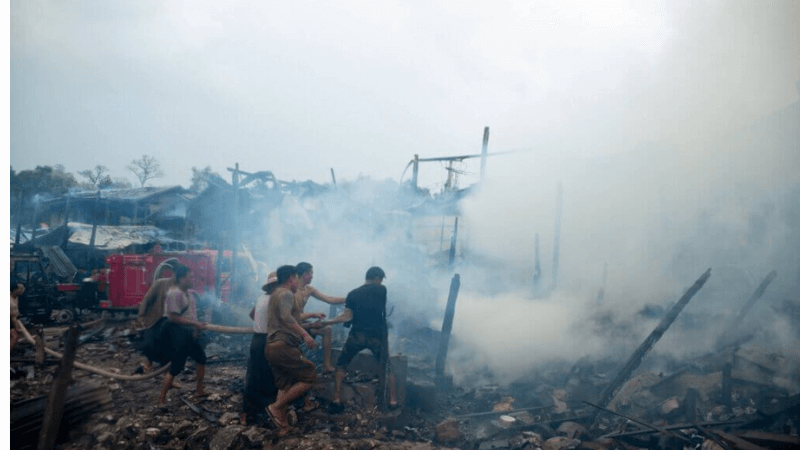
Nearly three months after a devastating earthquake struck central Myanmar, the country’s ruling junta has intensified aerial attacks on civilian areas, killing at least 471 civilians and injuring nearly 1,000 others, according to the opposition National Unity Government (NUG) in exile.
The March 28 Sagaing-Mandalay earthquake claimed approximately 5,000 lives and left thousands more homeless. Despite the Myanmar military's repeated claims of a ceasefire to facilitate humanitarian aid and disaster relief, airstrikes have persisted with devastating consequences.
Since the earthquake, the anti-regime NUG has documented 552 separate air raids across Myanmar—many of which allegedly targeted schools, homes, and infrastructure in areas under opposition control. Of the 931 people wounded, at least 183 were children, the NUG reported.

Use of Cluster Munitions, Targeting of Schools
In a briefing paper released this week, the NUG accused the military of using cluster bombs and 300-pound bombs in populated areas. A particularly harrowing attack occurred on June 9 in Paing Yat village, Karen state, near the Thai border.
According to the NUG, three children aged between six and eight, a teacher, and another civilian were killed when a fighter jet dropped a series of bombs, hitting a local home-school and nearby road. The village reportedly endured three bombing waves, totaling eight munitions.
“This is a blatant attack on children and educators,” the NUG said. “There is now an urgent need for modern air-raid alert systems and bomb-resistant shelters to protect civilian populations.”

International Humanitarian Law Violations
Myanmar is not a signatory to the Convention on Cluster Munitions, which prohibits the use of such indiscriminate weapons. However, targeting schools, civilians, and healthcare facilities is widely considered a violation of international humanitarian law and constitutes a war crime.
As of now, 111 countries have ratified the cluster munitions convention. International rights groups and observers have called for the urgent investigation of Myanmar’s aerial campaigns.
“The use of these deadly munitions on civilians—especially children—reflects the junta’s complete disregard for international norms,” said a Southeast Asia regional analyst. “The international community must stop treating this regime with kid gloves.”
In an address to the UNICEF Executive Board in New York, Myanmar’s Permanent Representative to the UN, U Kyaw Moe Tun, highlighted the immense humanitarian crisis gripping the country.
“Since the 2021 coup, Myanmar’s political, security, economic, and human rights conditions have all collapsed under the weight of military atrocities,” he said. “About 3.5 million people are internally displaced, and 20 million—including 6.3 million children—urgently need humanitarian assistance.”
The United Nations and international aid agencies continue to face restricted access to many of the worst-affected areas, as military checkpoints and targeted attacks hamper relief operations.
Civilians Caught Between Earthquakes and Airstrikes
Church leaders in Mandalay, one of the cities devastated by the March quake, have also raised the alarm about the worsening plight of civilians.
“The people are helpless and defenseless. They don’t know where to find refuge,” said Father Peter Sein Hlaing Oo, Vicar General of the Mandalay Archdiocese. “Even the believers are caught in the crossfire.”
Mandalay remains in ruins following the quake and ongoing conflict between junta forces and anti-regime groups. With the monsoon season now underway, fears of disease outbreaks and further displacement are growing.
Criticism of International Inaction
Observers and exiled officials have sharply criticized the muted response of the international community.
“The junta’s systematic use of airpower against civilians in the wake of a natural disaster represents a new low,” said a spokesperson for the NUG. “International powers must go beyond statements of concern and implement targeted sanctions, no-fly zones, and humanitarian corridors.”
Despite evidence of continued atrocities, Myanmar’s military regime continues to receive arms and diplomatic support from a handful of powerful allies, further emboldening its campaign of repression.
BOB Post