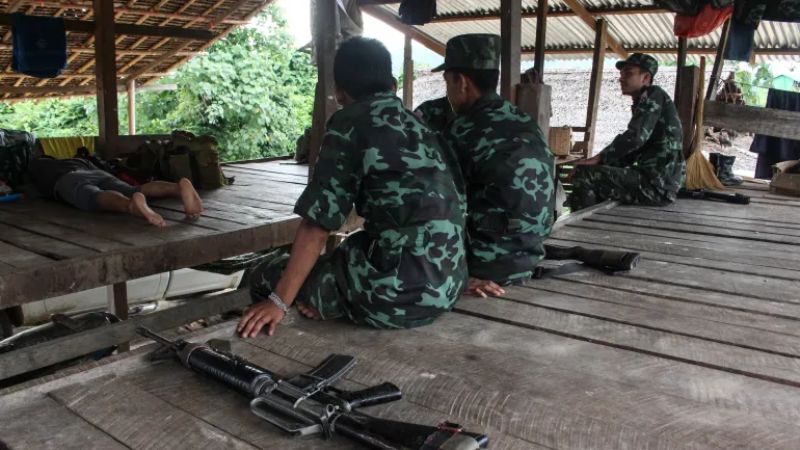
The lush, green hills of Myanmar’s southern Tanintharyi region have long been home to conflict, as the military junta and various armed groups clash over control of the country. In recent years, these confrontations have become even more intense following the military’s coup in February 2021. Among the fighters resisting the junta, a unique battalion has emerged—a group whose distinct religious identity sets them apart in this largely Christian- and Buddhist-dominated conflict.
This group, known as the "Muslim Company," officially forms part of the Karen National Union (KNU), one of Myanmar’s oldest and most prominent ethnic armed organizations. Stationed at key checkpoints, the Muslim Company inspects cars and trucks on roads leading into junta-controlled territories, playing a crucial role in securing access routes and defending Karen villages. Their presence has become increasingly familiar in Tanintharyi, yet their story remains largely untold.
An Unlikely Alliance
The Muslim Company, officially designated as the 3rd Company of Brigade 4 within the KNU, consists of 130 soldiers. Though small compared to the tens of thousands fighting across Myanmar, their contribution is far from insignificant. What makes this unit stand out is its religious identity: in a country where both the KNU and other resistance groups are predominantly led by Christians and Buddhists, the Muslim fighters represent a rare unity across faith lines.
Despite Myanmar’s majority-Buddhist population, and the historical mistrust and discrimination that the Muslim minority often faces, the Muslim Company has found common ground with their Christian and Buddhist comrades in arms. Their fight is not just one of ethnic identity or religious affiliation, but of shared ideals and the mutual goal of establishing a democratic Myanmar free from military oppression.

One of the Muslim Company’s key leaders, who spoke under the condition of anonymity for security reasons, emphasized that their involvement is not just about religion or ethnicity. “We are fighting for freedom and justice for all of Myanmar’s people,” he said. “Our goal is to overthrow the dictatorship and to help create a country where everyone—regardless of race, religion, or background—can live in peace.”
The Role of the KNU
The Karen National Union has been fighting for greater autonomy for the Karen people since 1949, making it one of the longest-standing ethnic armed groups in Myanmar. The group’s roots are deep in the Christian and Buddhist communities of the Karen ethnic group, and over the decades, they have developed a formidable military wing, known as the Karen National Liberation Army (KNLA).
Since the 2021 coup, the KNU has been at the forefront of the armed resistance against Myanmar’s military government. Along with other ethnic armed groups, the KNU has provided sanctuary to protesters and dissidents, while engaging in guerrilla warfare against the junta’s forces.
The decision to incorporate the Muslim Company into the KNU is a testament to the changing dynamics of the resistance. While historical divisions between Myanmar’s ethnic groups and religious communities have often hindered unity, the military junta’s brutal crackdown on civilians has forged new alliances among once-divergent factions.
The Struggle for Democracy
Myanmar’s post-coup landscape is marked by chaos and violence. Since seizing power, the military has violently suppressed protests, imprisoned opposition leaders, and launched indiscriminate attacks on civilian populations. The junta’s aggressive tactics have led to the formation of the People’s Defense Force (PDF), a loose coalition of civilian and ethnic armed groups determined to resist military rule.

The Muslim Company’s involvement in the fight highlights the evolving nature of Myanmar’s resistance movement. Once relegated to the margins, Myanmar’s Muslim minority has found new ways to assert its voice in the country’s political landscape, fighting not only for religious tolerance but for the broader cause of freedom and human rights.
Despite the Karen National Union’s stronghold in certain parts of the country, the battle for democracy remains perilous. The military government retains control of vast swaths of territory, and its forces continue to launch brutal offensives against resistance-held areas. In this struggle, the Muslim Company’s soldiers stand firm, guarding their checkpoints and defending Karen villages alongside their Christian and Buddhist comrades.
Unity in Diversity
The Muslim Company’s presence in Myanmar’s fight for democracy underscores the remarkable and unexpected alliances that have formed since the 2021 coup. Despite the ethnic and religious divides that have long characterized the country, a new narrative is emerging—one where people of different backgrounds are uniting against a common foe.
![Mohammed Yusuf lost his eyesight in a landmine explosion two decades ago but still leads a jungle outpost with young Muslim fighters [Lorcan Lovett/Al Jazeera]](https://www.aljazeera.com/wp-content/uploads/2024/10/8-1729238288.jpg?w=770&resize=770%2C513&quality=80)
One of the Muslim fighters shared his vision for the future of Myanmar: “We are fighting not just for Muslims, but for all people who have suffered under military rule. We believe in a future where every community—whether Karen, Muslim, Buddhist, or Christian—can live together peacefully.”
As Myanmar’s conflict continues, the Muslim Company serves as a powerful symbol of this unity in diversity. While the road to democracy remains fraught with challenges, their fight is a reminder that the struggle for freedom transcends religious and ethnic boundaries. Their hope is that one day, Myanmar will be a nation where all people, regardless of faith or ethnicity, can live in peace.
BOB Post
Source : Al Jazeera