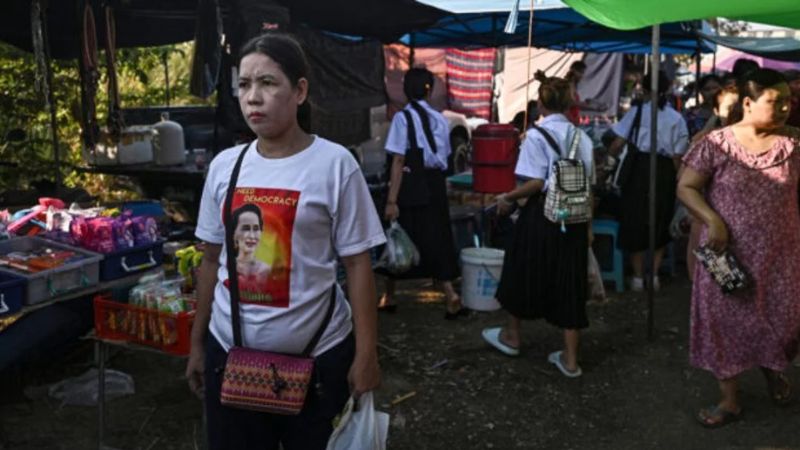
More than a million people fleeing Myanmar’s brutal civil war have sought refuge in Thailand, but rising anti-migrant sentiment, fuelled by disinformation, is making life increasingly difficult for them.
False claims that Myanmar migrant workers are demanding a daily minimum wage of 700 baht ($21) – nearly double the Thai minimum wage – have spread rapidly on social media, triggering backlash and reinforcing nationalist ideologies. One widely circulated post was even shared by former Thai intelligence official Nantiwat Samart, further amplifying the misinformation.
“The clip claiming that Myanmar workers are demanding 700 baht is a fabrication,” said Linn, a 37-year-old factory worker who has been in Thailand for 17 years. He, like many others, still earns the official minimum wage of 400 baht per day.
Historical Resentment Fuelling Xenophobia
Thailand and Myanmar share cultural and religious ties, but centuries of warfare have left a historical imprint that some authorities are exploiting to fuel nationalist fervor.
Thailand was invaded by Burmese forces in the 16th century, culminating in the 1767 destruction of Ayutthaya, the former Siamese capital. This history has led to a long-standing perception that Myanmar workers are ‘stealing’ Thai jobs, a fear that has been exacerbated by the increasing number of migrants arriving since Myanmar’s 2021 military coup.
Myanmar labour rights expert Hnin Wut Yee argues that these historical references are being weaponized.
“Referring to history or warning against foreign invasions can trigger the nationalist mindset or sustain a sense of togetherness in defence of external enemies,” she said.
Growing Migrant Numbers and Social Media Disinformation
According to Thailand’s Foreign Workers Administration Office, the number of registered Myanmar migrant workers has risen from 1.5 million in 2020 to 2.3 million in 2024. Additionally, the International Organization for Migration (IOM) estimates that 1.8 million others are working illegally, leaving them without legal protection or social benefits.
Amid this surge, misinformation campaigns on social media have led to increased hate speech. Historian and security adviser Lalita Hanwong describe it as a “coordinated campaign designed to curb the number of Burmese in Thailand” by portraying them as national security threats.
AFP fact-checkers debunked viral videos purportedly showing Myanmar workers protesting for a 700-baht wage. One widely shared clip was actually of a migrant protesting against high visa and work permit fees.
“I don’t want someone to take advantage by manipulating my video,” the migrant told AFP, requesting anonymity due to fears for their job and safety.
Decades of Prejudice
Despite their hard work in low-paying, difficult, and often dangerous jobs that many Thais avoid, Myanmar migrants continue to face discrimination.
“Some Thais really like us because of our diligence and loyalty to employers,” said Cho, a 40-year-old garment worker in Bangkok. “But at the same time, some may perceive us negatively, as if we are taking their jobs.”
As Thailand grapples with economic challenges and rising job insecurity, the spread of misinformation threatens to deepen divisions and further marginalize Myanmar migrants. Without intervention to counter xenophobic narratives, experts warn that tensions could escalate, making an already difficult situation even worse for those seeking safety and stability in Thailand.
BOB Post