Following the fall of Prime Minister Sheikh Hasina’s government in Bangladesh on August 5 through a mass uprising, India has been forced to rethink its strategic posture in the region. For decades, India relied on the Awami League as a trusted partner, securing vital trade and transit routes through Bangladesh, especially via the Chittagong port under a bilateral agreement signed in 2018. However, with Hasina gone and the interim government in Dhaka offering no guarantees of continued favor, New Delhi is hedging its bets—this time with the controversial Arakan Army (AA) in Myanmar.
This pivot underscores a stark shift in India’s foreign policy—one that appears increasingly driven by expedience rather than principle. For years after Myanmar's 2021 military coup, India maintained a cautious but pragmatic relationship with the junta, betting on their ability to secure border areas and suppress insurgent groups, including anti-India militants hiding in Myanmar’s western frontiers. But that bet has spectacularly failed.
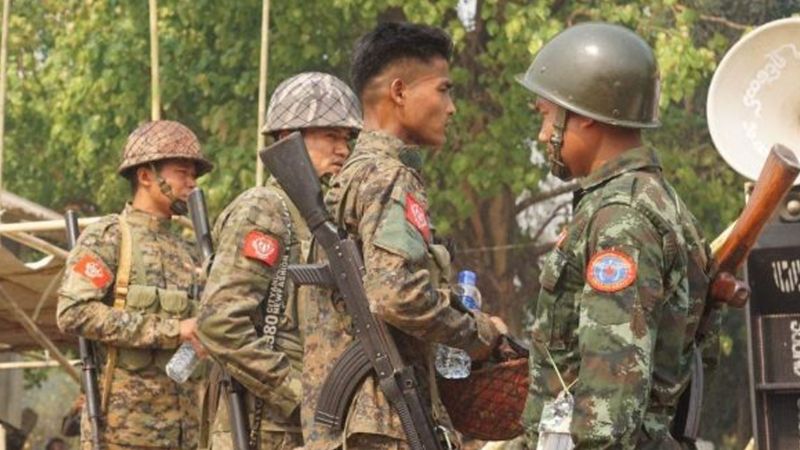
Despite the junta’s rapid loss of control across vast swathes of territory—including almost the entire India–Myanmar border region—New Delhi hesitated to revise its Myanmar policy. The military regime in Naypyidaw has been steadily losing ground to a growing coalition of ethnic armed organizations and pro-democracy forces. One of the most powerful among them, the Arakan Army, now exercises de facto control over large parts of Rakhine State, including areas critical to India’s long-ambitious Kaladan Multi-Modal Transit Transport Project (KMTTP).
This project, key to India’s “Act East” policy, aims to connect the landlocked northeastern states with the Bay of Bengal via a sea-river-road route, bypassing the narrow Siliguri Corridor. But with Naypyidaw no longer controlling these regions, India has begun quietly engaging with those who do—the very rebels it once viewed with suspicion.
According to the latest report from the International Crisis Group, Indian intelligence and government officials have held multiple covert meetings with senior AA representatives since August 2024. In one instance, the Deputy Commissioner of Lawngtlai District in Mizoram reportedly crossed into Myanmar’s Paletwa Township, inspecting Kaladan’s progress directly under AA control.
Furthermore, senior AA leaders held high-level meetings in Aizawl with Mizoram’s Chief Minister and other top officials—meetings greenlit by New Delhi. Even India's Ministry of External Affairs (MEA) appears to be involved, having invited AA representatives and other ethnic rebel groups like the Chin and Kachin factions to a confidential seminar in Delhi in November 2024. Organized by the government-affiliated Indian Council of World Affairs, the event marked India’s first formal outreach to Myanmar’s opposition militias.
The shift marks a dramatic departure from India’s former policy of strategic silence. Throughout 2021–2023, as Western nations imposed sanctions and condemned the junta, India remained publicly noncommittal, justifying engagement as necessary for border security and economic projects. Yet, this new engagement with the Arakan Army suggests that Delhi is finally acknowledging the reality on the ground—and the junta’s diminishing relevance.
However, the manner in which this pivot is being executed raises serious concerns. India’s sudden warmth toward armed insurgents—some of whom were, until recently, considered a threat to Indian security—smacks of geopolitical opportunism. Worse, this clandestine diplomacy bypasses transparency and democratic accountability, both within India and among its regional partners.
The fall of Hasina’s government was a critical inflection point. With the Chittagong port access now uncertain, India’s fears of losing strategic leverage in the Bay of Bengal have intensified. While the Kaladan project had previously receded in importance due to access through Bangladesh, New Delhi’s renewed investment in it underscores a deeper anxiety: Can India trust any future Bangladeshi government?
Rather than building regional consensus or supporting democratic transitions, India has chosen to align with non-state actors and fragmented insurgent movements in Myanmar—many of whom are also receiving support from China. This triangular entanglement—India, China, and Myanmar’s rebels—could ignite unpredictable conflicts in an already volatile region.
India’s pivot to the Arakan Army may offer short-term strategic benefits, such as securing Kaladan and asserting regional dominance. But it also threatens to backfire in multiple ways. By tacitly legitimizing armed militias, India risks undermining its long-held principle of non-interference and state sovereignty, especially dangerous in a region with numerous insurgencies of its own.
Moreover, this approach could alienate both the Myanmar civilian resistance and India’s traditional allies in ASEAN, who have called for a peaceful and inclusive resolution to the crisis. It may also raise eyebrows among Western powers, who still view the Arakan Army with suspicion, particularly in light of past allegations of human rights abuses.
India’s Myanmar policy after the fall of the Hasina regime reveals a troubling willingness to sacrifice ethical diplomacy for strategic expediency. Engaging with the Arakan Army may seem like a logical move in the face of regional uncertainty, but it is a high-risk gamble that could destabilize both India’s northeastern frontier and its broader standing in Asia.
As the region grapples with fast-changing alliances and power vacuums, India’s next steps will define whether it remains a stabilizing force—or succumbs to the temptations of realpolitik at the cost of long-term peace and credibility.
BOB Post