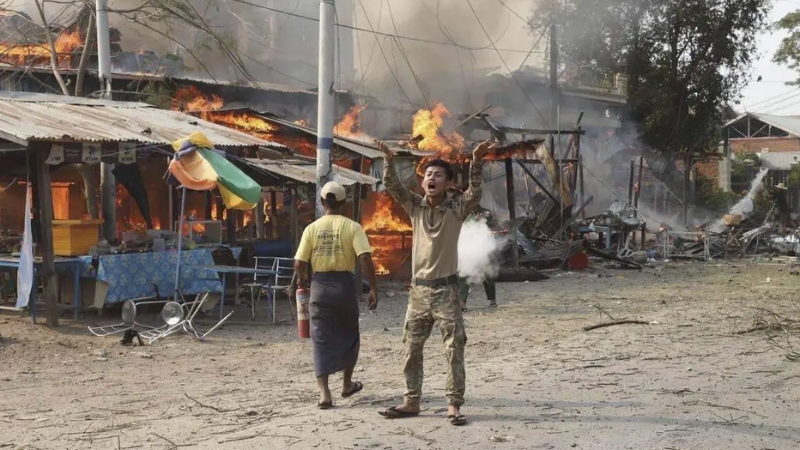
A brutal airstrike by Myanmar’s military has claimed the lives of at least 27 civilians and injured 30 others in a central village controlled by resistance forces, marking yet another escalation in the country’s deepening crisis. The attack, which targeted the crowded market area of Let Pan Hla village in Singu township, occurred at approximately 3 p.m. on Friday, according to opposition sources and Myanmar’s independent online media.
A spokesperson for the Mandalay People’s Defense Force (MDY-PDF), an armed opposition group, confirmed that the victims included six children. The group asserted that the strike deliberately targeted civilians rather than military objectives, further exposing the Myanmar military’s brutal tactics in suppressing resistance.
“This airstrike was not aimed at a military target, but rather at the market area, where civilians visit daily,” said MDY-PDF spokesperson Osmond in a message to the Associated Press. The attack reportedly destroyed ten houses near the village market, where many had gathered at the time of the bombing. Reports from independent news outlet Myanmar Now suggested that the death toll had climbed to 30, with seven individuals in critical condition. The military has yet to issue a statement regarding the attack.
Myanmar’s Deepening Crisis and Anti-Democracy Repression
Myanmar has remained in a state of turmoil since the military overthrew the elected government of Aung San Suu Kyi on February 1, 2021, igniting nationwide resistance. The coup was met with mass demonstrations, but peaceful protests were brutally suppressed by security forces. In response, pro-democracy activists and ethnic armed groups formed resistance forces, leading to widespread armed conflict across the country.
The military regime, led by General Min Aung Hlaing, has increasingly relied on airstrikes as a means of countering resistance fighters, who lack air defense capabilities. According to a report by the Myanmar-based research organization Nyan Lynn Thit Analytica, military airstrikes have killed 2,224 civilians and injured 3,466 since the coup, with a staggering 4,157 air raids documented.
Singu township, where Friday’s deadly strike occurred, had been seized by the MDY-PDF in July last year as part of the opposition’s ongoing campaign against the junta. Despite the resistance’s gains in several regions, the military has intensified its use of indiscriminate attacks on civilian areas, allegedly aiming to weaken popular support for opposition groups.
With internet and cellphone services frequently cut in conflict zones, verifying casualties and conditions on the ground remains difficult. However, reports from independent journalists and advocacy groups consistently highlight the junta’s strategy of targeting civilian infrastructure, including schools, hospitals, and markets.
Uncertainty and a Nation in Crisis
Myanmar’s political landscape has become increasingly unstable, with no clear resolution in sight. The international community has largely condemned the military’s actions, but concrete measures to halt the violence remain limited. Sanctions imposed by Western nations have failed to deter the junta, which continues to receive military and economic support from allied countries, including Russia and China.
Meanwhile, millions of civilians are caught in the crossfire, suffering from ongoing violence, displacement, and economic collapse. The military’s relentless crackdown on dissent and its use of airstrikes against civilian areas reflect the deepening repression in a country that once aspired to democratic rule.
As Myanmar plunges further into uncertainty, the question remains: How much longer will the people of Myanmar endure this cycle of violence and oppression before meaningful international intervention forces the junta to relinquish its grip on power?
BOB Post