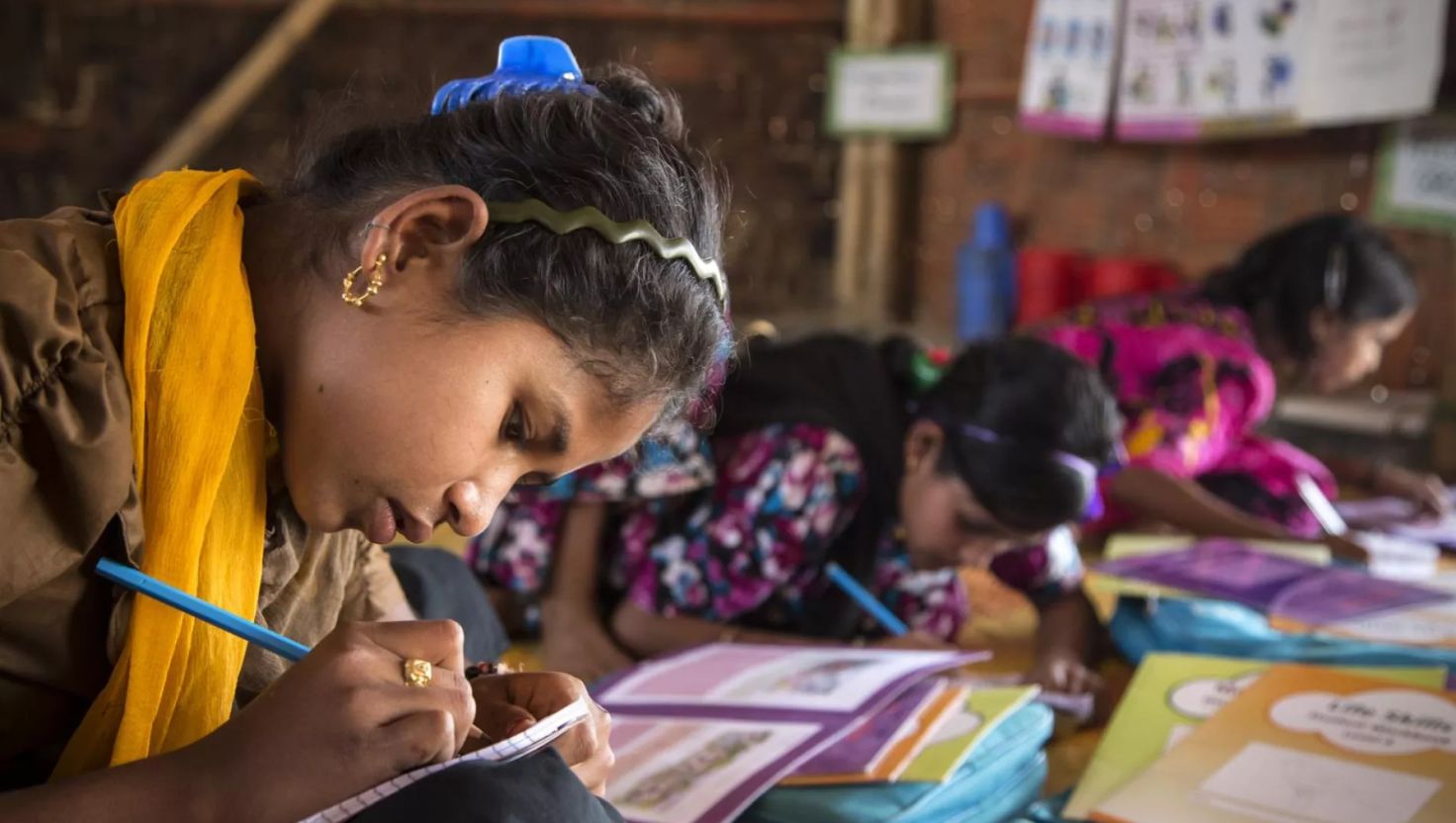
Thousands of Rohingya refugee children are being denied access to education after the United Nations children's agency, UNICEF, was forced to suspend its learning centers in Bangladesh’s camps due to a major funding shortfall, largely triggered by recent U.S. aid cuts.
With over 437,000 school-aged Rohingya children living in camps across Cox’s Bazar, the world’s largest refugee settlement, the closure of these centers has deepened an already dire education crisis. The Rohingya, a persecuted Muslim minority from Myanmar’s Rakhine State, have sought refuge in Bangladesh for decades—most notably in 2017, when more than 700,000 fled a brutal military crackdown described by the UN as “a textbook example of ethnic cleansing.”
Currently, more than 1.3 million Rohingya are confined to 33 camps in southeastern Bangladesh, surviving almost entirely on humanitarian aid. But earlier this year, the U.S.—previously the largest donor, contributing $300 million in 2024 alone—halted aid globally, further exacerbating conditions for the refugees.
Human Rights Watch (HRW), in a report this week, warned that these funding cuts have “worsened the already existing education crisis.” In the absence of UNICEF-run centers, community-led schools—established and operated by the Rohingya themselves—have become the only source of learning for many children.
One such student, 15-year-old Mohammed Shofik, told Arab News that education is his only hope. “It gives me knowledge, enhances my life skills, and makes me think for my community,” he said. “As a refugee, I don’t have many opportunities, but education can open doors.”
However, these community schools operate with little to no support. “We are not funded by any NGOs or donors. We rely solely on tuition fees from the students’ families,” said Arif Salam, a teacher in one of the camps. “Only a small number of children can afford this, while the majority—those who depended on UNICEF—are now sitting idle. This will cause irreversible damage to their future.”
About 150 such schools exist in the camps, typically with 10 to 15 teachers serving 150 to 400 students each. Monthly tuition fees range from $0.50 to $6.50, a cost many families cannot bear, as the Rohingya are prohibited from working legally in Bangladesh.
Education experts and rights groups are urging the Bangladeshi government to step in. Migration and refugee specialist Asif Munir said informal education must be encouraged as a "coping strategy" to prevent children from falling into risky or exploitative work.
HRW has also called on the government to recognize and fund community schools to expand access and attract international support.
For students like Rohul Amin, a 10th-grader with aspirations to become a motivational speaker, school is not just about lessons—it’s about self-worth and identity. “History makes me understand who we are,” he said. “As a Rohingya, I have no identity. But I try to remember our land and our story.”
With their future hanging in the balance, education remains the last glimmer of hope for the Rohingya youth in exile.
BOB Post