Myanmar is emerging as a focal point in Asia's strategic connectivity race, with China, Russia and India simultaneously advancing major transport and energy projects that could reshape regional trade despite the country's ongoing civil conflict.
Myanmar government has intensified efforts to revive long-delayed infrastructure initiatives, viewing the projects as critical to transforming Myanmar into a regional logistics hub linking East Asia, South Asia and the Indian Ocean.
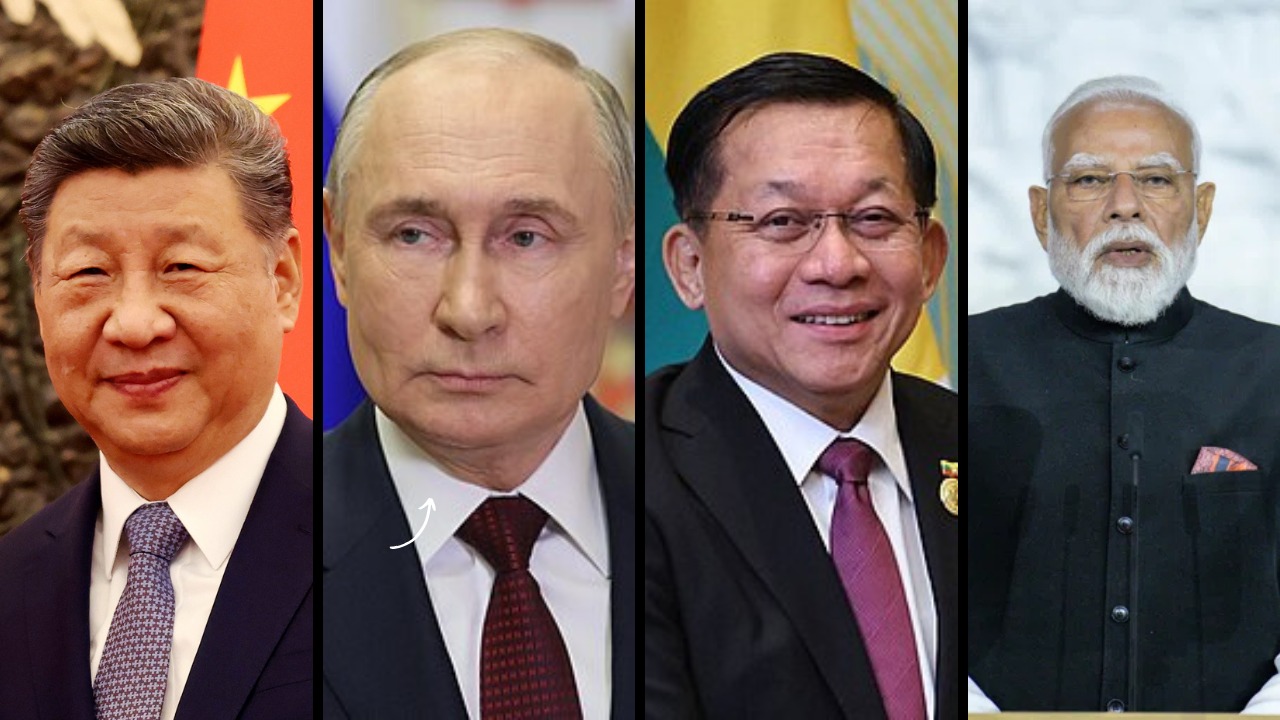
China has moved to accelerate the China-Myanmar Economic Corridor (CMEC), following recent talks between Myanmar president Min Aung Hlaing and Chinese President Xi Jinping in Beijing. The two sides agreed to speed up construction of the corridor, a flagship Belt and Road Initiative project that will connect China's Yunnan Province with the deep-sea port of Kyaukphyu on Myanmar's western coast.
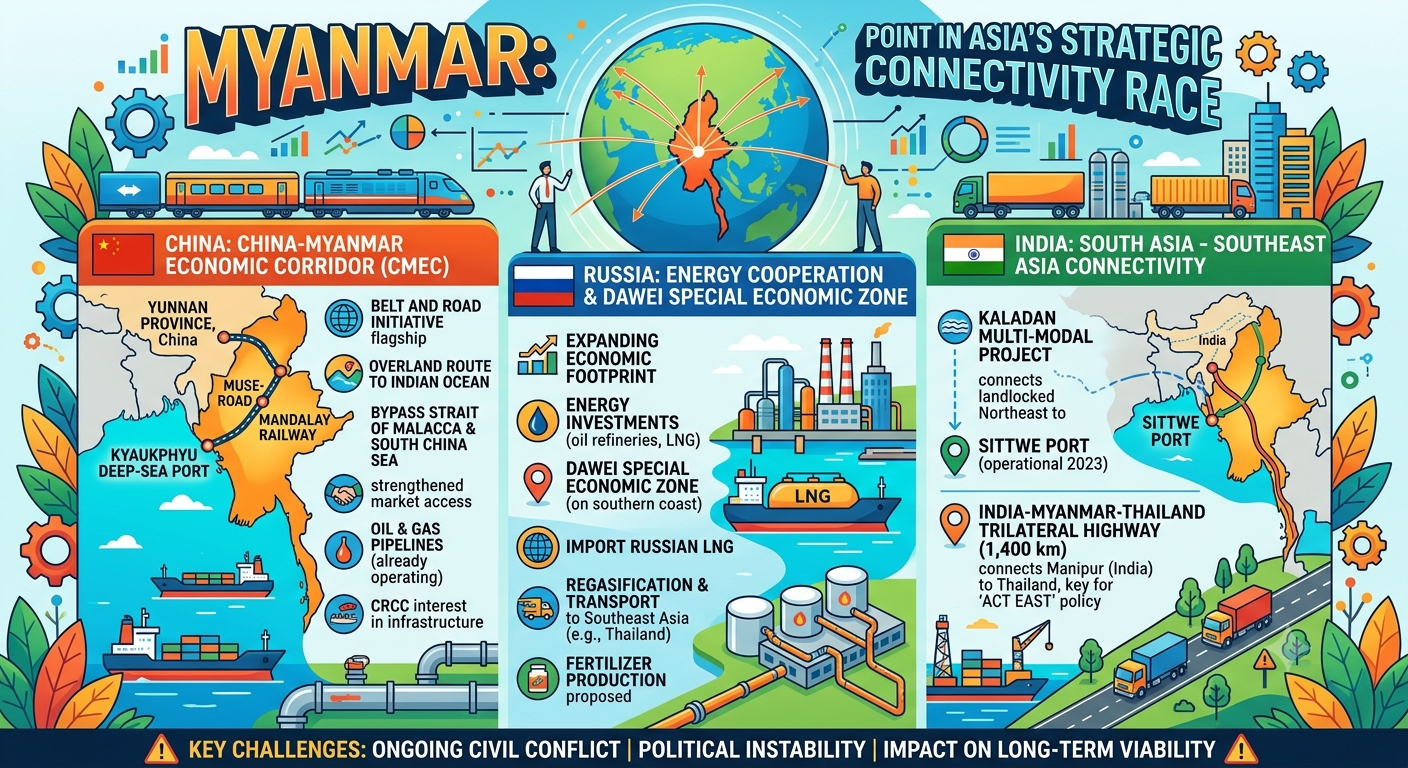
During the visit, China Railway Construction Corp. (CRCC) Chairman Dai Hegen expressed the company's interest in participating in the development of Myanmar's railway and road network. Myanmar officials have since indicated that construction of the long-delayed Muse-Mandalay railway is expected to begin soon, eventually extending to the strategic port of Kyaukphyu.
According to Nikkei Asia, the China-backed corridor is designed to provide Beijing with a direct overland route to the Indian Ocean, allowing Chinese trade and energy imports to bypass the congested Strait of Malacca and the disputed South China Sea. The publication noted that once rail, road and port infrastructure are completed, the route could significantly strengthen China's access to markets in South Asia, the Middle East and Africa.
China has already secured an important foothold through oil and natural gas pipelines running from Kyaukphyu into Yunnan Province, while construction preparations for the Chinese-backed deep-sea port continue despite ongoing instability in Myanmar's Rakhine State.
Russia is also expanding its economic footprint in Myanmar through large-scale energy cooperation. In June, Russian power company Inter RAO signed a memorandum of understanding with a Myanmar partner to cooperate in electricity generation, following a broader framework agreement reached earlier this year covering oil refineries, liquefied natural gas (LNG) infrastructure and other energy investments.
The centerpiece of Moscow's plans is the Dawei Special Economic Zone on Myanmar's southern coast. Originally promoted by Japan and Thailand, the project stalled due to financing and implementation challenges. Myanmar has now turned to Russia as a key development partner.
Russian and Myanmar officials have discussed plans to import Russian LNG into Dawei, regasify it, and transport the fuel through pipelines to neighboring Southeast Asian countries, particularly Thailand. Fertilizer production facilities have also been proposed as part of the broader industrial development strategy.
For Russia, which continues to face Western sanctions on its energy exports, Myanmar offers an opportunity to expand into Southeast Asian markets, while Myanmar sees Russia as an alternative long-term energy partner.
India, meanwhile, is pressing ahead with two flagship connectivity initiatives aimed at improving access between South Asia and Southeast Asia. During recent bilateral discussions, New Delhi and Naypyidaw reaffirmed their commitment to completing the Kaladan Multi-Modal Transit Transport Project and the India-Myanmar-Thailand Trilateral Highway.
The Kaladan project integrates sea, river and road transport to connect India's landlocked northeastern states with Myanmar's Sittwe Port, which became operational in 2023. The trilateral highway, stretching approximately 1,400 kilometers from India's Manipur state to Thailand, remains incomplete, with around 120 kilometers in Myanmar still under construction with Indian support.
The highway forms a key pillar of Prime Minister Narendra Modi's Act East policy, which seeks to deepen India's economic integration with Southeast Asia through enhanced regional connectivity.
Despite growing international interest, progress on many of Myanmar's infrastructure projects continues to be constrained by the country's armed conflict following the 2021 military takeover. While China's mediation has contributed to reducing hostilities in some northern border areas, fighting persists across several regions, particularly in western Myanmar, creating uncertainty over the implementation and long-term viability of these ambitious projects.
Taken together, the parallel investments by China, Russia and India underscore Myanmar's increasing geopolitical significance as competing regional powers seek alternative trade routes, diversify energy supply chains and strengthen strategic influence across the Indo-Pacific.
BOB Post