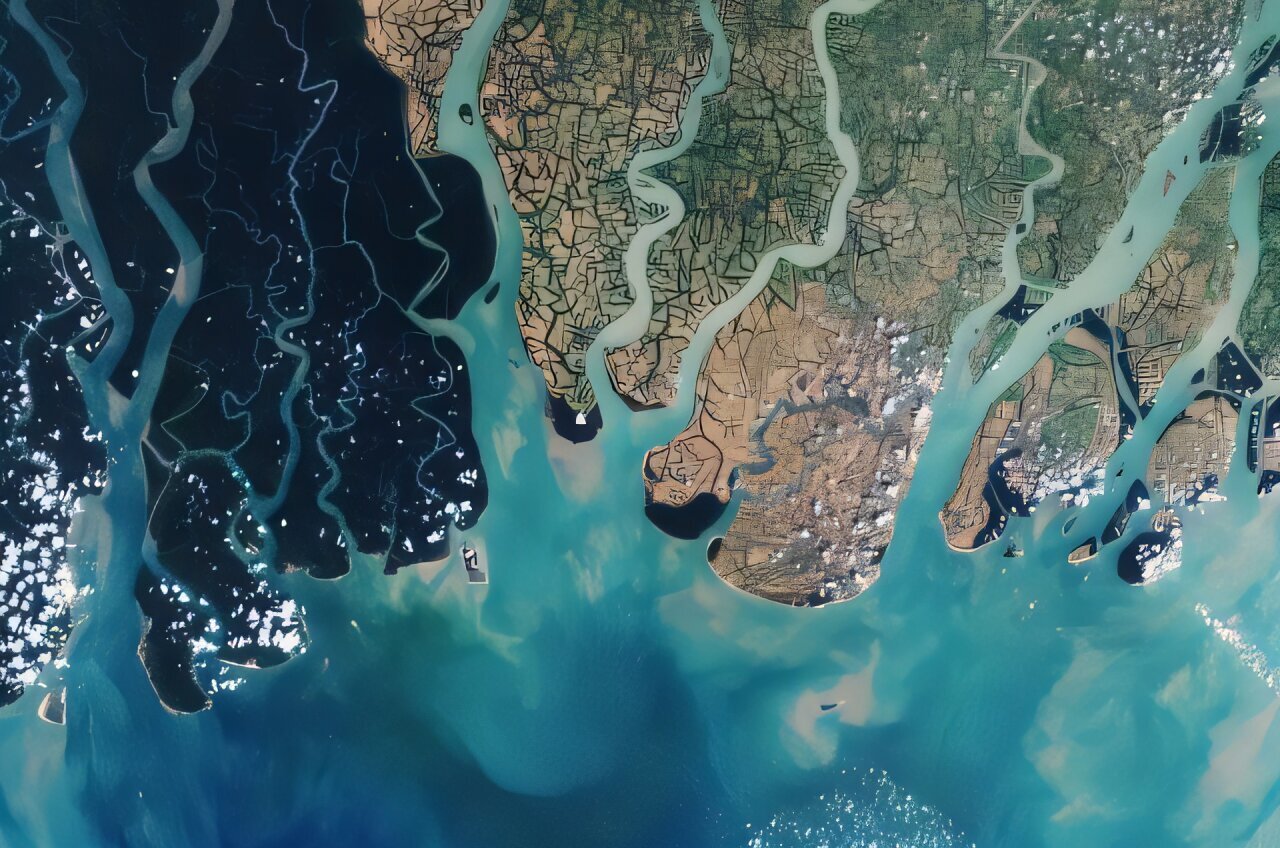
A delta is often imagined as land that is fixed, owned, settled. In reality, a delta is a process. It is neither fully land nor fully sea, but a continuous negotiation between water, sediment and time. Few places illustrate this more clearly than the Bengal Delta, where the ground beneath millions of people is not ancient bedrock but material still in motion, delivered grain by grain from the Himalayas. Understanding this simple but unsettling idea is essential to grasp both the delta’s past and its uncertain future.
The Bengal Delta exists because sediment moves more slowly than water. During the monsoon, Himalayan meltwater and rain can reach the Bay of Bengal in days, but the sediment it carries may take centuries or never arrive at all. Some of it settles on floodplains, some builds coastal land, and about 15 percent travels far offshore to form the Bengal Fan, the world’s largest submarine fan stretching nearly 3,000 kilometres into the Indian Ocean. This deep-sea archive, formed over more than 20 million years, marks the geological birth of the delta on which today’s Padma River flows.

The story begins much earlier. Around 140 million years ago, the supercontinent Gondwana fractured, sending the Indian tectonic plate drifting north. As it collided with Eurasia roughly 50 million years ago, the Himalayas and Tibetan Plateau rose, intensifying the monsoon system. That climatic engine powered vast rivers—the Ganges, Brahmaputra and Meghna capable of transporting extraordinary volumes of sediment. The rise of the Himalayas was not just the creation of mountains; it was the trigger that made the Bengal Delta possible.
River paths across the subcontinent were never fixed. Geological evidence suggests the Ganges once flowed westward into the Arabian Sea before tectonic barriers redirected it east during the Miocene Epoch. The uplift of landforms such as the Rajmahal Hills and the Shillong Plateau further reshaped drainage routes, guiding ancient versions of the Ganges–Padma and Brahmaputra into the Bengal Basin. There, sediment accumulated relentlessly, building a delta more than 100,000 square kilometers in area and up to 20 kilometers thick in places.

Ice ages added another layer of complexity. Over the last three million years, repeated cycles of glacial advance and retreat caused dramatic sea-level fluctuations. When seas fell, rivers cut deep channels and delivered sediment directly to the ocean. When seas rose, flooding spread sediment across the land, expanding the delta. Since the last glacial maximum about 18,000 years ago, sea level has risen roughly 120 meters, and the modern Bengal Delta emerged around 7,000 years ago.
This history explains a paradox at the heart of delta dynamics: rising seas are not always an enemy. Deltas survive by remaining close to sea level. Flooding allows rivers to deposit sediment that offsets land subsidence caused by compaction and tectonic movement. When land rises too high, flooding stops; when it sinks, new sediment arrives. The system works only through constant adjustment.
Today, that balance is under strain. Global sea level is rising at more than four millimeters per year, with acceleration expected as climate change intensifies. Some projections suggest up to one meter of rise by 2100. Long-term models indicate that a two- to three-meter rise could submerge around 14 percent of Bangladesh’s land area, though estimates differ. Yet recent observations complicate these forecasts. In parts of the Padma-Meghna estuary, sediment accretion has accelerated to 10–20 square kilometers per year, far exceeding historical averages.
Extreme events reveal why. After Cyclone Aila in 2009, breached embankments allowed tidal waters to spread freely, depositing tens of centimeters of sediment in a single season equivalent to decades of normal accumulation. Studies suggest that where rivers and tides interact naturally, vertical sediment buildup may keep pace with moderate sea-level rise, even accounting for land subsidence.
Still, skepticism remains strong. Upstream dams, river training works and embankments restrict sediment flow, while subsidence and accelerating sea-level rise threaten to outstrip natural deposition. Scientists stress the need for better, long-term data on sediment transport, river behavior, and ground movement to refine predictions. The delta’s response, they argue, will not be uniform; some areas may grow while others decline.
One emerging consensus is that human control of water has altered the delta’s basic functioning. Embankments and polders have reduced flooding and protected agriculture, but they have also blocked sediment from reaching the land. In doing so, they may have traded short-term security for long-term vulnerability. Carefully managed reconnection of rivers to floodplains is increasingly discussed as a way to restore sediment pathways without exposing communities to uncontrolled risk.
The Bengal Delta has never been stable, and stability was never its strength. It has survived continental collisions, ice ages and shifting seas by remaining adaptable. The challenge now is not how to freeze the delta in place, but how to live with a landscape that must move in order to endure. The future of the delta may depend less on resisting water, and more on accepting sediment as the true foundation beneath our feet.
BOB Post