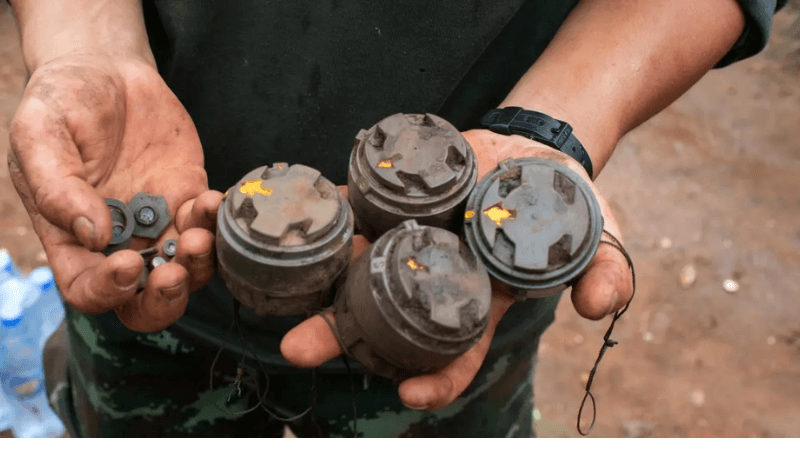
A rising tide of landmine terror, largely attributed to the non-state Arakan Army (AA), is creating a severe humanitarian and security crisis along the Bangladesh-Myanmar border. The indiscriminate use of these banned weapons has inflicted a growing toll on Bangladeshi civilians, Rohingya refugees, and has now escalated to a direct attack on Bangladeshi military personnel, challenging the nation's sovereignty.
With the Arakan Army having seized control of the entire 271-kilometre border from the Myanmar junta, Bangladeshi officials report a significant shift in the threat.

"In the past, landmines were laid by Myanmar border guards," stated Lt Col SKM Kafil Uddin Kayes, commander of the 11 BGB Battalion. "Now, it's Arakan Army."
This escalating threat culminated in a flagrant assault on Bangladeshi territory on October 12. A member of the Border Guard Bangladesh (BGB), Nayek Akhter Hossain, was severely injured in a landmine explosion while on patrol inside Bangladesh.
The incident occurred in the Khasthund Circle area of Naikhongchhari, Bandarban, near Border Post No. 41. The blast, which caused severe injuries to Hossain's right ankle and left leg, was confirmed by Lt. Col. SM Khairul Alam of the 34th BGB. Security sources report the device was deliberately planted to target patrol teams, calling it a direct "threat to border peace and security."

A Brutal Toll on Civilians
The attack on a uniformed officer is the most recent in a string of tragic incidents. According to BGB data, in the first six months of this year alone, at least 17 Bangladeshis and one Rohingya were wounded in landmine explosions along the border.
These casualties are often impoverished villagers. On July 13, Mohammad Hosain from Ukhiya's Patabari village lost his leg after stepping on a mine while collecting bamboo in the border forests.

The mines also serve as a brutal barrier for Rohingya refugees. Nur Kaida, a 23-year-old woman, lost her right leg in a blast in February while attempting to return to her home in Maungdaw, Rakhine State. "I have become a burden," she said from a refugee camp in Teknaf. "Landmines were laid around many houses after we fled... Now, people are too afraid to go back."
A Calculated Strategy of Control
This wave of violence has contributed to Myanmar becoming the world's deadliest country for landmine casualties, as per the Landmine Monitor 2024, with 1,003 civilian deaths and injuries in 2023.
Analysts and BGB officials believe the AA is planting these mines for two main reasons:
To Prevent Return, the mines, often placed around abandoned homes, are seen as a deliberate tactic to prevent the return of the more than one million displaced Rohingyas sheltering in Bangladesh.
To Control Trade, an official from the Armed Police Battalion (APBN) noted that the "Arakan Army controls many of the routes and landmines are planted to deter movement outside those," allowing the group to manage and extort informal trade.
The use of antipersonnel mines is a violation of the Ottawa Treaty, to which Myanmar is not a signatory. With the border now controlled by the non-state AA, coordination to address the threat has become exceptionally difficult for Bangladesh.
While local authorities are working to raise awareness, the attack on Nayek Akhter Hossain demonstrates that awareness alone is insufficient to counter what has become an absolute and unacceptable threat to Bangladesh's territorial integrity.
BOB Post