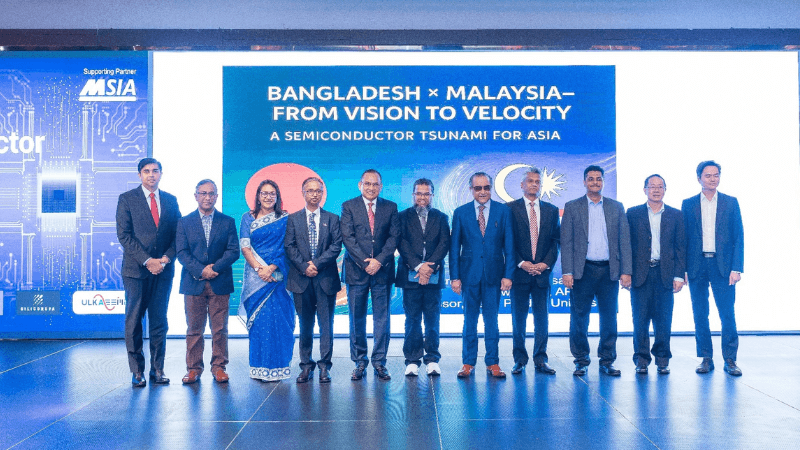
The Bangladesh Semiconductor Industry Association (BSIA) has successfully concluded a three-day "Malaysia Semiconductor Roadshow" in Penang, running from November 11-13, 2025. The initiative aimed to showcase Bangladesh as a rising partner in the global semiconductor supply chain and explore the potential for a "South-South Silicon Corridor" between the two nations.
A reception was held at a hotel here on November 11 to mark the event, bringing together senior figures from Malaysian industry and government. Notable attendees included leaders from the Malaysia Semiconductor Industry Association (MSIA), the Malaysia Investment Development Authority (MIDA), Penang’s Deputy Chief Minister II, YB En Jagdeep Singh Deo, and the High Commissioner and Deputy High Commissioner of Bangladesh to Malaysia.

Speaking at the reception, YB En Jagdeep Singh Deo welcomed the Bangladeshi delegation, noting that BSIA member companies are entering a well-established ecosystem, as many global tech companies already operate in Penang. He expressed optimism for expanded cooperation in the semiconductor sector in the future.
Bangladesh’s High Commissioner to Malaysia, Manjurul Karim Khan Chowdhury, urged Penang-based semiconductor firms to explore deeper partnerships. He highlighted Bangladesh's significant advantage: a large pool of young, talented professionals contributing to advanced semiconductor research, design, and innovation, both domestically and globally.
Throughout the roadshow, the BSIA delegation engaged in high-level meetings and visited several key Malaysian semiconductor organisations, including Rapid Manufacturing, Infinecs Corporation, TF-AMD, Micro Modular System, Aemulus Corporation, YBS International, and the Penang Skills Development Centre (PSDC).
BSIA President Mohammed Abdul Jabbar emphasized Bangladesh's growing role, stating the country is shifting from "observation to participation" in the global semiconductor landscape. This sentiment was echoed by academic and industry leaders. Prof Muhammad Mustafa Hussain of Purdue University declared, "The Silicon River is our shared future. We will knock on every company’s door and build the foundations of a South-South Silicon Corridor." According to Financial Express news, Prof. Hussain concluded, "This is only the beginning... We should aim so high that we can never fully reach it, but in trying, we will travel farther than anyone thought possible."
Dr Shatil Haque, AVP of Credo Semiconductor, added that the roadshow signifies "the beginning of a new regional alliance," moving from intention to implementation and from conversations to co-creation.
The delegation also included senior officials from Neural Semiconductor, ULKASEMI, Prime Silicon, SILICONOVA, Cactus Materials, and iTest Bangladesh. The event has successfully opened new pathways for collaboration in chip design, packaging, test engineering, automation, and workforce development.
BOB Post