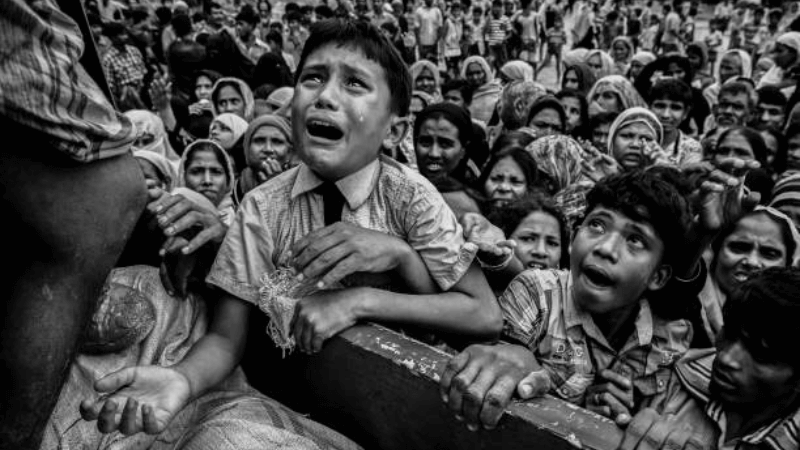
For the Rohingya community, August 5 is no longer just another date,it has become a new symbol of genocide, etched into collective memory as a day of systematic slaughter, terror, and erasure. On this day in 2024, brutal drone strikes and coordinated attacks by the Arakan Army (AA) killed hundreds of Rohingya civilians in Myanmar’s Rakhine State, pushing thousands more into displacement, poverty, and grief.
Widely known for its role in the ongoing civil war against the Myanmar military, the Arakan Army has increasingly turned its firepower against Rohingya communities, echoing the tactics once used by the junta itself. Survivors and human rights defenders now assert that the AA is not liberating Rakhine—it is replacing one genocidal force with another.
“The events of August 5 were worse than 2017. The AA struck fleeing civilians with drones, leaving lifeless bodies floating in the Naf River. This must be remembered as the Naf River Massacre Day,” said Khin Maung Thein, a Rohingya storyteller and photographer, who documented the aftermath.

According to local testimonies and rights groups, between April and August 2024, the AA forcibly displaced more than 100,000 Rohingya, burned down 48 villages in Buthidaung, and blocked life-saving humanitarian aid. On August 5 alone, drone and artillery attacks in Maungdaw reportedly killed at least 200 people.
“I pulled the bodies of children out of the river. Their only crime was being Rohingya,” said Md Younus Arman, a human rights activist working along the border.
These targeted attacks backed by communication blackouts and enforced media silence have alarmed genocide monitors. Rohingya civilians report being trapped between Myanmar military airstrikes and the Arakan Army’s ultimatums. One message from the AA, according to eyewitnesses, read: “Leave your villages or we will kill you.”
“The Myanmar military struck our villages while the Arakan Army threatened to wipe us out. This is a coordinated extermination,” said Osman, a survivor now sheltering in Bangladesh.

Reports also indicate a disturbing rise in forced economic extortion. In April 2024 alone, over $635,000 was reportedly extracted from Rohingya families through threats of violence, eviction, and execution. Fishing boats, livestock, and even burial land have been seized by AA forces under the pretext of “security taxes.”
Meanwhile, satellite imagery and field intelligence confirm that the AA has begun relocating Rakhine and Marma settlers into razed Rohingya villages such as Burashikdar Para, Rabaillah, and Minga Lar. In Thaie Chaung, mosques and homes were destroyed on February 25, 2025, suggesting a deliberate campaign of cultural erasure and demographic engineering.
“This is not a conflict,it is ethnic cleansing,” said Ro Habib Arkani, a human rights defender. “The AA is copying the military’s playbook, using brutality, disinformation, and forced resettlement to erase the Rohingya.”
Humanitarian sources have confirmed that over 6,000 Rohingya were abducted or disappeared in 2024. Many were tortured or killed when ransoms could not be paid. Women and girls remain particularly vulnerable, facing rape, slavery, and systematic exploitation in territories now controlled by the AA.
Despite the horror, survivors continue to speak out. Many now view August 5 as a day of remembrance and resistance a new Black Day that must be internationally recognized.
“We need the world to know: this is not history repeating itself. This is the same genocide continuing with new actors and new weapons,” said a youth leader from the Rohingya FDMN Representative Committee.
While the international spotlight remains focused on Myanmar’s broader civil war, activists warn that ignoring the atrocities against the Rohingya enables a second genocide to unfold one that is slower, but no less deadly.
The international community, including the UN, ASEAN, and global powers, faces mounting pressure to hold the Arakan Army accountable, ensure humanitarian access, and guarantee the protection of the Rohingya as an ethnic and religious minority.
“The silence is deafening. How many massacres must happen before the world acts?” asked Younus Arman.
As Rohingya communities commemorate the victims of August 5, 2024, the call is clear: justice delayed is justice denied. Without immediate international intervention, the Rohingya risk being erased not just from maps, but from memory.
BOB Post