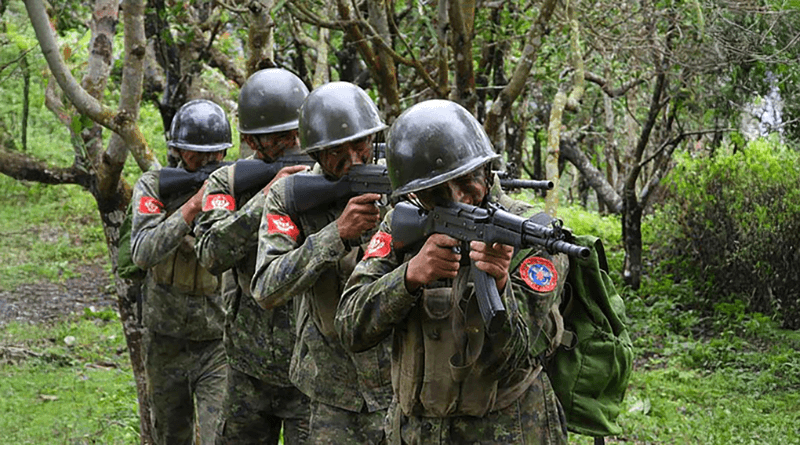
The Arakan Army (AA) has launched a new wave of extortion against Rohingya communities in Maungdaw Township, imposing monthly "building taxes" on already-impoverished families and deepening a climate of fear and repression under its control.
Rohingya residents told Rohingya Khobor that AA fighters are going door-to-door in villages across northern Maungdaw, demanding payments ranging from 5,000 to 10,000 kyats for homes made of wood or bamboo, and up to 50,000 kyats for concrete houses. The so-called taxes are being enforced with threats of eviction, seizure of property, or physical punishment.
“For the first time in our lives, we are being forced to pay house taxes,” said a resident from rural Maungdaw. “We were barely surviving, and now wemust pay just to keep a roof over our heads.”

The tax comes on top of a mounting list of arbitrary restrictions placed on Rohingya civilians since the AA seized control of Maungdaw in late 2024. These include harsh curfews, internal travel bans, the confiscation of property, and accusations of military collaboration used to justify land grabs and detentions.
One elder described the situation as “a war of exhaustion,” saying, “First the army stole our freedom. Now the AA is bleeding us dry. There’s no difference anymore—we’re living under a different uniform, but the oppression continues.”
The AA’s targeting of the Rohingya—already one of the world’s most persecuted and stateless communities—has sparked sharp criticism from human rights monitors. While the group claims to represent ethnic Rakhine interests, its treatment of Rohingya civilians increasingly mirrors the tactics of the very military it is fighting.
“This is not governance; it’s organized abuse,” said a local activist, who asked not to be named for fear of reprisal. “The Arakan Army is exploiting a vulnerable population under the guise of authority. This is extortion, plain and simple.”
Several families have already reported losing their homes or livestock after being unable to pay the new fees. Others fear they will be next, especially as monsoon rains worsen already dire living conditions and humanitarian aid remains blocked from reaching many villages.
Despite mounting evidence, limited access and tight AA control over local communications have made it nearly impossible for outside observers to verify the full extent of abuses.
Analysts warn that the Rohingya are once again becoming victims in a larger power struggle—caught between the Myanmar junta’s brutality and the Arakan Army’s rising authoritarianism.
“Whether it's the military or the AA, the Rohingya continue to suffer under regimes that treat them as disposable,” said a rights researcher focused on Rakhine State. “What’s unfolding in Maungdaw is not liberation—it’s another chapter of oppression.”
BOB Post