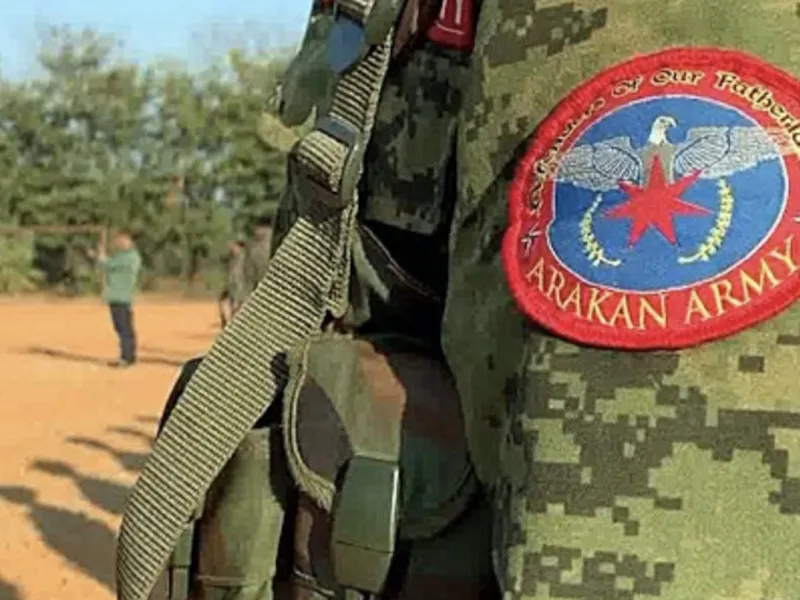
The Arakan Army (AA) has escalated its campaign of persecution against the Rohingya in western Myanmar’s Arakan State, shifting from property confiscation and forced displacement to a systematic assault on the community’s identity and leadership.
Over the past year, the AA has been accused of abducting Rohingya intellectuals, teachers, and community leaders in both Maungdaw and Buthidaung, with victims disappearing without trace. Families say they have received no information about their loved ones, while rights observers warn the arrests are part of a deliberate strategy to weaken the Rohingya’s social fabric.
One such case is that of Ahmad Kamal, a 40-year-old teacher from Maungdaw and a respected scholar from Kyain Chaung Village. After Arabic schools were shut down in 2012, Kamal devoted himself to educating hundreds of Rohingya children in science and Islamic studies. In August 2024, while sheltering as an internally displaced person in Harbi Village under AA control.He was arrested by armed AA members. A year later, his fate remains unknown.

Similar arrests took place in the same period:
U Hla Myint, a Burmese-language teacher from Maungdaw, and
Enam, a teacher from Du Nyaung Pin Gyi Village, both disappeared in late August 2024,Zuhurul Haq, a former aid worker, and his Grade 12 son Rabee’ul Hasan were seized by AA troops on August 24, along with another Rohingya man, Muhtar.
In Buthidaung, the targeting has continued. On April 24, 2025, the AA arrested U Maung Tun, a Burmese-language teacher from Ward No. 5, who had been invited to what he thought was a meeting with the group. He never returned home. Relatives say he was a man of integrity with no history of wrongdoing. He is also the son of another well-known teacher previously detained by the AA and later released.

A Rohingya activist told Arakan News Agency that the AA “speaks kindly to people when they meet them, but abuses the absence of phone and internet connectivity to carry out arrests and other abuses with impunity. They are deliberately targeting intellectuals to weaken the community.”
A senior diplomat monitoring the situation described the arbitrary detention of community leaders as a “serious violation of human rights” that “undermines peace and stability in the region.”

The abuses are not limited to arrests. In July 2025, the AA reportedly detained 25 Rohingya families in Maungdaw and subjected them to forced labor, including garbage collection, sewage cleaning, and street maintenance in Buthidaung.
Since launching its offensive against the Myanmar military in November 2023, the AA has seized control of 14 of Arakan’s 17 towns. While the conflict has displaced thousands of Rakhine civilians, the Rohingya have faced double persecution first from the Myanmar military, which in 2017 drove nearly a million into Bangladesh in what the UN called a genocidal campaign, and now from the AA itself.
During its territorial expansion, the AA has been accused of burning entire Rohingya villages, confiscating land, imposing punitive taxes, resettling Rakhine families into Rohingya homes, and restricting Rohingya movement between villages. Forced labor, discriminatory laws, and violent intimidation have reportedly become systematic.
Human rights advocates warn that the AA’s actions mirror the very abuses it claims to oppose, calling its persecution of the Rohingya a grave hypocrisy and a potential war crime. As one activist put it: “They claim to fight for freedom, but what they practice against the Rohingya is oppression deliberate, targeted, and inhumane.”
BOB Post