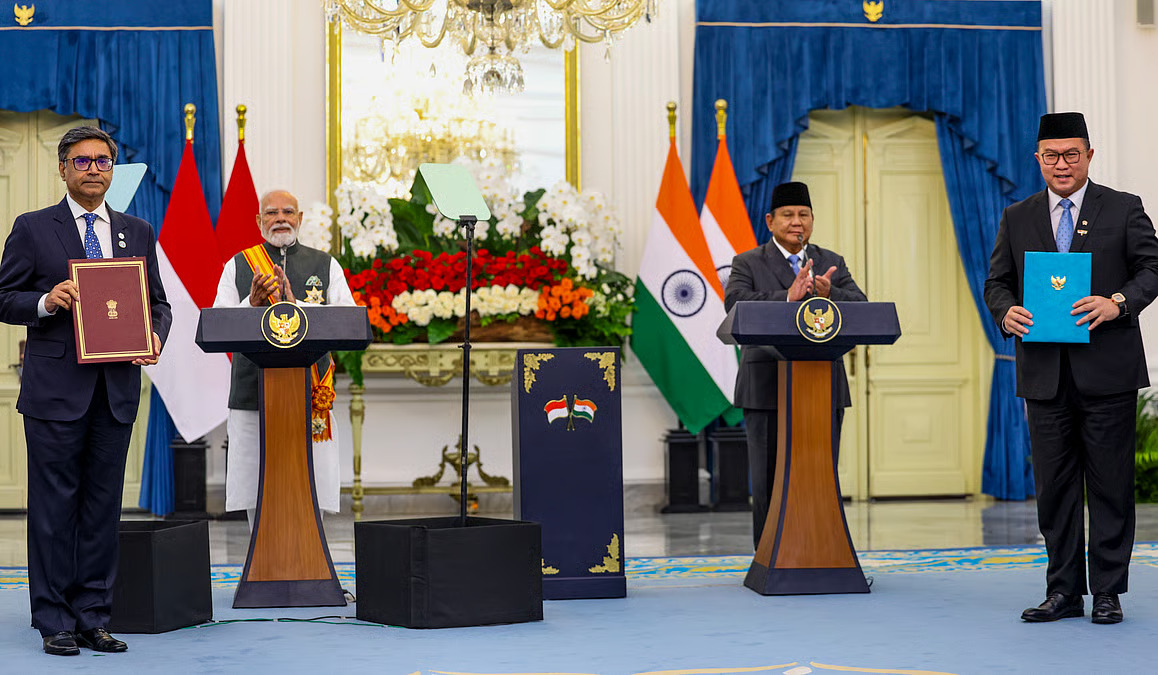
When India and Indonesia announced agreements covering critical minerals, agriculture, steel, and defense- including Jakarta's acquisition of the BrahMos missile system- the official narrative was predictable. New Delhi spoke of a "shared Indo-Pacific future," democratic values, maritime security, and South-South cooperation. Yet beneath the diplomatic language lies a far more strategic reality.
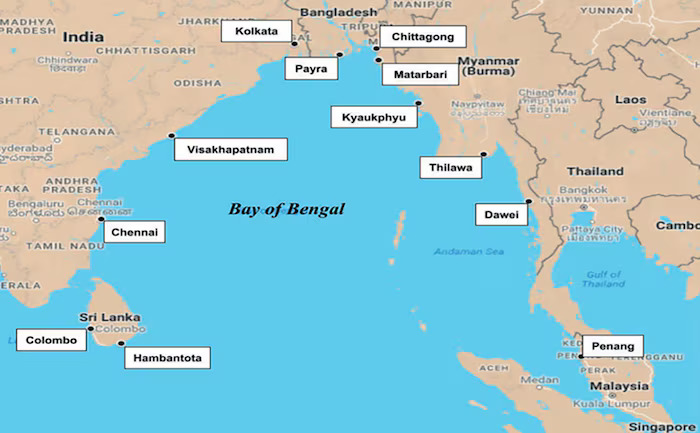
The BrahMos agreement is not merely a commercial defense export. It is another chapter in India's long-term effort to reshape the military balance across the eastern Indian Ocean while expanding its strategic footprint in Bay of Bengal. The timing, the choice of partner, and the nature of the agreements all suggest that New Delhi's primary objective is geopolitical influence- not simply economic cooperation.
India has increasingly adopted what might be called a "security-first diplomacy." The Philippines became the first ASEAN country to purchase the BrahMos system. Vietnam has pursued closer defense cooperation with India. Indonesia now joins the same trajectory.
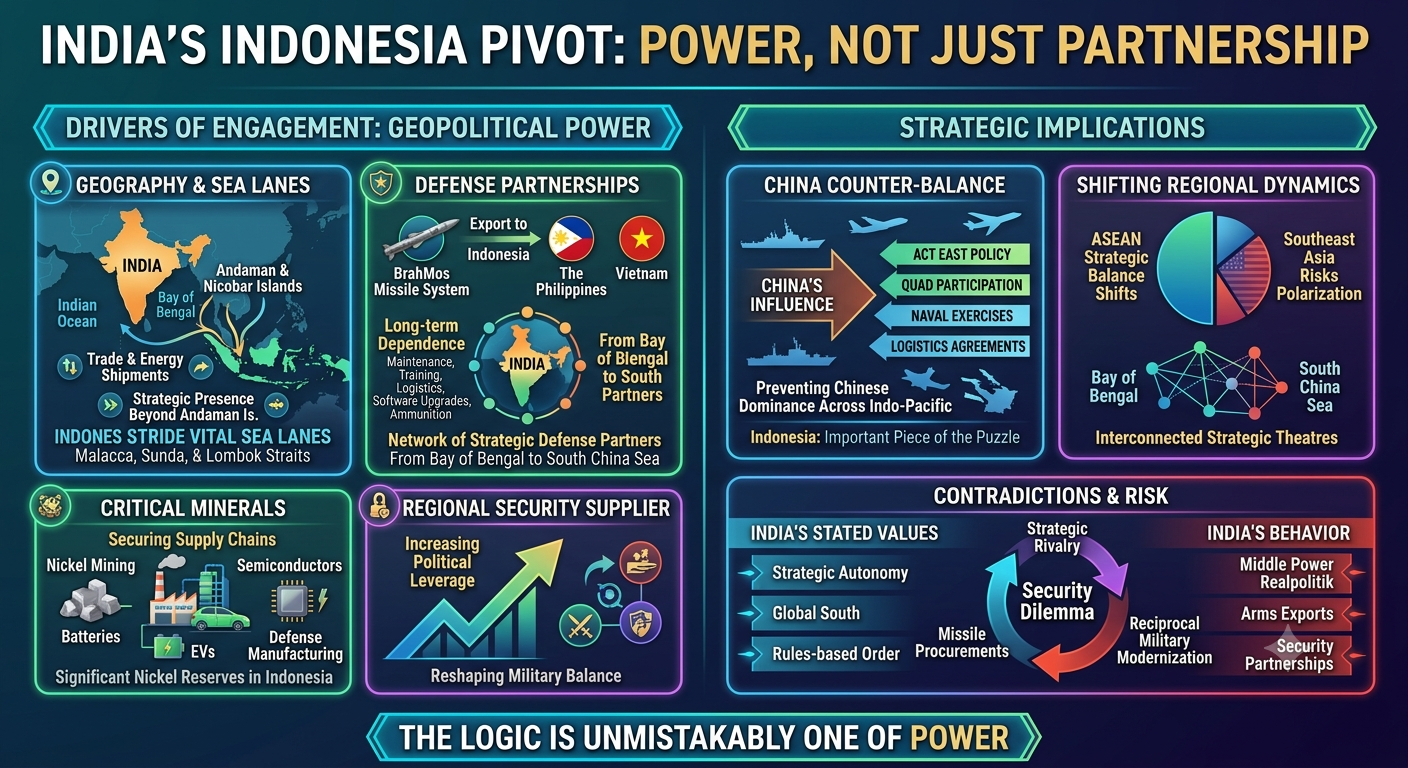
This is not coincidental. Rather than relying solely on traditional diplomacy, India is steadily building a network of strategic defense partners stretching from the Bay of Bengal to the South China Sea. Each new missile agreement strengthens India's position as a regional security supplier while simultaneously increasing its political leverage. Defense exports, in this context, are instruments of foreign policy.
Indonesia is not simply another export destination. It occupies one of the world's most strategic maritime positions. The country sits astride vital sea lanes connecting the Indian Ocean with the Pacific through the Malacca, Sunda, and Lombok Straits. A significant share of global energy shipments and commercial trade passes through these waters.
For India, cultivating Jakarta serves multiple strategic objectives. First, it extends India's strategic presence far beyond the Andaman and Nicobar Islands. Second, it strengthens India's position within ASEAN at a time when competition among major powers is intensifying. Third, Indonesia possesses significant reserves of critical minerals, particularly nickel which are essential for batteries, electric vehicles, semiconductors, and advanced defense manufacturing.
The agreements on critical minerals and steel are therefore no less strategic than the missile deal itself. Control over supply chains increasingly defines geopolitical influence in the twenty-first century.
Neither Narendra Modi nor Prabowo Subianto mentioned China directly. They did not need to. Virtually every major strategic initiative in the Indo-Pacific today is shaped, directly or indirectly, by China's growing influence.
India's "Act East Policy," participation in the QUAD, expanding naval exercises, logistics agreements with regional partners, and growing defense exports all fit into a broader effort to prevent Chinese dominance across the Indo-Pacific.
Indonesia becomes another important piece of that puzzle. The challenge is that strategic balancing often creates strategic polarization. As more regional states become integrated into competing security architectures, Southeast Asia risks becoming less neutral and more divided between rival spheres of influence.
India frequently presents itself as the voice of the Global South- a country committed to strategic autonomy, peaceful coexistence, and a rules-based international order. Yet its foreign policy increasingly resembles the behavior of traditional middle powers seeking influence through arms exports and security partnerships.
There is an inherent contradiction. New Delhi criticizes military blocs when they constrain its own autonomy, but actively builds security partnerships when they expand Indian influence. India argues against external interference in South Asia while simultaneously seeking a larger strategic role across Southeast Asia.
This does not necessarily make India's actions illegitimate. But it does raise questions about consistency. If strategic influence is acceptable for India abroad, should similar behavior by other regional powers be viewed differently?
History suggests that arms diplomacy rarely remains confined to deterrence. Major powers have repeatedly used defense cooperation to expand political influence. The United States relied on military assistance throughout the Cold War to build alliances. The Soviet Union employed similar methods across Asia and Africa. China has increasingly integrated arms exports into its Belt and Road relationships.
India appears to be following a comparable though smaller-scale trajectory. Military technology creates long-term dependence through maintenance contracts, training, logistics, software upgrades, ammunition supply, and future procurement. Defense partnerships often evolve into broader political alignment.
The Indonesia agreements may generate several important consequences. First, ASEAN's internal strategic balance could gradually shift as member states deepen defense cooperation with external powers. Second, China's strategic planners are unlikely to ignore India's expanding defense footprint across maritime Southeast Asia. Third, increased missile deployments may encourage reciprocal military modernization elsewhere in the region. Finally, South Asia and Southeast Asia- which historically evolved as distinct strategic theatres are becoming increasingly interconnected. Events in the Bay of Bengal will increasingly influence developments in the South China Sea, and vice versa.
Supporters will argue that India's rise as a defense supplier contributes to regional stability by providing countries with greater strategic choices. Critics, however, see a different picture. The Indo-Pacific does not necessarily become safer simply because more advanced missiles enter the region. Security dilemmas often emerge precisely when every actor claims to be acting defensively. Each new missile system prompts another procurement. Each new partnership generates another counter-partnership. Each effort to enhance deterrence can unintentionally deepen insecurity.
The agreements signed in Jakarta should therefore not be interpreted merely as trade deals or defense contracts. They represent India's growing ambition to transform itself from a regional power into an influential Indo-Pacific security actor.
Whether this ambition ultimately contributes to stability or accelerates strategic rivalry remains uncertain. What is clear is that India's engagement with Indonesia is driven by far more than friendship. It is driven by geography, maritime competition, critical minerals, strategic supply chains, and the emerging contest for influence across the Indo-Pacific.
The language may be one of partnership. The logic, however, is unmistakably one of power.
Editor, Bay of Bengal Post