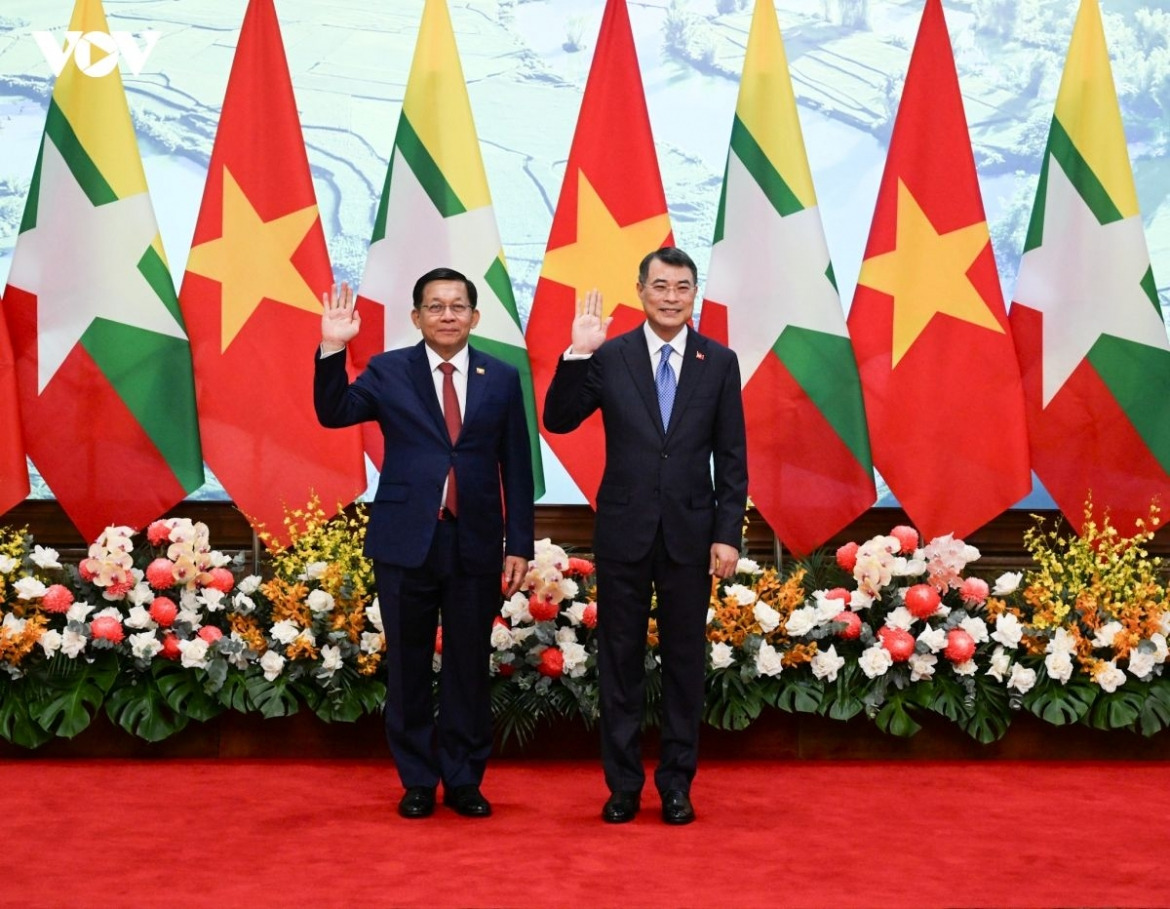
Vietnam and Myanmar have agreed to strengthen defense and security cooperation, marking a significant development in Hanoi’s engagement with Myanmar’s military-backed government.
The agreement comes at a particularly sensitive moment. Myanmar remains engulfed in a nationwide civil war following the military’s 2021 coup, while Min Aung Hlaing’s government continues to face international criticism over the conflict and allegations of widespread human rights violations.
Yet Myanmar’s diplomatic isolation appears to be gradually weakening.
Min Aung Hlaing’s visit to Vietnam is therefore more than a routine bilateral engagement. It reflects two parallel calculations: Myanmar’s effort to rebuild diplomatic space and Vietnam’s decision to pursue strategic engagement rather than isolation.
Defence Cooperation at the Centre
According to Reuters and Anadolu Agency, Vietnam and Myanmar agreed to make defense and security cooperation an important pillar of their bilateral relationship.
The two sides discussed military training, exchanges between young officers, search-and-rescue operations, disaster response, information sharing and cooperation against transnational crime, including trafficking and cybercrime. The countries also agreed that their territories would not be used for activities directed against each other.
The agreement does not amount to a military alliance, and there is no clear evidence from the reported deal that Vietnam has committed to supplying weapons to Myanmar. Nevertheless, the expansion of military-to-military contacts is strategically significant.
For Myanmar, deeper defence cooperation with another ASEAN member provides diplomatic and institutional breathing space. For Vietnam, it creates another channel of influence in a strategically important country located between China, India, Southeast Asia and the Bay of Bengal.
Why Does Min Aung Hlaing Need Vietnam?
The answer lies largely in Myanmar's diplomatic isolation since the 2021 coup. ASEAN has repeatedly struggled to deal with Myanmar's military-backed authorities. The bloc has restricted the junta from high-level political meetings because of its failure to implement the Five-Point Consensus, which called for an end to violence, dialogue among stakeholders and humanitarian assistance.
But the regional environment is changing. Since becoming president in April 2026, Min Aung Hlaing has expanded his international travel, visiting countries including China, India, Russia, Laos, Thailand, Kazakhstan and Belarus. Vietnam is the latest stop in this diplomatic campaign.
The objective appears to be diversification. Myanmar does not want its external relations to depend entirely on China or Russia. By developing ties with India, Thailand and now Vietnam, Naypyidaw is building a broader diplomatic network that makes sustained international isolation increasingly difficult.
The strategy is straightforward: if Myanmar cannot obtain universal diplomatic acceptance, it can at least ensure that enough countries continue to engage with it.
Vietnam's Calculation
It would be misleading to interpret Hanoi's policy simply as support for Myanmar's military leadership. Vietnam's foreign policy is strongly shaped by strategic autonomy, sovereignty, non-interference and balancing major powers. Its relationship with Myanmar is therefore likely driven less by ideology than by practical interests.
Myanmar offers Vietnamese businesses opportunities in telecommunications, technology, agriculture, infrastructure and energy. Security cooperation also gives Hanoi a mechanism to address cross-border crime, trafficking and other regional threats.
The role of Viettel is particularly notable. Myanmar's leader visited Viettel during his Vietnam trip. The Vietnamese telecommunications company is owned by the country's defense ministry and already operates in Myanmar through Mytel. That existing relationship provides an important institutional bridge between the two countries.
It would be premature to conclude that Vietnam is preparing to provide military technology to Myanmar. But the overlap between telecommunications, digital infrastructure, cybersecurity and defense makes the relationship strategically relevant—particularly for a government fighting a technologically evolving civil war.
Vietnam Is Not Alone
The broader pattern is more important than the Vietnam visit itself. Myanmar is increasingly building relationships with multiple powers simultaneously.
China remains one of Naypyidaw's most important economic and strategic partners. Beijing has continued supporting major infrastructure and connectivity projects, including the China-Myanmar Economic Corridor, while maintaining security cooperation.
Russia has emerged as one of Myanmar's most important military and diplomatic partners. Min Aung Hlaing's meetings with Vladimir Putin have focused on defence, energy and strategic cooperation.
India, meanwhile, has maintained engagement with Myanmar despite the political crisis, largely because of security concerns along its northeastern border and its broader strategic competition with China. Thailand has also played an increasingly important role as a neighboring state and regional intermediary.
Vietnam now adds another ASEAN channel. Taken together, these relationships indicate a deliberate strategy of multi-directional diplomacy.
China offers economic and strategic depth. Russia provides military and diplomatic backing. India offers another major regional connection. Thailand provides geographic and ASEAN access. Vietnam adds another institutional security and economic partner within Southeast Asia.
The cumulative effect is to reduce Myanmar's vulnerability to diplomatic isolation.
What Does This Mean for ASEAN?
This development also highlights ASEAN's unresolved dilemma. The bloc's approach to Myanmar has produced limited results. The Five-Point Consensus has not stopped the violence, while the military government has resisted external political pressure.
At the same time, some ASEAN members increasingly appear to favor practical engagement. That creates a difficult choice.
Should ASEAN continue isolating Myanmar's military-backed authorities in the hope of forcing political concessions? Or should it engage Naypyidaw in order to maintain influence, protect regional interests and create channels for humanitarian and political dialogue?
Vietnam's decision appears to lean toward the second approach. If more ASEAN countries adopt the same strategy, Myanmar could gradually move from diplomatic exclusion toward functional regional engagement—even without a genuine political settlement at home. That would represent a major shift.
Does Engagement Mean Legitimization?
There is a legitimate concern that high-level meetings and defense agreements could contribute to the normalization of Myanmar's military-backed government.
But engagement does not necessarily mean endorsement. Vietnam has not publicly declared support for the military's conduct in the civil war, nor does the defense agreement amount to recognition of every aspect of Naypyidaw's political system.
The more accurate description is engagement without political reconciliation. That distinction matters.
For many Southeast Asian governments, refusing to engage Myanmar has not ended the war. Maintaining relations, therefore, is viewed as a way of protecting their own security and economic interests while keeping channels open.
The danger is that pragmatic engagement can gradually produce de facto normalization without resolving the underlying political crisis.
The War Remains the Central Problem
Myanmar's improving external relations should not be confused with an end to its internal conflict. The military continues to fight ethnic armed organizations and resistance forces across multiple parts of the country. The conflict remains deeply fragmented and politically unresolved.
This creates a paradox. The more international relationships the military-backed government develops, the greater its diplomatic and economic room for maneuver.
But without a political settlement, foreign engagement alone cannot bring lasting peace. Min Aung Hlaing may therefore be gaining something short of victory—but highly valuable nonetheless: options.
The ability to travel, sign agreements, attract investment and maintain military relationships means the government is becoming less dependent on any single foreign partner and less vulnerable to isolation.
The Bigger Picture
The Vietnam-Myanmar agreement is ultimately a sign of a broader regional shift. Myanmar's international isolation is becoming increasingly porous. The military-backed government is pursuing a strategy of diplomatic diversification, building simultaneous relationships with China, Russia, India and Southeast Asian states.
Vietnam, meanwhile, is choosing pragmatism. Hanoi appears to be saying that maintaining influence and protecting national interests requires engagement with Myanmar—even while the country's political crisis remains unresolved.
For Min Aung Hlaing, that is valuable. He does not necessarily need every government to endorse his rule. He needs enough governments to keep talking, trading and cooperating with Myanmar that diplomatic isolation becomes impossible to sustain. That may be the real significance of his Vietnam visit.
Vietnam may not be choosing Myanmar's military over democracy. But it is clearly choosing engagement over isolation. And if that approach spreads across Southeast Asia, Myanmar's military-backed government could gradually regain diplomatic normality without first achieving political reconciliation at home.
That would not mean the civil war is over. It would mean something more consequential: the regional environment surrounding Myanmar is beginning to change.
EDITOR , Bay of Bengal Post