India's long-running border dispute between Assam and Nagaland has once again come under sharp political scrutiny, exposing what critics describe as New Delhi's continuing inability to resolve one of the country's oldest internal territorial conflicts.
Assam Pradesh Congress Committee (APCC) president Gaurav Gogoi has accused both the Assam state government and the central government of failing to protect Assam's territorial interests, alleging that encroachments along the Assam-Nagaland border continue despite the dispute remaining before the Supreme Court.
Following a visit to the Mariani sector near the Assam-Nagaland border, Gogoi alleged that residents living in the frontier villages continue to face uncertainty, restrictions on development work and repeated interference from across the border. He questioned whether the BJP-led governments in Dispur and New Delhi had effectively allowed the status quo on the ground to shift before the Supreme Court reaches a final verdict.
According to Gogoi, local residents informed him that infrastructure projects and administrative activities from the Nagaland side have continued in areas claimed by Assam. He further alleged that MGNREGA-related road work undertaken by Assamese villagers was recently obstructed, raising concerns about the state's ability to exercise administrative control over disputed territory.
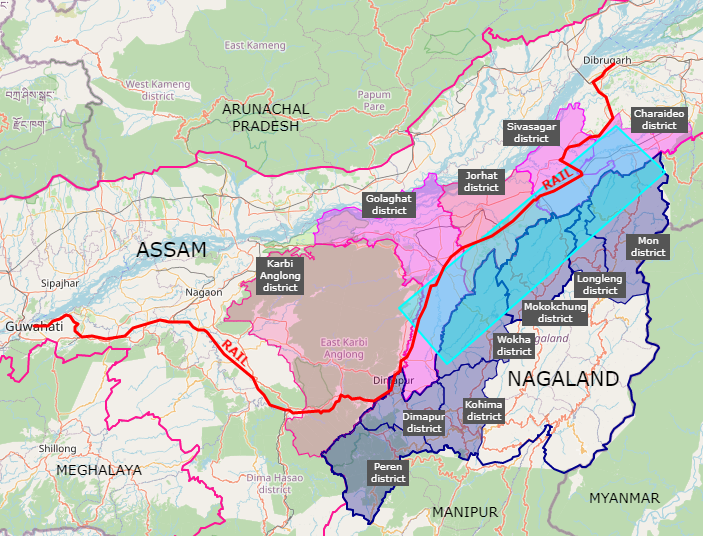
The Assam-Nagaland boundary dispute dates back to 1963, when Nagaland was carved out of Assam. More than six decades later, the issue remains unresolved despite multiple commissions, negotiations and legal proceedings. The matter has been pending before the Supreme Court since 1989, highlighting the complexity of one of India's longest-running interstate territorial disputes.
Official figures previously presented by the Assam government indicate that nearly 59,490 hectares of Assam's land are allegedly under encroachment by Nagaland-claimed to be the largest such territorial dispute involving Assam and any neighboring state.
Political observers say the renewed controversy also raises broader questions about India's federal governance model. While New Delhi has frequently emphasized its ability to maintain territorial integrity and administrative cohesion, the persistence of unresolved interstate border disputes- including those involving Assam, Nagaland, Mizoram, Meghalaya and Arunachal Pradesh- continues to expose structural governance challenges within the Indian Union.
The latest exchange comes at a politically sensitive time, with opposition leaders arguing that the "double-engine government" has failed to deliver lasting solutions despite the BJP being in power at both the state and national levels. Gogoi contended that border communities continue to bear the burden of policy paralysis while legal and political processes remain stalled.
Although New Delhi has repeatedly stated that interstate disputes should be resolved through dialogue and constitutional mechanisms, the continuing tensions along the Assam-Nagaland frontier illustrate how unresolved internal boundaries remain a persistent governance challenge, affecting local security, development and public confidence in state institutions.
BOB Post