India’s long-held ambition of becoming a high-income economy faces a growing demographic challenge as falling fertility and rapid population ageing threaten to erode the country’s once-powerful demographic advantage, according to a recent Moody’s analysis.
For decades, India’s enormous and relatively young population has been regarded as one of the country’s biggest economic strengths. A large working-age population has supported production, consumption and economic growth while strengthening the country’s fiscal position and debt-servicing capacity.
But that advantage is beginning to fade. India’s fertility rate has fallen below the replacement level needed to maintain a stable population, while the proportion of elderly people is set to rise sharply in the coming decades. Moody’s warns that the demographic shift could eventually reduce the size of India’s workforce, weaken domestic demand and place increasing pressure on public spending.
The concern is particularly significant because India risks becoming an ageing society before reaching the level of prosperity achieved by developed economies when they underwent similar demographic transitions.
According to Moody’s projections, India entered the “ageing” stage of its demographic transition around 2024. It is expected to become an “aged” society by 2049 and a “super-aged” society by 2065.
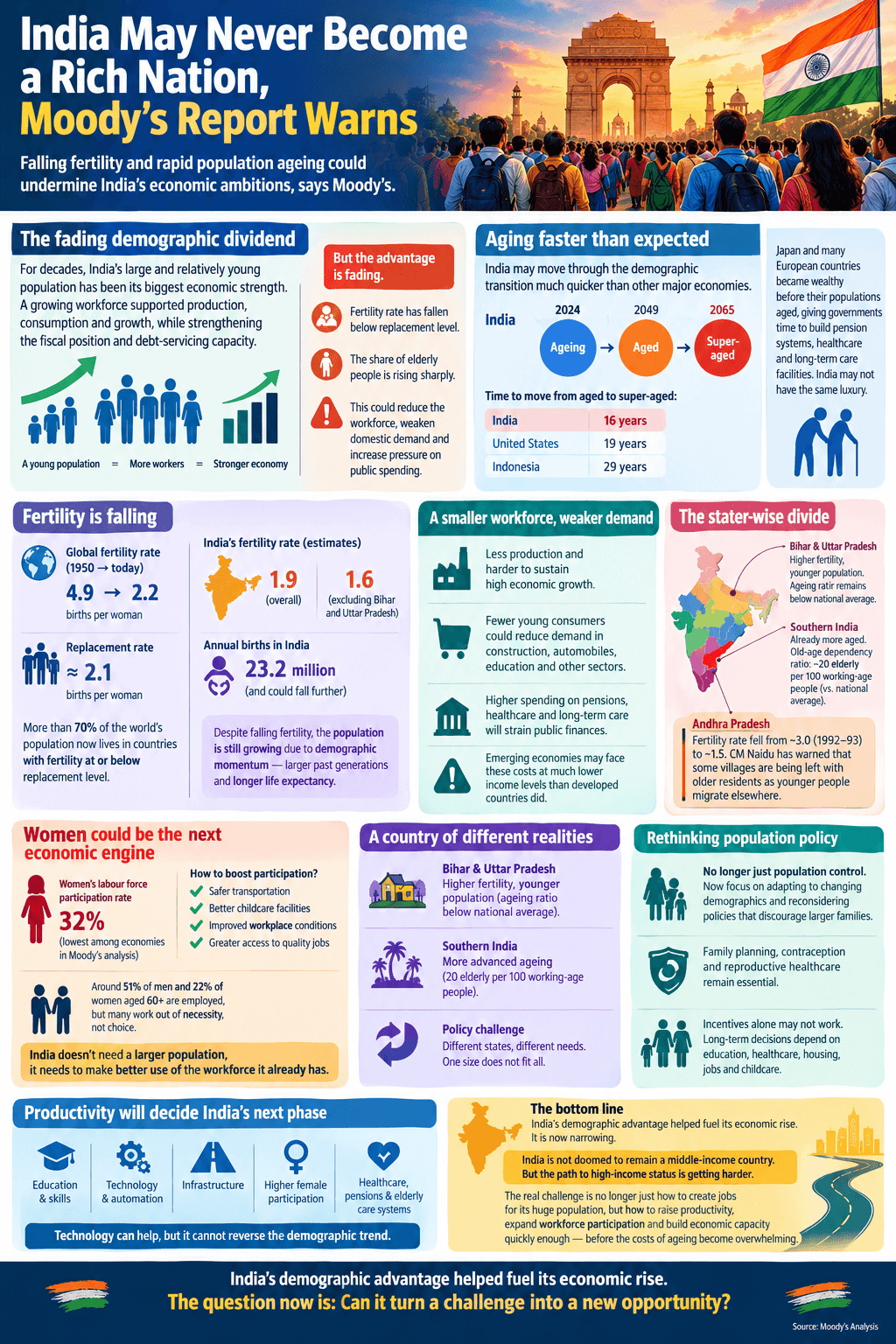
The transition could happen remarkably quickly. India may move from an aged to a super-aged society in just 16 years, compared with about 19 years for the United States and 29 years for Indonesia.
The experience of Japan and several European countries offers an important contrast. Those economies became relatively wealthy before their populations aged rapidly, giving governments and societies several generations to build pension systems, healthcare infrastructure and long-term care facilities. India may not have the same luxury.
The end of India’s demographic dividend?
The central issue is the country’s declining fertility rate. Globally, fertility has fallen from about 4.9 births per woman in 1950 to roughly 2.2 today. The replacement rate is generally considered to be around 2.1 births per woman.
More than 70% of the world’s population now lives in countries where fertility is at or below replacement level. India is among them.
A study prepared under India’s Economic Advisory Council to the Prime Minister, led by economist Sanjeev Sanyal, estimates India’s fertility rate at around 1.9. If Bihar and Uttar Pradesh, two of the country’s higher-fertility states, are excluded, the rate falls to about 1.6.
The study also estimates that the annual number of births in India has declined to around 23.2 million and could continue to fall without policy intervention. Yet India’s overall population is still growing. The apparent contradiction is explained by demographic momentum.
Earlier generations were larger, and people are living longer. As a result, the population can continue to grow even after fertility falls below replacement level. But that momentum will eventually weaken.
As fewer young people enter the population, the proportion of working-age people will begin to decline. That could fundamentally alter the economic conditions that helped India benefit from its demographic dividend.
A smaller workforce, weaker demand
The economic consequences could be significant. A shrinking working-age population could constrain production and make it harder for India to sustain rapid economic growth. At the same time, fewer households and fewer young consumers could reduce demand in sectors such as construction, automobiles and education.
The impact would extend to government finances. As the population ages, spending on pensions, healthcare and long-term care is likely to increase. Moody’s warns that emerging economies may face these costs at considerably lower income levels than developed countries did when they experienced similar demographic changes.
That is the core of India’s demographic dilemma. Japan confronted the financial consequences of an ageing population after becoming a wealthy country. India could face the same challenge while still being a middle-income economy and while millions of people continue to seek higher living standards.
In that sense, India could be forced to deal with the costs of ageing before it has fully captured the benefits of its demographic dividend.
Women could become India’s next economic engine
There is, however, an important source of potential economic resilience: women.
Women’s participation in India’s labour force remains relatively low. The rate is around 32%, according to the comparison cited by Moody’s, making it the lowest among the economies examined in its analysis.
That weakness could also represent one of India’s biggest opportunities. If the number of new workers entering the labour market declines, increasing women’s participation could help compensate for part of the demographic slowdown.
Economists argue that India could make substantial progress through safer transportation, better childcare facilities, improved workplace conditions and greater access to quality employment.
In other words, India does not necessarily need a larger population to expand its workforce in the short term. It needs to make better use of the workforce it already has.
The country already has a sizeable number of older people who continue to work. Around 51% of men and 22% of women aged 60 and above are reportedly employed. But many older Indians continue working out of economic necessity rather than choice, highlighting the limitations of existing retirement and social-security systems.
India is ageing at different speeds
India’s demographic transition is also highly uneven. The country effectively contains several different demographic realities. States such as Bihar and Uttar Pradesh still have relatively high fertility rates and younger populations. Their elderly populations will increase, but their ageing ratios are expected to remain below the national average for some time.
Southern India, by contrast, has already moved much further into demographic ageing. The old-age dependency ratio in southern states is around 20 elderly people for every 100 working-age people, higher than the national average.
Andhra Pradesh provides a particularly striking example. The state’s fertility rate has fallen from around 3.0 in 1992–93 to approximately 1.5. Its government has already moved away from policies that discouraged larger families and has introduced incentives for families having a third or fourth child.
Andhra Pradesh Chief Minister N. Chandrababu Naidu has warned that some villages are increasingly being left with older residents as younger people migrate elsewhere.
The contrast reveals a growing policy contradiction within India: while some states are still dealing with relatively high fertility, others are already concerned about a shortage of young people.
Should India encourage more births?
The demographic shift is forcing India to reconsider its traditional approach to population policy. The Economic Advisory Council has argued that population control should no longer be treated as the primary objective of demographic policy. Instead, policymakers need to respond to the country’s changing demographic structure and reconsider policies that may discourage larger families.
That does not mean abandoning family planning. Access to contraception, reproductive healthcare and the ability to decide freely when and whether to have children remain important objectives. The emerging question is whether governments should actively encourage higher fertility to slow population ageing.
Evidence suggests that simply providing financial incentives may not be enough. Research cited in the debate, including studies published in The Lancet, suggests that cash payments, tax benefits and childcare subsidies have generally had limited success in significantly reversing declining fertility.
Long-term decisions about having children are influenced by broader social and economic conditions, including women’s education, healthcare, housing costs, employment opportunities and access to childcare.
Productivity will determine India’s next phase
For India, the demographic challenge ultimately comes down to productivity. If the workforce grows more slowly, each worker will have to contribute more to economic output for the country to maintain strong growth.
That means investment in education, skills, technology, infrastructure and automation will become increasingly important. India will also need to raise female labor-force participation and develop stronger systems for healthcare, pensions and elderly care.
Technology can help businesses compensate for labor shortages and improve productivity, but it cannot reverse the underlying demographic trend.
The country’s demographic dividend once offered India a historic opportunity: a huge working-age population capable of driving growth and transforming the economy. That window is now narrowing.
India is not inevitably destined to remain a middle-income country. Nor does Moody’s report establish that the country will never become wealthy. But the demographic trends mean that the path to high-income status is becoming more difficult.
The central challenge is therefore no longer simply how India can create enough jobs for its enormous population.
It is whether India can raise productivity, expand workforce participation and build sufficient economic capacity quickly enough to become prosperous before the costs of population ageing become overwhelming.
India’s demographic advantage helped fuel its economic rise. The question now is whether that advantage will disappear before the country becomes rich.
BOB Post