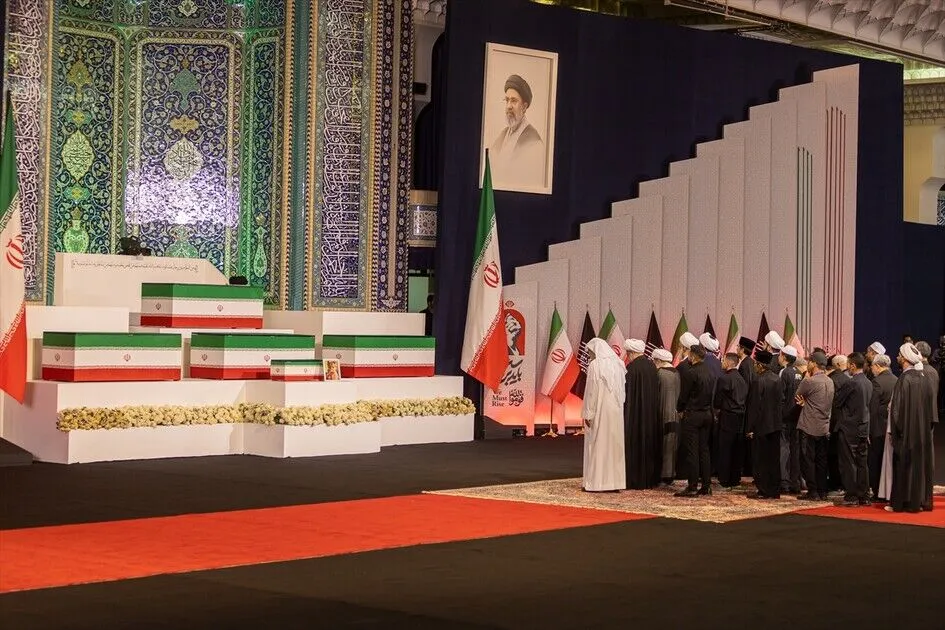
Iran on Saturday morning began six days of public funeral ceremonies for late Supreme Leader Ayatollah Ali Khamenei, drawing thousands of mourners and senior foreign officials to Tehran months after he was killed in a joint United States-Israeli air strike.
State television showed large crowds gathering at Tehran's Grand Mosalla prayer complex, where Khamenei's coffin was placed for public viewing. Many mourners carried red banners, a symbol of vengeance in Shiite tradition, as they paid their final respects.
Khamenei, who led Iran from 1989 until his death at the age of 86, was killed on February 28 when U.S. and Israeli forces struck his official residence in Tehran on the opening day of the war between Iran and the U.S.-Israel coalition.
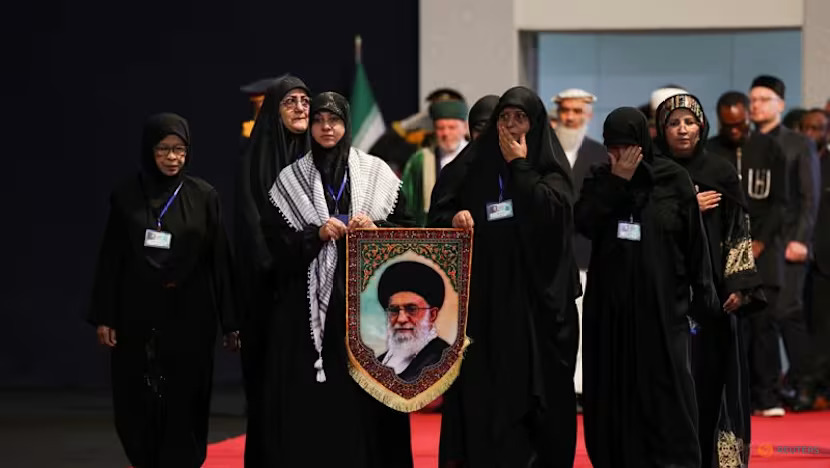
According to Deutsche Welle (DW), Khamenei's coffin will remain in Tehran until Monday before being taken to the holy city of Qom, followed by neighboring Iraq, and finally to his hometown of Mashhad, where he is scheduled to be buried on Thursday. Iranian authorities have imposed extensive security measures, including temporary airspace closures and traffic restrictions in cities hosting the funeral procession.
The funeral has attracted a number of high-profile international figures. Pakistani Prime Minister Shehbaz Sharif and Army Chief Field Marshal Asim Munir attended the ceremony, while former Russian President Dmitry Medvedev represented President Vladimir Putin. China sent He Wei, vice chairman of the National People's Congress Standing Committee, and Afghanistan was represented by Foreign Minister Amir Khan Muttaqi of the Taliban administration.
An Indian delegation also traveled to Tehran to pay tribute, while family members of the late Hezbollah leader Hassan Nasrallah, who was killed in an earlier Israeli strike, were present during the ceremonies.
Iranian authorities have not confirmed whether Mojtaba Khamenei, who succeeded his father as the country's supreme leader, will make a public appearance during the mourning period. He has remained out of public view for several months.
Meanwhile, General Ahmad Vahidi, a senior figure in Iran's Revolutionary Guards and a key advocate of Tehran's hardline position in negotiations with Washington, was seen publicly for the first time since early February. His appearance comes as diplomatic efforts to end the conflict continue despite months of hostilities.
The funeral ceremonies are expected to continue through next week, with Iranian authorities maintaining heightened security as the country bids farewell to one of the most influential figures in the history of the Islamic Republic.
BOB Post