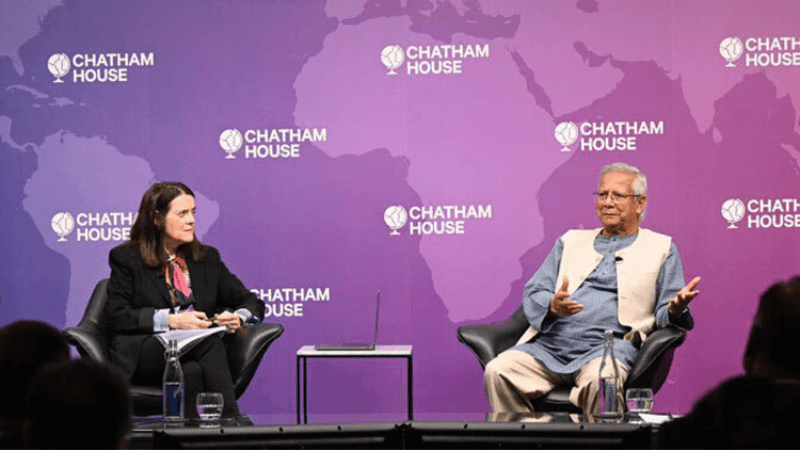
Professor Muhammad Yunus, the Nobel laureate now leading Bangladesh’s interim government following the 2024 ousting of Sheikh Hasina, laid out his vision for democratic transition and social reform during a candid discussion at Chatham House in London.
Speaking with Chatham House Director Bronwen Maddox, Yunus addressed a wide range of pressing issues facing his administration, including systemic corruption, youth unemployment, foreign policy, and the looming humanitarian crisis in the country’s south — where over a million Rohingya refugees remain stranded in what has become the world’s largest refugee camp.

In stark terms, Yunus warned that the sharp decline in international aid for Rohingya refugees risks triggering unrest. “What used to be $12 a month per person for food, suddenly that $12 disappeared,” Yunus said, referring to the abrupt withdrawal of USAID funds. “It went down to $6 and then $3. What do you do with $3 a month for food for a person?”
The professor turned politician stressed the emotional and political consequences of prolonged statelessness. “We have a whole new young generation coming up, and they have no hope,” he said. “These will be very angry young people growing up... it will be a big explosion, I can assure you right now.”
Yunus reaffirmed that the only sustainable solution to the Rohingya crisis is repatriation to Myanmar, not integration into Bangladesh. However, he called on the international community to urgently restore humanitarian assistance to avoid further deterioration.
The interim leader also announced that national elections will be held in April 2026, with the goal of restoring democratic governance. He emphasized that he will not participate in any future elected government. “No way,” he said firmly, asserting that his role is limited to enabling a clean transition.
Yunus said his administration is undertaking deep institutional reforms and pursuing legal action against figures linked to political violence, enforced disappearances, and corruption under the previous regime. “We are trying to create a new Bangladesh,” he said, “one where justice and accountability are not negotiable.”
As Yunus pushes forward with reforms and navigates a fragile humanitarian situation, his remarks highlighted the delicate balancing act Bangladesh now faces — one that will test both domestic resilience and international support.
BOB Post