After years of diplomatic isolation, Myanmar’s military rulers appear to be knocking on Washington’s door again.
The signals are subtle but difficult to miss. An American businessman detained in Myanmar has been released. President Min Aung Hlaing has opened his doors to a major US media outlet. And behind the scenes, Naypyidaw has been investing in lobbying efforts aimed at rebuilding connections in Washington.
Together, the developments suggest that Myanmar’s military government is testing whether a new channel with the United States can be opened, even as Washington’s sanctions remain firmly in place.
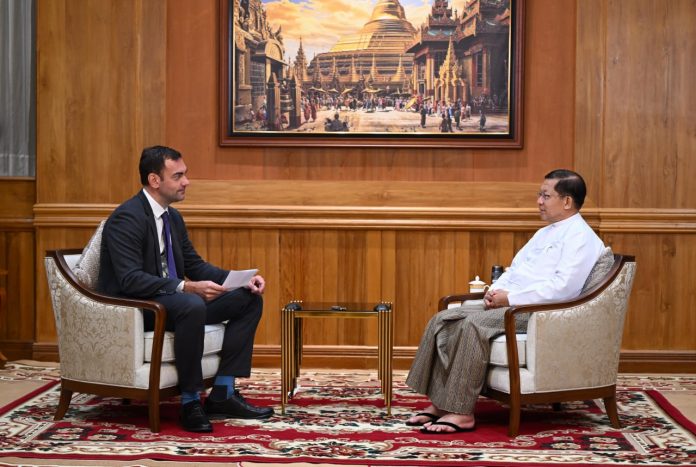
Adam Castillo, a former president of the American Chamber of Commerce in Myanmar, was released after spending more than three months in detention. Around the same time, TIME journalist Charlie Campbell travelled to Naypyidaw and interviewed Min Aung Hlaing , the first known interview the junta chief has given to a major Western media outlet since the 2021 military coup.
In the interview, Min Aung Hlaing portrayed his treatment of ousted civilian leader Aung San Suu Kyi as lenient and called on the United States and other Western countries to reconsider their sanctions on Myanmar.
According to Asia Times, the developments reflect the junta’s growing efforts to rebuild contacts with Washington at a time when Myanmar’s strategic importance is being reshaped by the wider rivalry between the United States and China.
The outreach is not entirely new.
Since July 2025, Myanmar’s military authorities have reportedly hired Washington-based lobbying firm DCI Group under a multimillion-dollar annual contract to promote their interests in the United States. The effort indicates that Naypyidaw is looking beyond traditional diplomatic channels and trying to cultivate political access in Washington.
The calculation is largely geographical.
Myanmar sits at a strategic crossroads between China, India and Southeast Asia, with direct access to the Bay of Bengal and the wider Indian Ocean. Its territory also offers routes linking China’s southwest with the Indian Ocean.
That geography has made Myanmar difficult for Washington to ignore, even during periods of deep political hostility.
During the Cold War, the United States backed anti-communist forces operating in Myanmar. Relations later went through several cycles of cooperation and confrontation. Following the brutal suppression of the 1988 pro-democracy uprising, Washington imposed increasing pressure on the military government. But intelligence and security contacts did not disappear entirely.
Relations improved again after Myanmar began political reforms in the early 2010s, when the Barack Obama administration sought greater engagement with the country.
The situation changed dramatically after the February 2021 coup. Washington imposed sanctions on the military leadership and entities linked to the junta while backing democratic forces and pressing for an end to military rule.
Yet four years later, the strategic landscape has become more complicated.
Myanmar’s rare-earth resources, trade routes, energy sector and role in regional connectivity have acquired greater importance as Washington and Beijing compete for influence across Asia. The junta has also sought to present issues such as cybercrime, trade and access to natural resources as possible areas of cooperation with the United States.
For Naypyidaw, the objective is clear: reduce international isolation and create room for economic and diplomatic manoeuvre.
But Washington has not abandoned its pressure campaign. US sanctions against Myanmar’s military and state-linked entities remain in force, while more than $1 billion linked to Myanmar remains frozen at the Federal Reserve and outside the junta’s control.
So, is America returning to Myanmar?
Perhaps the more accurate question is whether Washington is preparing to look at Myanmar through a different lens.
For the junta, the door to the United States may represent a route out of isolation. For Washington, Myanmar remains a difficult balance between democratic principles, human rights concerns and the strategic reality of China’s growing influence.
The door may be opening slightly. But whether anyone is ready to walk through it remains the bigger question.
BOB Post