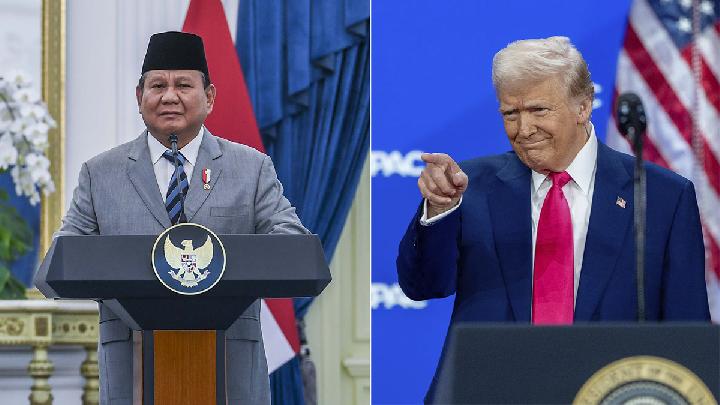
U.S. President Donald Trump’s decision to impose an additional 10 percent import tariff on goods from eight European countries starting February 1, 2026, is expected to add fresh strain to global trade, but economists believe Indonesia will see little direct benefit from the move.
The tariff, announced by Trump via his Truth Social account, targets imports from Denmark, Norway, Sweden, France, Germany, the Netherlands, Finland, and the United Kingdom. Trump linked the measure to what he described as Europe’s resistance to U.S. efforts to take control of Greenland. He warned the tariff could be raised to 25 percent from June 1 unless Washington reaches an agreement to “purchase” the strategically located autonomous Danish territory.
Economist Muhammad Faisal of the Center of Reform on Economics (CORE) Indonesia said that while higher tariffs could theoretically weaken European competitiveness in the U.S. market, Indonesia is unlikely to capture significant replacement demand. “In theory, a 10 percent tariff reduces the appeal of European products in the U.S. and opens space for other exporters,” Faisal said. “But Indonesia’s export structure is very different from Europe’s.”
Indonesia’s main exports to the United States consist of garments, textiles, footwear, fisheries products, and palm oil, while European countries largely ship high-value-added goods such as machinery, electronics, and automotive products. “The overlap is minimal, so Indonesia’s chances of substituting Europe’s market share are small,” Faisal explained.
According to Indonesia Business Post, Faisal also cautioned that the broader risk lies not in trade diversion but in heightened uncertainty surrounding U.S. policy under Trump. “Everything depends on Trump’s policy mood. If Indonesia takes steps Washington dislikes, the risks could rise quickly,” he warned, urging policymakers to remain prudent amid an increasingly volatile global environment.

A similar assessment was offered by Wijayanto Samirin, an economist at Paramadina University. He said Trump’s tariff threats against Europe would likely have only a limited direct effect on Indonesia’s trade with both the U.S. and the European Union. However, the indirect consequences could be more significant. “Global trade pressure will persist, and that will inevitably affect Indonesia’s export–import performance,” Wijayanto said.
He added that financial markets could feel the strongest impact, with increased volatility and downward pressure on the rupiah as investors seek safer assets in stronger currencies. Reduced portfolio inflows and foreign direct investment could follow, outweighing any modest gains from trade diversion. “Indonesian products are not direct substitutes for European or U.S. goods, so opportunities to fill gaps remain limited,” he said.
Wijayanto emphasized the need for Indonesia to strengthen export diversification and competitiveness, improve the domestic business climate, and accelerate negotiations on the Indonesia–European Union Comprehensive Economic Partnership Agreement (EU-CEPA). “As Europe looks for more reliable trade partners, Indonesia should position itself strategically,” he said, while cautioning against overreacting to Trump’s statements. “Many of his ideas ultimately do not materialize.”
Trump has repeatedly insisted on acquiring Greenland, arguing that the island is critical to U.S. national security because of its strategic location and mineral resources. Denmark and the Greenlandic government have firmly rejected the idea, stating that Greenland is not for sale. Reports suggest several European countries have deployed military personnel to Greenland at Denmark’s request, while European leaders have warned that any U.S. attempt to seize territory within NATO could severely undermine the alliance.
BOB Post