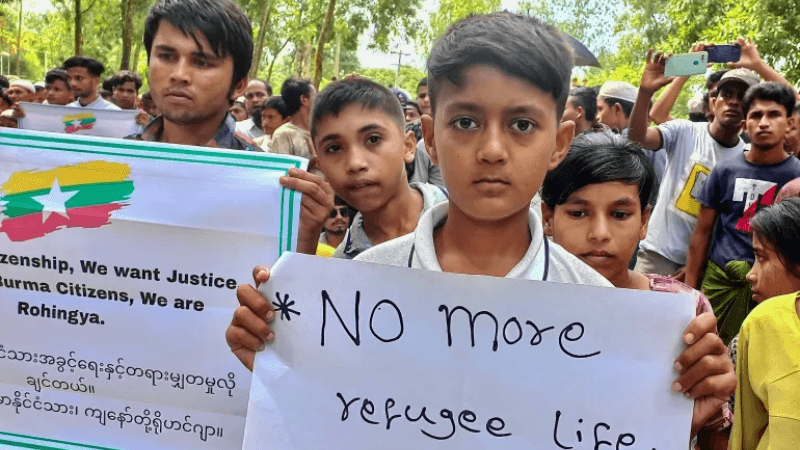
Nearly eight years after the mass exodus of Rohingya refugees into Bangladesh, the long-promised dream of returning to their homeland in Myanmar is becoming a mirage. While the United Nations has quietly facilitated third-country resettlement for a small group—around 5,000 to 11 countries—this alternative pathway is now drawing criticism from within the camps themselves.
Despite a decade of diplomatic gestures, repatriation efforts have repeatedly stumbled. Many Rohingya now believe they are caught in a geopolitical stalemate, victims of a policy void where trust has eroded and time is their worst enemy.
"We came to save our lives, not to lose our identity,” says Arfaz Kamal, a Rohingya youth at the Lumbashia camp in Ukhiya. Like thousands around him, Kamal dismisses third-country resettlement as a distraction from their fundamental right: returning home to Rakhine with dignity, citizenship, and safety. "Why should I go to London or America? My country is Myanmar."

Statistics paint a stark picture. Over 1.3 million Rohingya now reside in the overcrowded camps of Ukhiya and Teknaf. Among them, over 52% are children. Every year, an additional 30,000 Rohingya babies are born stateless—trapped in limbo, with no clear path to a future.
The Government of Bangladesh, along with the Refugee Relief and Repatriation Commission (RRRC), warns that third-country resettlement is undermining repatriation efforts. "Educated leaders are being resettled, leaving behind a vacuum in camp leadership,” said RRRC Commissioner Md. Mizanur Rahman. "This growing brain drain is eroding the collective will for repatriation."
Even local officials echo this alarm. Helal Uddin, a local representative, points out that while only 5,000 Rohingya were resettled abroad over eight years, 250,000 children were born in that same period. "Repatriation is the only sustainable solution—not resettlement, not indefinite encampment.”

Inside the camps, despair is palpable. Rohingya women and men express fears that international actors are shifting focus away from repatriation, turning temporary exile into permanent displacement.
“We have left our parents’ graves in Rakhine,” says Mohammad Idris, his voice cracking. “How can we find peace in a foreign land when our roots are still in Myanmar?”
The contrast is jarring: While Myanmar's military junta recently expressed willingness to take back 180,000 Rohingya, an estimated 118,000 more crossed into Bangladesh again in 2024–25 due to fresh violence in Rakhine—further complicating an already unmanageable crisis.
Critics argue that the current trajectory serves no one—not the host communities, not the displaced, and certainly not the values of justice and international law. As repatriation stalls and resettlement accelerates selectively, many now fear that the original cause of their flight—the right to belong—has been quietly sidelined.
“Third-country resettlement is not liberation; it’s a second wave of exile,” says Rohingya youth Riaz. “We want citizenship, not charity.”
The message from the camps is loud and clear: They want to go home. But the world must decide whether it will continue to offer promises without plans—or finally act to restore the Rohingyas' right to return.
BOB Post