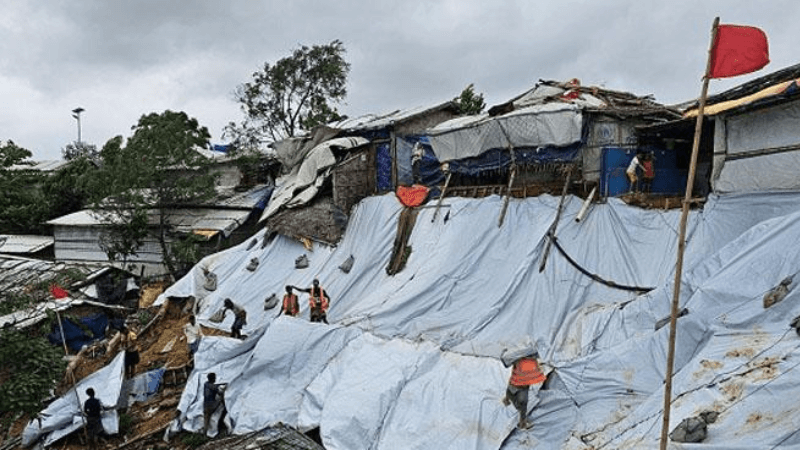
Relentless monsoon rains over the past two days have battered Bangladesh’s southeastern coast, leaving a trail of destruction in the already vulnerable Rohingya refugee camps of Cox’s Bazar. According to the UNHCR, over 1,400 shelters were damaged, 53 landslides occurred across 33 camps, and one refugee tragically lost their life when a wall collapsed. At least 11 others sustained injuries from lightning strikes.
The disaster has once again exposed the precarious conditions in which more than 1.3 million Rohingya refugees live—most of whom fled mass atrocities in Myanmar’s Rakhine State in 2017. As heavy rain lashed the camps, the refugees—already living in fragile bamboo-and-tarpaulin shelters on steep, unstable slopes—faced yet another round of hardship in what has become a grim cycle of vulnerability and displacement.

“Steep slopes, floods, and makeshift shelters make a dangerous mix in such a densely populated place,” said Juliet Murekeyisoni, interim UNHCR Representative in Bangladesh. “Strong winds risk further weakening shelters, and the margin for error is incredibly small.”
The arrival of thousands of newly displaced Rohingya fleeing renewed violence in Myanmar’s Rakhine State has further strained the already overcrowded camps. As families jostle for space and safety, humanitarian responders face another serious challenge: a dire lack of funding.
The 2025 Joint Response Plan, which aims to support both Rohingya refugees and host communities, sought $934.5 million in international assistance. Yet only 20% of the target—less than $190 million—has been received. This critical shortfall has left humanitarian agencies unable to complete key disaster preparedness measures ahead of the monsoon season.

“Preparing for these disasters is not just essential – it is lifesaving,” said Gwyn Lewis, UN Resident Coordinator in Bangladesh. “Without adequate funding, we are forced to make impossible choices, and the price is paid by those who can least afford it.”
Ordinarily, monsoon preparations begin by early May—fortifying shelters, clearing drainage systems, and relocating families from high-risk zones. This year, due to limited resources, most of those steps could not be fully implemented.
While the situation in Cox’s Bazar is no stranger to international attention, the fatigue of a prolonged crisis and shifting global priorities have contributed to waning donor engagement. But for the Rohingya refugees facing the immediate danger of landslides, flooding, and disease, the urgency has never been greater.
As the monsoon season intensifies, the humanitarian community continues to call on the international community to step up support—not just to respond to emergencies, but to invest in durable solutions for one of the world’s most protracted refugee crises.
BOB Post