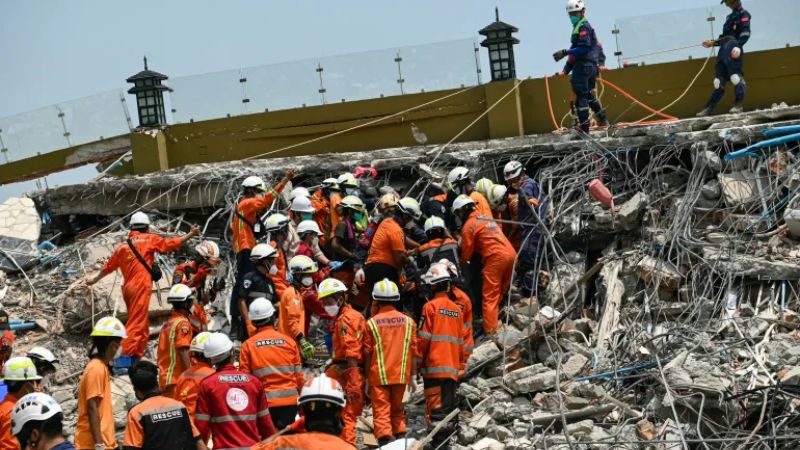
Myanmar’s military government has announced a unilateral, temporary ceasefire to facilitate rescue and relief operations following last week’s devastating earthquake, which has claimed more than 3,000 lives.
State broadcaster MRTV reported that the ceasefire, effective from Wednesday until April 22, aims to ease humanitarian efforts in the wake of the 7.7-magnitude quake. The military’s move follows similar temporary truces declared by armed resistance groups opposing the junta. However, the military warned that if these groups use the pause to launch attacks or regroup, it will take "necessary" measures.
Rising Death Toll and Widespread Destruction
MRTV confirmed late Wednesday that 3,003 people had died in Myanmar, with more than 4,500 others injured. In neighboring Thailand, the death toll has reached 22, with hundreds of buildings damaged and 72 people still missing.
Amid the ongoing crisis, rescue teams managed to pull three survivors from the rubble—two from a collapsed hotel in Myanmar’s capital, Naypyidaw, and another from a guesthouse in a separate city—five days after the disaster. However, most efforts now are focused on recovering bodies rather than finding more survivors.
Tensions Amid Relief Efforts
Delivering aid remains a major challenge, particularly in conflict-ridden areas. On Tuesday, Myanmar’s military fired warning shots at a Chinese Red Cross convoy traveling through a contested zone, alleging it had not informed authorities of its route. China’s Foreign Ministry later confirmed that its rescue team and supplies were safe, with spokesperson Guo Jiakun urging all parties in Myanmar to prioritize relief efforts and keep aid routes open.
Military government spokesperson Zaw Min Tun defended the security forces' actions, stating that the convoy, which included local vehicles, failed to stop as instructed.
International Calls for Unhindered Humanitarian Access
The United Nations estimates that more than 28 million people across six regions have been affected by the earthquake and has allocated $12 million in emergency funding for food, shelter, water, sanitation, and mental health support.
Human rights organizations have raised concerns about Myanmar’s ability to manage the crisis. Human Rights Watch urged the junta to allow unrestricted access for humanitarian aid and called on international donors to bypass the military government in distributing relief.
“Myanmar’s junta cannot be trusted to respond to a disaster of this scale,” said Bryony Lau, deputy Asia director at Human Rights Watch. “Concerned governments and international agencies need to press the junta to allow full and immediate access to survivors, wherever they are.”
The hardest-hit areas, including Myanmar’s Sagaing region—largely controlled by armed resistance groups—remain among the most difficult for aid agencies to reach, exacerbating the humanitarian crisis.
BOB Post