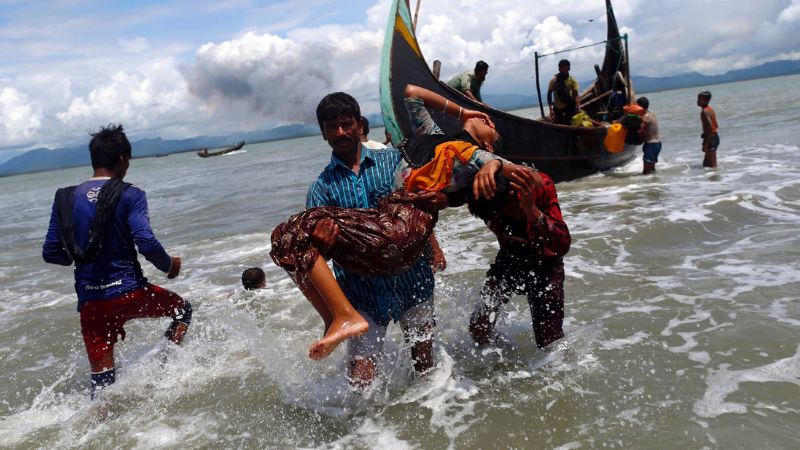
Fear and uncertainty loom large over the Rohingya refugee camps in India after reports surfaced that Indian authorities allegedly forced at least 40 Rohingya refugees off a naval vessel into the sea near Myanmar.
Mohammed Alam, 43, a refugee at the Nuh camp in Haryana, was seen packing his belongings in plastic bags amid fears that his family may be next. “We are terrified. They took them with life jackets and made them swim to Myanmar. What if they do that to us too?” he said.
The incident, allegedly occurring on May 8, has drawn international condemnation, including from Amnesty International, which called it “a grave violation of international law.” The refugees were reportedly blindfolded, flown to the Andaman and Nicobar Islands, then placed on a naval ship, before being forced to swim to Myanmar’s shores.
Families claim the deported refugees held valid identity cards issued by the United Nations High Commissioner for Refugees (UNHCR).
The Indian government has not confirmed nor denied the reports. During a hearing in the Supreme Court on May 16, the government failed to present a prosecutor, and the court found “no conclusive evidence” of wrongdoing.
Rohingya refugees like Mohammed Arib, who has lived in Jammu since 2011, say they now live in fear despite holding UNHCR documentation. “We are grateful India gave us refuge, but the current government has made us feel hated,” Arib said.
In Assam, over 100 Rohingyas were recently moved from a detention center to areas near the Bangladesh border, raising deportation fears.
India, which is not a signatory to the 1951 UN Refugee Convention, is still obligated under international customary law to uphold the principle of non-refoulement, which forbids returning refugees to places where they face threats to life or freedom.
Human rights organisations have pointed to a broader anti-Muslim and anti-refugee sentiment since the rise of the Bharatiya Janata Party (BJP) government in 2014. The Citizenship Amendment Act (CAA) of 2019, which excludes Muslims from its provisions, has further worsened the situation for the Rohingyas.
Many of the refugees, some living in India for over a decade on Long-Term Visas (LTVs), remain in legal limbo without protections or rights, and are subject to Indian laws without enjoying any of the benefits accorded to citizens.
With their futures uncertain and basic rights denied, Rohingyas in India remain trapped in a cycle of statelessness, fear, and survival, caught between persecution in their homeland and hostility in exile.
BOB Post